You missed it. A car horn, a notification, someone saying your name—and your brain ignored them all. Yet a moment later, a single quiet sound snaps you to full alert. Same ears, same world. So why does your attention “wake up” for some signals and sleep through others?
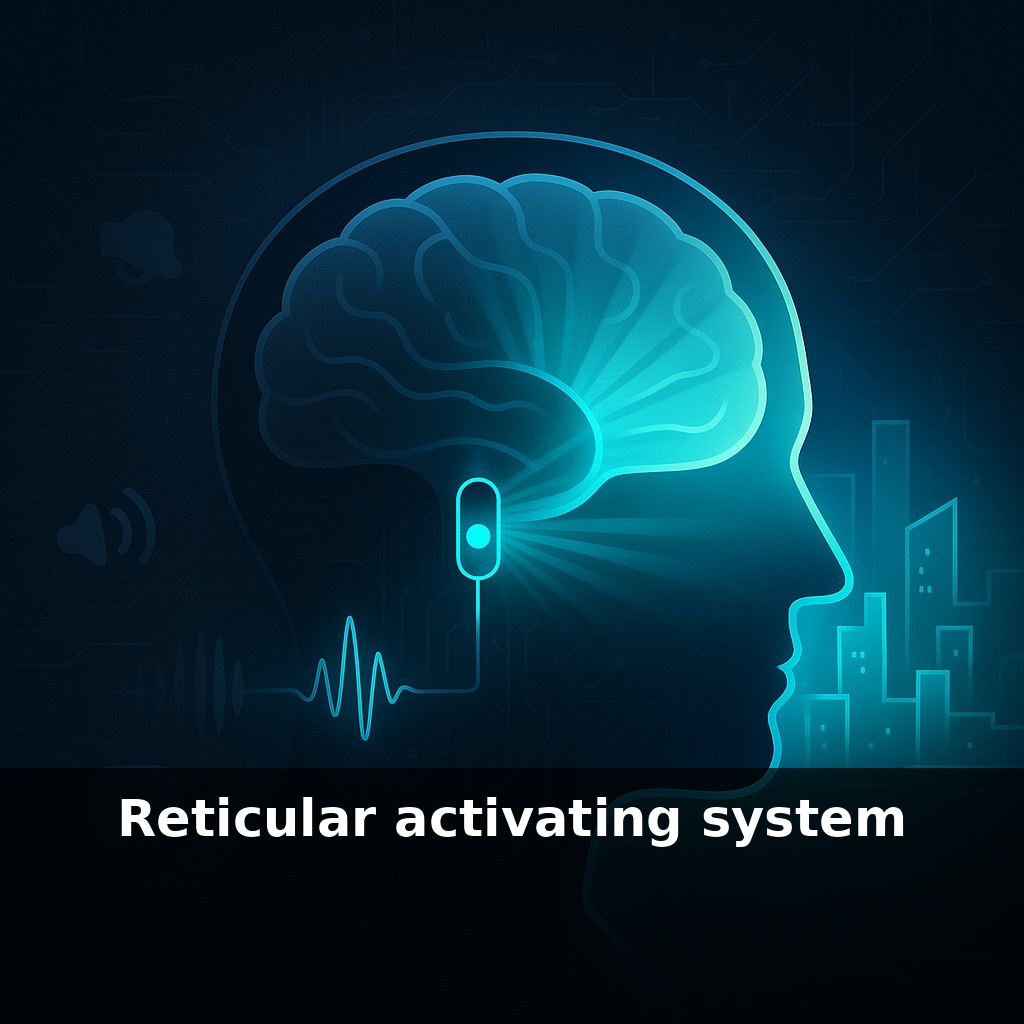
Buried deep in your brainstem is a strip of tissue barely the length of a small paperclip that quietly decides whether your world feels sharp and vivid—or dull and far away. This is the reticular activating system, the circuitry that helps determine whether a late‑night text jolts you awake or fades into the background hum of the night. It doesn’t generate thoughts or store memories; instead, it sets the *conditions* under which thinking and memory can actually happen. When it ramps up its activity, your cortex shifts into a high‑energy, desynchronized rhythm; when it eases off, your internal lights dim. Modern tools like EEG and even simple pupil tracking let researchers watch this shift in real time, revealing that moment‑to‑moment changes in your capacity to focus are tightly linked to the ebb and flow of this tiny but powerful system.
In daily life, you feel the RAS most clearly when it misfires: that foggy morning when coffee does nothing, or the late‑night second wind that arrives exactly when you meant to sleep. Those swings aren’t random; they track shifts in neuromodulators like norepinephrine and acetylcholine, released by tiny clusters of cells in the brainstem that broadcast to vast stretches of cortex. Crucially, these broadcasts are rhythmic and context‑sensitive, adjusting how “noisy” or “quiet” your brain’s background becomes, and biasing you toward scanning for threats, pursuing goals, or drifting inward.
Zoom in on that paperclip‑sized strip of tissue and you don’t see a tidy “on/off” switch; you see overlapping circuits negotiating *how* awake you should be, *what* deserves priority, and *how long* you should keep caring. One part of this network biases you toward scanning widely, another toward locking onto a single stream, and yet another toward shutting things down so repair and consolidation can happen.
A key player here is the locus coeruleus, whose brief bursts of activity can flip you from passive to poised in a couple hundred milliseconds. Those transients aren’t random: they line up with moments when something in the environment turns out to be more important or surprising than expected. Too few bursts, and the world feels flat; too many, and everything feels urgent at once. This is why over‑activation can leave you jumpy and distractible rather than sharply focused.
Other nodes in the network tune *how stable* your state is. Cholinergic inputs from the brainstem and basal forebrain help maintain a sustained “task mode,” so you can hold a goal in mind despite interruptions. When that tone sags, you’re more vulnerable to drift, mind‑wandering, or drowsy micro‑lapses that you only notice after you’ve scrolled three pages with no memory of what you saw.
Crucially, this system doesn’t work in isolation. Prefrontal regions send signals back down, effectively requesting a particular mode: broad monitoring when you’re exploring options, tight focus when you’ve committed. The RAS then adjusts background gain so that some cortical circuits become easier to ignite and others quieter. Over time, repeated demands—deep work every morning, doomscrolling every night—train predictable patterns of responsiveness. The network learns what *you* treat as important.
This is where technology slips in. Every alert, feed refresh, and autoplay sequence competes to trigger brief surges in this system, nudging you toward a high‑volatility state optimized for reacting, not reflecting. The same circuitry that once helped you survive rustling in the bushes now helps apps pull your gaze back, again and again, by capitalizing on surprise, intermittency, and novelty.
On a quiet train ride, scrolling through your phone, a sudden headline spike in your feed can feel like a cymbal crash in an otherwise soft piece of music. That jolt isn’t just “psychological”; it reflects a shift in how your brain is amplifying or muting incoming signals. Apps lean into this by spacing out rewards—likes, unexpected messages, “someone mentioned you”—so that your internal gain knobs keep getting tapped rather than settling into a steady groove.
Developers experiment with timing the tiniest frictions: how long a loading spinner appears, when a notification badge shows, how often a “new for you” section updates. Each tweak changes how likely it is that your state flips from relaxed monitoring to “I should check that now.” In usability tests, companies quietly track not just clicks, but micro‑pauses and rapid app‑switching, treating those as readouts of how unstable your focus has become. Over many sessions, your brain starts to predict that certain icons or sounds are worth orienting to *instantly*, even before you’ve consciously decided why.
Those same circuits your apps keep poking may soon be tools you deliberately train. Labs are testing breath‑paced light patterns, adaptive soundscapes, even VR scenes that shift based on your pupil size, nudging your brain toward steadier “work modes” instead of jittery scrolling loops. Like a smart thermostat learning your routines and quietly smoothing temperature swings, future systems could learn your arousal patterns and help you catch overload or burnout *before* you feel fried.
Your challenge this week: treat your devices as biofeedback tools. Each day, pick one app you use often and notice *when* you open it—after a yawn, during a hard task, in a boring line. That timing is a clue to your arousal patterns. Over time, you can rearrange your digital “playlist” so the most demanding work appears when your inner volume is naturally highest.