The Anatomy of a Political System
📝 Transcript
Right now, almost half the world’s countries call themselves democracies—yet people in many of them feel politically powerless. You’re allowed to vote, protests are legal, news is “free”… and still, decisions seem wired to ignore you. How can that be true at the same time?
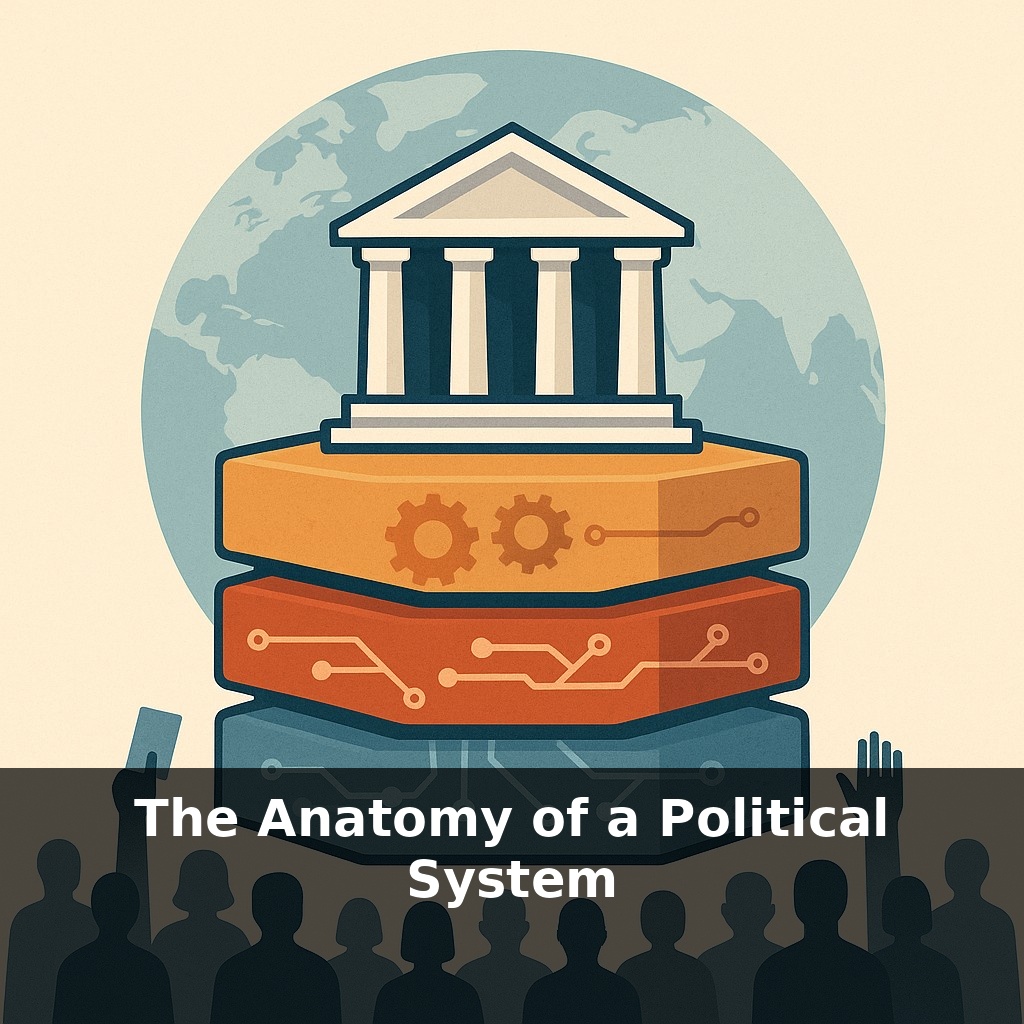
Here’s the twist: what we call a “political system” isn’t just the headline label on a country—democracy, autocracy, something-in-between. Beneath that label sit three moving parts that quietly shape your daily life: the formal bodies that can say “yes” or “no” to decisions, the routines that decide who gets into those bodies and how choices are made, and the shared expectations about what’s acceptable behavior in public life. Together, they decide who actually gets listened to, whose interests can be safely ignored, and how conflicts are handled when they inevitably appear. Think of a city where crosswalks exist, traffic lights work, and most drivers stop without a cop on every corner; that mix of rules, habits, and enforcement is how a political system feels from the sidewalk.
Some systems put most weight on the formal bodies—parliaments, presidents, monarchs—treating them like the only real stage. Others lean heavily on unwritten habits: “we just don’t do that here,” even if the law is silent. And then there are places where the real action happens in the in‑between spaces: party backrooms, military councils, business networks. What matters for you is how these pieces divide up power, authority, and legitimacy—who can block what, who gets heard first, and whose consent leaders feel they must actually earn.
Start with the skeleton: institutions. These are the “who” of decision‑making—courts that can strike things down, cabinets that can push things through, central banks that can quietly move billions with a vote behind closed doors. A country might have a glittering assembly hall on TV, but if real budget choices are made inside a small economic council, that’s the true backbone of the system. The key question isn’t “what’s on the constitutional chart?” but “which bodies can actually say no and make it stick?”
Then come the processes—the “how” of getting in and getting things done. Electoral rules decide whose votes count most. In systems with single‑member districts, whole parties can win a hefty share of the national vote and still end up nearly invisible in the legislature. In proportional systems, tiny parties can become kingmakers. Elsewhere, leadership rotations happen through party congresses, seniority ladders, or opaque selection committees. That’s one reason only a small fraction of U.S. congressional bills ever become law: procedures deliberately slow things down, forcing coalitions to be broad, not just loud.
Culture is the “when we look away, what still happens?” part. In some countries, leaders technically can extend their rule, but step down because the unwritten script says it’s time. In others, the public may tolerate heavy control as long as jobs grow and streets feel safe; legitimacy flows less from ballots and more from performance. Places with dense civic habits—local clubs, neighborhood groups, unions—tend to generate more people who know how to organize, monitor, and pressure those in office.
Now connect these three layers to the flow of authority and legitimacy. Electoral democracies, roughly half of assessed countries today, claim authority from competitive selection. Yet if parties are cartelized, courts deferential, and media captured by a few owners, citizens’ formal choices can be squeezed into a narrow funnel. Meanwhile, some tightly controlled regimes survive for decades because institutions are disciplined, processes are predictable for insiders, and enough people believe the trade‑off—less voice for more order or prosperity—is acceptable, at least for now.
Those arrangements shape everyday outcomes: who can claim rights without fear, which neighborhoods see reliable services, and how crises are absorbed—or explode—when trust runs out.
Think of three real countries as different “recipes” using the same three ingredients. In Switzerland, institutions like parliament share space with frequent national referendums, so processes regularly pull issues back to voters; the culture treats close oversight of leaders as normal, not hostile. In the U.S., those same ingredients are arranged to produce friction: separate branches, staggered elections, and committee bottlenecks help explain why only a small slice of bills ever becomes law. That isn’t just inefficiency; it’s a design that trades speed for multiple veto points. Contrast that with China’s 2018 removal of presidential term limits. Here, a single institutional change, decided inside a tightly managed congress, reshaped succession rules and signaled a cultural shift toward strong‑man continuity over rotation. Across these cases, what differs isn’t whether people care about outcomes, but how far the architecture lets ordinary citizens redirect the flow when they dislike where things are going.
Rising AI tools might turn some states into “smart panopticons,” scoring citizens like students under constant exam proctoring, while others use similar tools to open budgets and draft laws with live public input. Climate stress could act like a slow, erratic tide, forcing authorities to redraw who decides what, and where. The systems that bend without quietly dropping whole groups overboard will be the ones that feel legitimate in the long run.
Your challenge this week: treat your country like a house you just moved into. Walk through its “rooms”: who controls money, who handles disputes, who speaks for you far away. Note one door that seems locked—an opaque budget, a closed meeting, a ritual you don’t understand. Then ask: who gave them the key, and how could that ever change?
Unlock all episodes
Full access to 5 episodes and everything on OwlUp.
Subscribe — $1.99/monthLess than a coffee ☕ · Cancel anytime