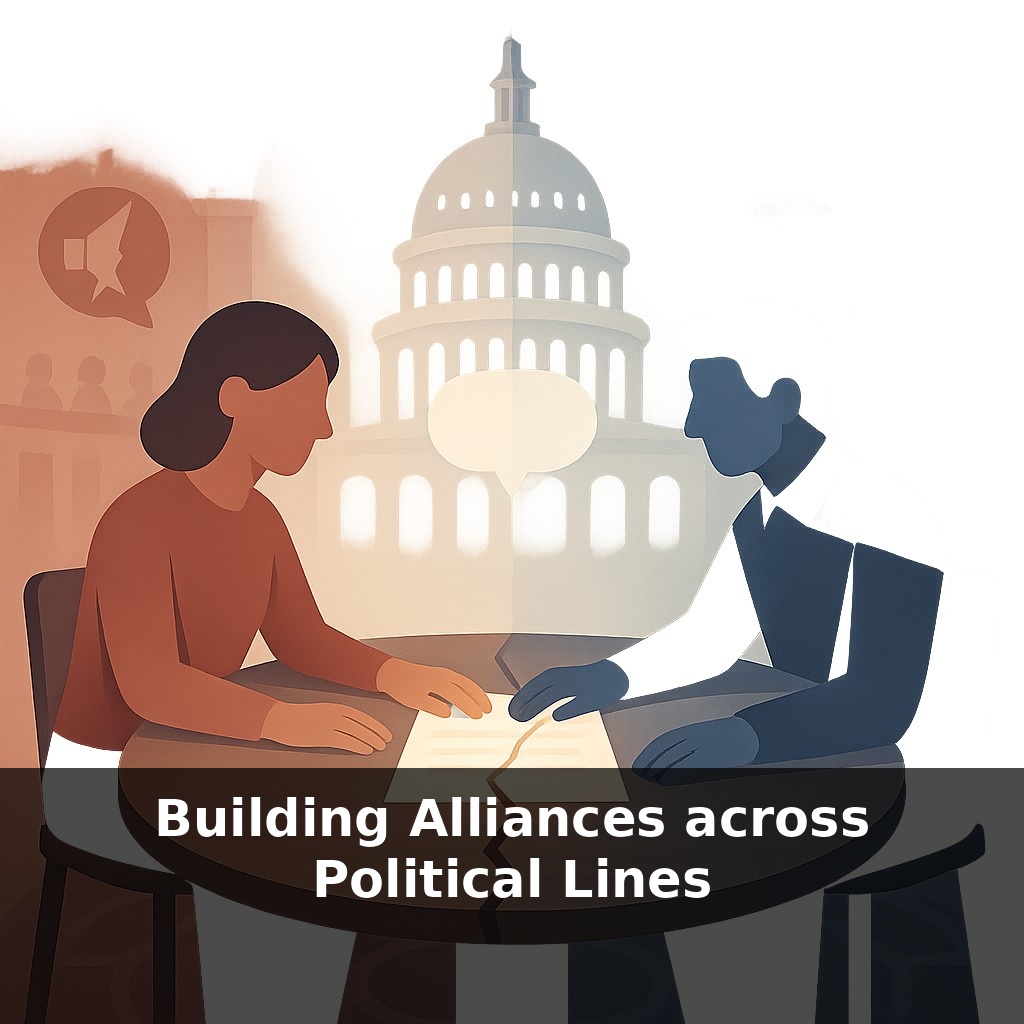
A bill backed by both Koch Industries and the ACLU sailed through the U.S. Senate with almost nine out of ten votes. In an era of constant political trench warfare, how does that happen? Today, we drop into the room where sworn opponents decide to become uneasy allies.
Most “across-the-aisle” efforts fail long before a vote is taken. They die in the first 30 minutes, when people posture for their own side, argue about who’s to blame, and never get to what they could actually do together. The alliances that survive those first 30 minutes look very different. They start by shrinking the goal. Instead of “fixing democracy,” they target one rule, one program, one budget line. In Congress, cross-party bills that succeed are more likely to focus on a single statute or funding stream than on sweeping reform packages. Outside legislatures, the same pattern appears: in one study of 50 local campaigns that united business, labor, and community groups, the winners almost always rallied around a tightly specified change—like raising a city’s minimum wage by a set dollar amount, or creating one new oversight board with a clear mandate.
When coalitions stay small and concrete, they can also widen who’s in the room. The FIRST STEP Act didn’t try to remake the justice system; it focused on sentencing and prison programs, and that narrow scope let groups as far apart as Koch Industries and the ACLU push together. In Congress, the 58-member Problem Solvers Caucus uses a similar tactic: members pick a single, discrete target—like a specific permitting rule—then recruit colleagues from both parties around that one fix. Notice the pattern: precise goals don’t limit participation; they make risk-taking safer for more people.
The next move isn’t to broaden the issue—it’s to broaden the **people** who can sell it.
Durable alliances almost always use “inside translators”: messengers who speak to their own side’s moral language while pointing to the same concrete objective. In the FIRST STEP Act fight, reform wasn’t sold to conservatives as “reducing mass incarceration”; it was framed as cutting wasteful spending and rewarding redemption. On the left, the very same provisions were justified as racial justice and human rights. Same bill, two moral narratives.
This isn’t spin; it’s strategy grounded in how persuasion works. In one large experiment with 8,000 Americans, messages that connected a policy to the listener’s core values (like fairness, loyalty, or authority) moved opinions **30–40 % more** than generic arguments. Effective coalitions map one shared goal onto multiple value frames, then recruit credible voices for each frame.
Notice who those voices are. In Ireland’s 2015 marriage-equality campaign, front-line messengers weren’t national celebrities but ordinary citizens from the 100‑member Citizens’ Assembly who had pored over evidence together. When 79 of them endorsed legalization, parties across the spectrum suddenly had political cover: they could say, “We’re following the people.” That citizen signal helped drive a national “yes” vote of **62.1 %**.
The same pattern shows up in U.S. local campaigns. In one analysis of 50 city-level coalitions, winning efforts averaged **5–7 distinct constituencies** on their public endorsement lists: faith leaders, small businesses, unions, neighborhood groups, sometimes even a police chiefs’ association. Each constituency supplied its own trusted translators. Losing efforts averaged closer to **2–3**.
But diverse messengers only matter if they keep meeting. Polarization research shows that when cross-party groups disband after a single victory, their members’ attitudes rebound toward baseline within **6–12 months**. When they institutionalize ongoing contact—through joint task forces, standing caucuses, or citizen panels that reconvene—the attitude shifts last **2–3 times** longer, and new campaigns spin out faster because the trust and norms are already there.
So the craft of alliance-building has three serial moves: narrow the target, multiply the value frames, and then lock in recurring spaces where unlikely partners keep seeing—and delivering—small, visible wins together.
In one U.S. state, gun‑safety advocates and firearm instructors—groups that rarely share stages—jointly backed a bill to modernize background‑check databases. They skipped sweeping rhetoric and focused on one failure: **42,000** disqualifying records missing from state files. Gun‑rights messengers told their base it protected “responsible owners”; safety groups called it “closing deadly gaps.” The bill passed with support from over **70 %** of legislators.
You can adapt this pattern locally. Suppose tenants’ groups and small landlords usually clash. They might still cooperate on a **single** repair‑fund pilot for aging buildings in one ZIP code, capped at **$2 million**. Tenants urge “healthy homes”; landlords stress “protecting investments.” If they meet monthly, publish repair totals—say, **150** units fixed in six months—and invite one new stakeholder each cycle (insurers, contractors), they’re no longer a one‑off alliance but the nucleus of a standing problem‑solving forum.
As feeds narrow our views, the rare skill will be **designing** unlikely teams. By 2035, civic programs may require students to run “mixed-ideology sprints,” tasked with co‑writing a 500‑word proposal with classmates who disagree. Cities could host annual **48‑hour coalition hackathons**, pairing 50 residents and 10 local officials to solve one budget, zoning, or safety problem. Expect hiring managers to rate applicants on “coalition literacy,” the way they now rate coding or data skills.
Your challenge this week: Identify one issue you care about and deliberately seek out a person who disagrees with you on most politics but shares that single concern. Ask them how they would *frame* a narrow, winnable step on that issue to their own community, then compare it to how you’d frame the same step to yours.
Now scale up. Treat each new partner as a test of your design: add **1** constituency at a time, define **1** clear ask, and schedule at least **2** follow‑ups before moving on. Track outcomes like signatures gathered, meetings won, or budget shifts. When **3–4** small campaigns stack up, you’ve built more than consensus—you’ve built shared habits.
Here’s your challenge this week: Invite one person you *disagree with politically* (family member, coworker, neighbor) to a 20-minute conversation where the **only goal** is to understand their story, not change their mind. Start by asking them one values-based question like, “What life experience most shaped how you see politics?” and let them talk for at least 5 minutes without interrupting or arguing. Before you share any of your own views, reflect *back to them* what you heard (“So if I’m hearing you right, you feel…”) and ask if you got it right. End the conversation by naming one value you genuinely share (for example, safety, fairness, opportunity, dignity) and thank them specifically for one thing they said that helped you see their perspective more clearly.