A war that ended over thirty years ago is still deciding where missiles sit, which countries feel “protected,” and who gets a veto at the UN. As you drive, work, or scroll today, you’re moving through a world quietly scripted by that unfinished Cold War story.
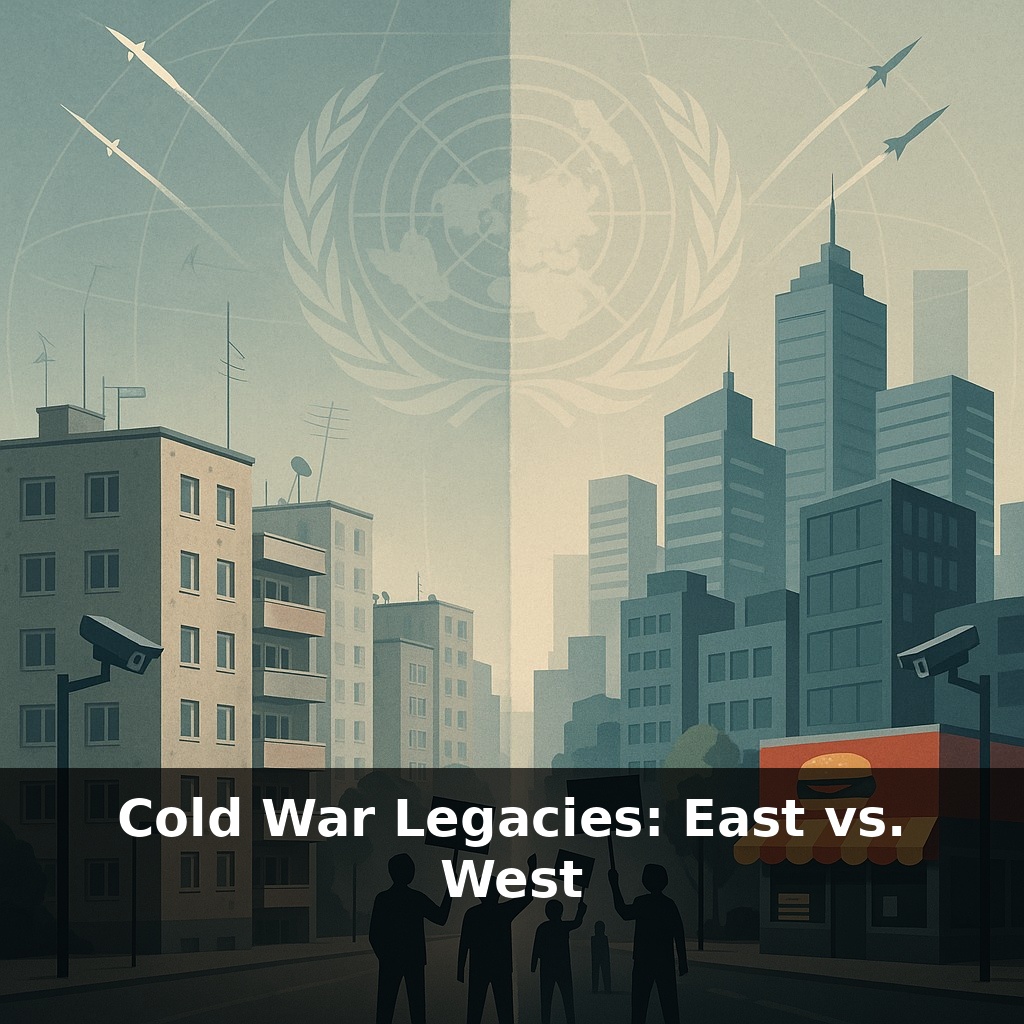
Stand in any major city and look closely: Soviet-era apartment blocks, American fast-food chains, surveillance cameras, protest slogans about “freedom” or “sovereignty”—these aren’t random features, they’re residues of a global argument that never fully wrapped up. The labels changed from “communist vs. capitalist” to “authoritarian vs. democratic,” “West vs. rest,” or “rules-based vs. multipolar,” but the underlying script still nudges who trusts whom, which borders feel negotiable, and what counts as a “threat.”
That script reaches inside countries too. School textbooks, state media, and even pop culture often carry subtle Cold-War-era assumptions about heroes, villains, and “our place in the world.” Like background music in a café, you may not notice it, yet it quietly shapes the mood—how societies justify military budgets, explain economic pain, or rally support when new crises flare.
Walk through your news feed and notice how often stories cluster around the same few hotspots: Ukraine, Taiwan, the Korean Peninsula, tensions over “spheres of influence.” These aren’t random crises; they sit on old fault lines that never fully healed. Trade routes, fiber‑optic cables, energy pipelines, and military bases often trace decisions made decades ago, then simply upgraded with newer hardware. Even debates about internet censorship, data privacy, and “foreign interference” inherit instincts shaped when information itself was treated like a weapon to be controlled, courted, or feared.
Look closely at the “East vs. West” labels and they start to blur around the edges. Formally, the blocs dissolved, but the habits they trained into states, elites, and even citizens outlived the flags. One habit is the idea that security is something you buy in bulk and store in alliances: NATO on one side, a looser web of partnerships around Russia and China on the other. When NATO spends over half of global military budgets, that’s not just hardware; it’s a signal about whose protection is considered normal, and whose buildup is seen as suspicious.
Another habit is reading local events through bloc-colored glasses. A protest in Hong Kong, a coup in the Sahel, a satellite launch in North Korea—each gets quickly slotted into a mental spreadsheet of “ours,” “theirs,” or “swing states.” During the Non‑Aligned Movement, many countries tried to escape that sorting; today their successors talk about “strategic autonomy,” but the gameboard they move on was laid down decades earlier.
Domestic politics carry the imprint too. Constitutions drafted under occupation or ideological pressure still shape what counts as legitimate opposition, how easy it is to declare emergencies, and who controls the military. In some places, anti‑communism became a tool to crush any left‑wing dissent; in others, “anti‑imperialism” still justifies one‑party rule. These old reflexes resurface when governments face economic shocks or mass protests: critics are framed as puppets of an external camp, not just rivals with different ideas.
Economically, the toolkit of sanctions, export controls, and aid packages descends from earlier struggles over who would industrialize under which rules. Today’s fights over 5G networks, semiconductors, and rare earths echo past battles over oil routes and steel plants, but with more intricate supply chains. Think of a modern smartphone: parts designed in one ex‑Cold‑War bloc, assembled in another, with critical minerals mined in countries that once tried to avoid choosing sides. When tensions spike, that invisible web becomes a battlefield without gunfire.
The result is a world where leaders insist we’re in a “new era,” yet still reach for inherited playbooks whenever pressure rises.
Think of three everyday scenes. First: a budget meeting in a small European country. The finance minister proposes cuts to welfare but leaves a costly fighter‑jet program untouched. Nobody in the room designed that priority list from scratch; it’s inherited from decades when being “reliable” to a bloc meant military readiness came first, and social spending adjusted around it.
Second: a university debate in an African or Asian capital. Students argue whether their country should sign a tech deal with a U.S. firm or a Chinese one. The terms—security guarantees, training, data access—echo older development offers, just repackaged around apps and cloud services instead of railways and dams.
Third: a startup founder pitching investors. One asks, “Will this product pass U.S. export controls?” Another worries whether hosting servers in a certain country will scare off clients. The founder isn’t thinking about ideology, but their entire business model bends around lines first drawn in a different century, by people solving different fears.
Elections, online platforms and even climate talks now double as testing grounds for post‑Cold‑War identities. A data‑privacy law in Brazil, a protest slogan in Thailand, or a satellite launch by the UAE can all trigger quiet recalculations in distant capitals. It’s less about choosing a camp and more like picking an operating system: which rules your internet follows, which courts you trust, which currencies you save in—and how easily you can switch if the system starts to fail.
So the “East vs. West” map you inherited isn’t destiny, it’s firmware. New actors, from climate‑vulnerable islands to gig workers and open‑source coders, are quietly rewriting parts of it—choosing tools, alliances, and narratives that don’t fit neat blocs. The more you notice those edits, the more room you have to question whose update you’ll install next.
Try this experiment: For the next three days, deliberately split your media intake into “East” and “West” Cold War legacies—watch one Russian or Eastern European news clip or commentary and one Western (US/UK/EU) piece on the same geopolitical issue (e.g., NATO expansion, Ukraine, or energy policy). Immediately after each pair, say out loud (to yourself or someone else) how each side frames “security,” “freedom,” and “threats,” and notice which arguments feel instinctively more “reasonable” to you. On day three, reverse the roles in your head: argue the Eastern position as if you fully believed it, then the Western one, and see which points suddenly feel weaker or stronger once you have to defend them.