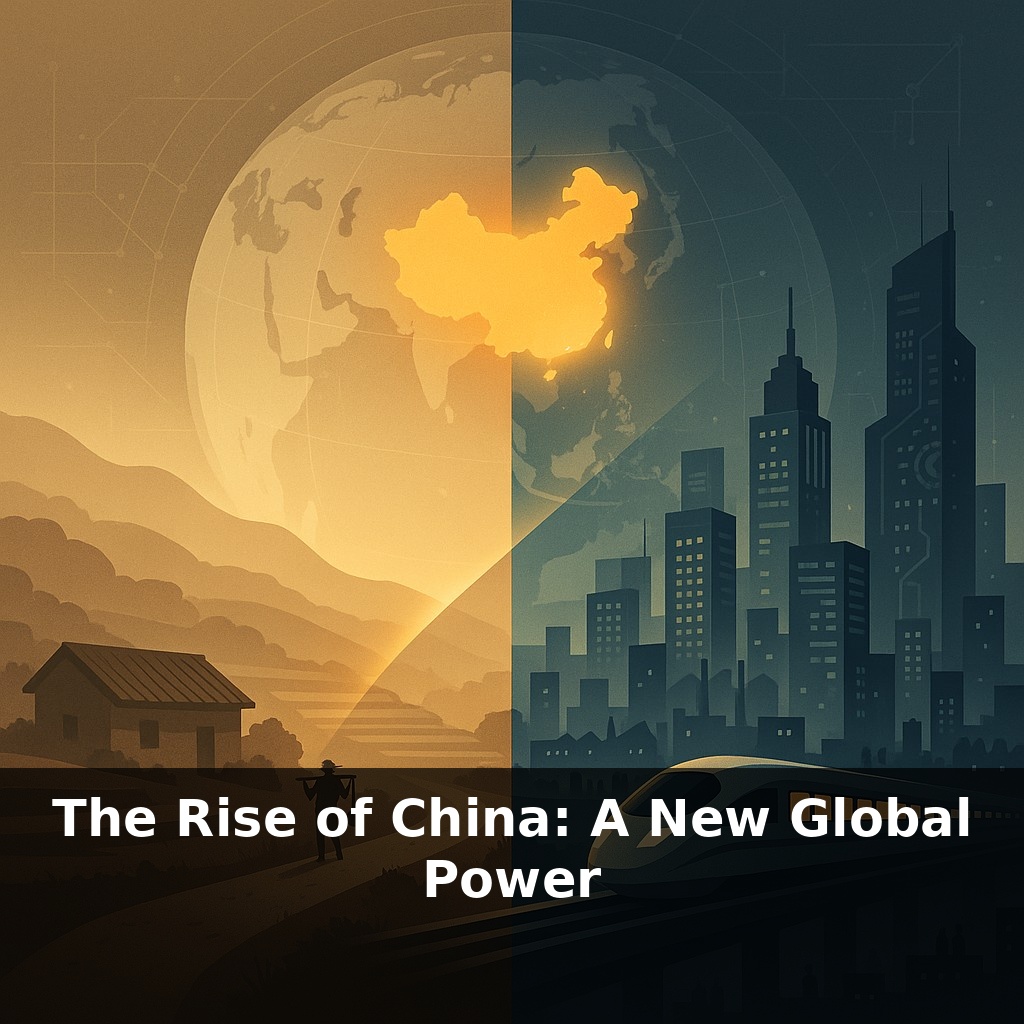
A poor farmer in rural China, in the late 1970s, would struggle to recognize their country today. In one long lifetime, China has become the world’s factory, a tech lab, and a financial giant—yet it still calls itself a “developing nation.” How can all of that be true at once?
To grasp China’s rise, you have to zoom out from factory floors and skyscrapers to the invisible architecture behind them: decisions about who gets credit, which regions get railways first, which technologies get protected or pushed. In the late 1970s, Beijing quietly began loosening the reins on farmers and small workshops, then selectively tightening them around sectors it wanted to scale. Over time, that mix of control and experimentation spread from villages to coastal export hubs, then into finance and high tech. Think of a software update that doesn’t replace the whole operating system at once, but patches critical functions, tests for bugs, then rolls out wider. China’s leaders treated the economy similarly—iterating policies, copying what worked abroad, and discarding what stalled growth—while steadily keeping the core political code intact.
Those policy “patches” didn’t just change factories; they reordered everyday life. Cities swelled as tens of millions left villages for assembly lines and service jobs. Local officials, judged on growth figures, chased investment like competitive startups, offering cheap land, tax breaks, and fast permits. At the same time, Beijing kept a tight grip on the banking system, major SOEs, and the political hierarchy, so experiments never threatened the core. This mix produced odd contrasts: gleaming coastal megacities beside inland regions still catching up, billionaires emerging under a party that still speaks the language of revolution.
If you follow the money rather than the slogans, China’s rise looks less like a miracle and more like a sequence of deliberate bets that kept shifting over time.
The first big bet was on manufacturing for the world. In the 1990s and 2000s, coastal zones turned into assembly powerhouses for multinationals like Apple, Samsung, and Nike. China offered three things in combination: an enormous, trainable labor force; improving ports, highways, and power grids; and local officials willing to clear red tape overnight to land a factory. Low margins were acceptable at first because the priority was learning: mastering quality control, logistics, and global standards.
Once firms moved up from making T‑shirts to electronics, a second bet emerged: own more of the value chain. Domestic suppliers began replacing foreign ones in components, packaging, and design. Companies like Huawei, DJI, and BYD didn’t just appear; they rose on years of subcontracting, reverse‑engineering, and gradual brand‑building. Policy nudged this along with tax perks for high‑tech zones, patent subsidies, and procurement that favored “indigenous innovation.”
At the same time, the growth engine was quietly re‑wired. Exports remained vital, but urban consumers started to matter more. E‑commerce giants such as Alibaba and JD.com built dense logistics networks so that a smartphone order from a third‑tier city could be delivered within a day or two. Mobile payments leapt ahead of many Western systems; street vendors, taxis, and luxury malls all plugged into the same digital wallets. Services—finance, logistics, entertainment, education—expanded around this new urban middle.
Strategic initiatives stretched China’s reach outward. The Belt and Road knit ports, railways, and fiber‑optic cables from Southeast Asia to Africa and Europe, creating new markets for Chinese steel, construction firms, and digital platforms. “Made in China 2025” highlighted specific sectors—advanced machinery, new‑energy vehicles, semiconductors—where Beijing wanted domestic champions to reduce reliance on foreign technology, especially after sanctions on firms like ZTE and Huawei exposed vulnerabilities.
This layered strategy—learn from the world, climb the value chain, then reshape parts of it—has turned China into both a key node in existing global networks and an architect of alternative ones.
Think of China’s rise less as a straight highway and more as a branching metro system, where each new “line” serves a different strategic purpose. One line runs through 5G, AI, and green tech: firms like CATL in batteries or Longi in solar didn’t just chase profit, they rode state signals that said, “this is where the next decade’s competition will be.” Another line runs through overseas projects: ports in Greece, rail in Kenya, power grids in Pakistan. These aren’t random trophies; they’re chosen to reduce bottlenecks for Chinese trade and secure energy and data routes that don’t rely on U.S. allies.
At home, yet another line serves social stability. Urbanization created demand for apartments, so construction and local government finance ballooned around real estate, locking households’ savings into property. Meanwhile, universities expanded rapidly, producing engineers and scientists who feed into chip design, electric vehicles, and biotech. The result is a system where factories, labs, ports, and phone apps are tightly interwoven—so shifts in one corner of the map ripple across the whole network.
China’s next phase may feel less predictable. As wages rise and its population ages, factories, data centers, and capital could fan out into Southeast Asia, India, and Africa, knitting new production “neighborhoods” into China‑centered networks. Digital platforms, satellite systems, and currency experiments might split standards into parallel tracks: one orbiting Beijing, another Washington. For smaller states and firms, strategy becomes navigating overlaps, not choosing a single side.
China’s ascent is still a moving target: debt strains, demographic shifts, and tech pushback abroad all tug at its trajectory. Yet its scale means even small course changes ripple globally—altering commodity prices, patent races, migration paths. Think less about who “wins” and more about how your job, city, or savings already plug into choices made in Beijing.
Start with this tiny habit: When you unlock your phone for the first time each day, type “China” into your news app or browser and read just one headline about China’s economy, technology, or foreign policy—no need to open the article yet. The next day, when you do the same thing, tap into one of those headlines and read only the first paragraph. If the episode mentioned a specific topic like the Belt and Road Initiative, TikTok, or US–China trade tensions, look for that exact phrase in the headlines so your daily 30-second check-in builds directly on what you just learned.