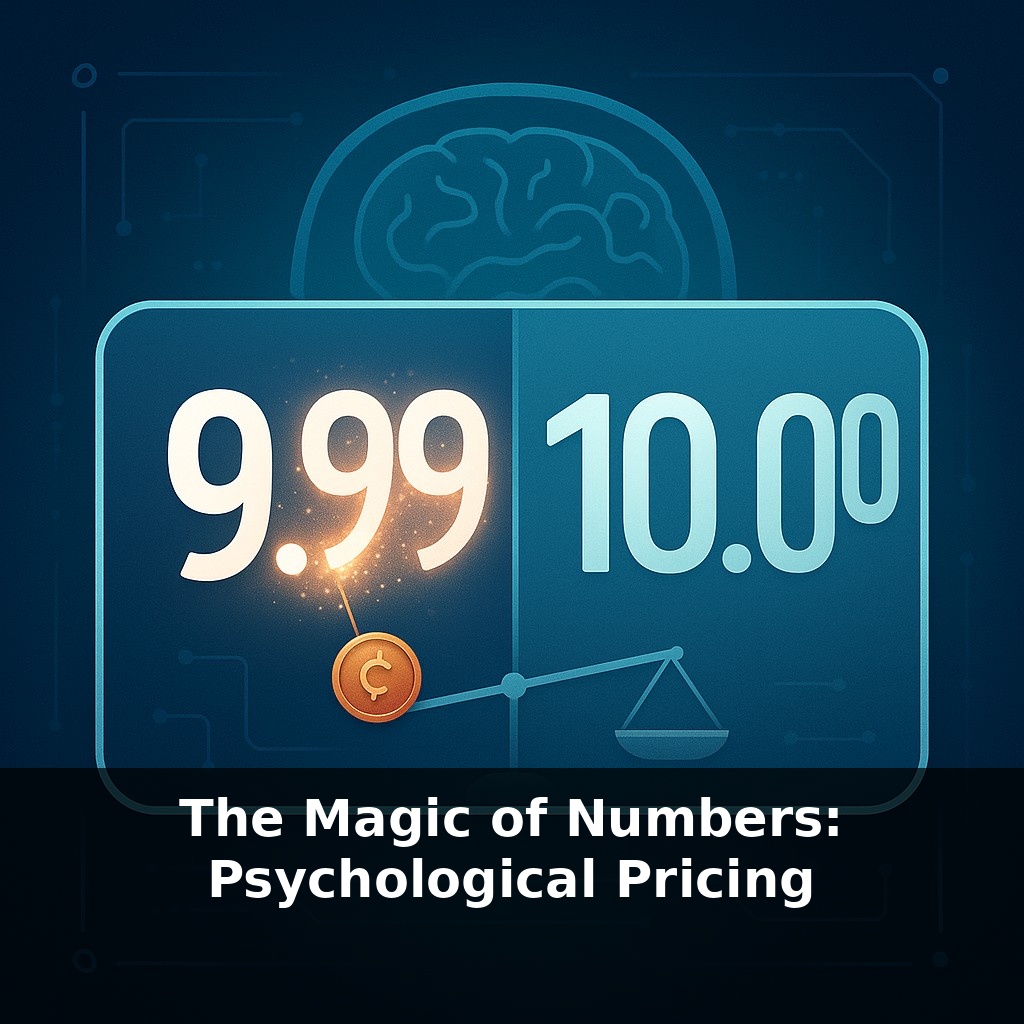
A one‑cent change can quietly outsell a flashy ad campaign. A book at $9.99 moves faster than the same book at $10, even when readers say “it’s basically ten bucks.” Today, we’re stepping into that tiny gap between “ten” and “almost ten” and why your brain cares so much.
Charm prices quietly reshape choices every day: Schindler & Kibarian found that simply ending a price in .99 can lift sales by as much as 24% for low‑stakes purchases. That single cent flips how the brain reads the number, and, as a 2007 MIT‑CMU fMRI study showed, your reward circuitry literally lights up more at $2.99 than $3.00 for the same item. In earlier episodes, we looked at how contrast and decoys bend “rational” decisions; here, we zoom in further to the digits themselves. Why does $4.99 feel meaningfully cheaper than $5 when you’ll hand over the same bill? How do platforms like Gumroad see 17% better conversion just by nudging creators toward .99 endings? And where does this stop being clever design and start edging into manipulation—especially as regulators and online transparency push back?
Marketers don’t just tweak prices; they choreograph how your eyes and brain travel across digits. That “left‑digit” effect you’ve met already is only one part of the script. Retailers combine font size, color, and even where the price sits on a page to nudge what feels “cheap enough” or “too much.” A higher “original” price shown beside a discount can pull your internal reference point upward, even if you’d never have paid that first number. Online, filters, comparison grids, and auto‑suggested tiers now join the cast, subtly steering you toward certain price bands while making others quietly disappear from view.
A price is never just a number; it’s a story about “who this is for” and “how seriously to take it.” That’s where endings, context, and category collide.
Start with endings that *aren’t* .99. In luxury or expert domains—consulting, fine dining, high‑end tech—rounded prices like $500 or $2,000 quietly signal confidence and quality. You’re not “on sale”; you’re declaring, “This is what it costs.” Push those same offers down to $499 or $1,997 and you risk sending them into the bargain bin in your buyer’s mind. The product didn’t change; the social role of the price did.
Category norms matter just as much. Supermarkets, fast‑fashion, and app stores train people to expect “busy” prices full of 9s and 7s. That clutter says, “We’re fighting to be the cheapest.” In B2B software or agency work, the same clutter can look unsophisticated or even desperate. This is why some SaaS companies keep public plans at clean tiers—$29, $99, $299—while using subtler psychological cues inside proposals: strategic discounts, odd‑sized bundles, or “founder pricing” that expires.
Then there’s the surrounding frame. A $39 course can look suspiciously low next to $499 competitors—unless you flank it with context: limited scope, self‑serve format, or a higher‑tier option above it. The number alone doesn’t carry trust; the offer architecture does. Many creators quietly pair a charm‑priced entry product with a premium, clean‑priced flagship, letting the first feel like a “no‑brainer” and the second feel like the serious step.
Culture and regulation add another layer. In some European markets, regulators now scrutinize “fake” reference prices and hyper‑fragmented tags. That pressure nudges retailers toward clearer, more stable structures: everyday low prices, transparent unit pricing, fewer theatrical markdowns. Online, comparison tools blunt the impact of a single clever ending. If ten tabs show nearly identical products, the difference between $19 and $19.99 shrinks; reviews, shipping, and trust signals take over.
For you as a builder or buyer, the practical move is to treat endings as hypotheses, not dogma. Sometimes the most profitable decision is to earn a premium by *not* looking like everyone else racing to .99.
A bakery tests two boards for the same croissant box. Board A: “Box of 6 – 6.00.” Board B: “Box of 6 – 5.95” with “Was 6.50” faintly crossed out. Same dough, same oven, yet the second board quietly moves more boxes on busy mornings. The tiny drop plus a “lost” higher number hints at urgency and thrift without a wordy pitch.
Now shift to an online design tool. One team prices templates at $12, $24, and $48. Another team runs $11.90, $23.80, and $47.60 but pairs each with “Best for 1 project,” “Best for 3 projects,” and “Best for 10+.” The labels anchor scale and seriousness; the odd cents simply decorate the tiers. Most buyers remember the “3 projects” promise, not the pennies.
In a different lane, a boutique hotel resists “€149.99” and stays with “€150” across all channels—but adds a “Stay 3 nights, save 12%” banner. The flat nightly rate signals stability; the percentage flexes for planners hunting deals.
As algorithms learn your habits—what you click, when you hesitate, how often you return—prices can start to feel like moving targets. A seat on the same flight, at the same time, might quietly cost each passenger something different. That flexibility can smooth demand and cut waste, but it also risks turning every checkout into a poker game where only the platform sees all the cards. Expect growing pressure for “fairness audits” of pricing systems and clearer rules on how your data shapes the numbers you see.
Treat every price you see this week like a headline: what attitude, promise, or target customer is it hinting at? Your challenge this week: pick one offer of your own and create two versions—one “serious and simple,” one “deal‑focused”—and show both to five people. Listen not for which is cheaper, but for which *story* they think they’re buying.