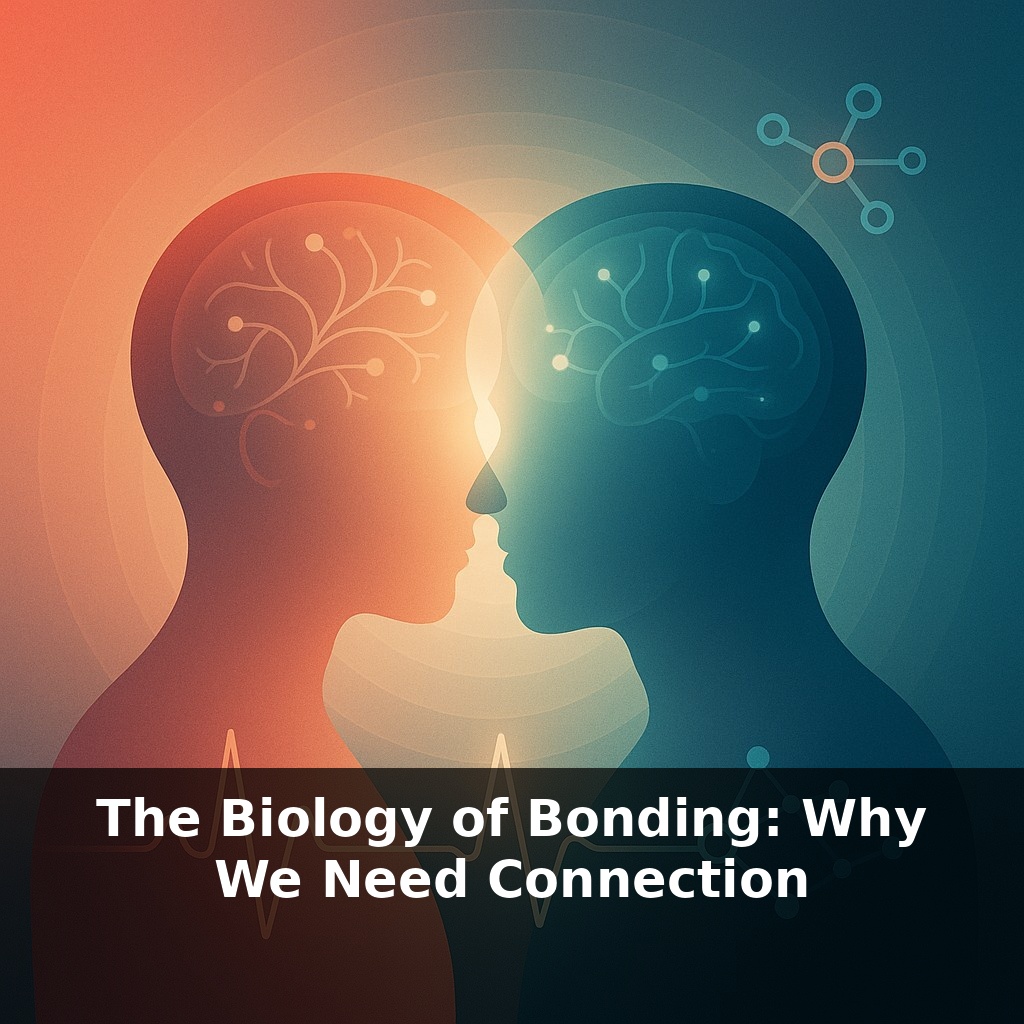
The Biology of Bonding: Why We Need Connection
📝 Transcript
Right now, your brain is quietly ranking who your “inner circle” is—those few people you’d call at 2 a.m. In a typical life, that tiny group can shape how long you live as much as diet or exercise. So why does your biology treat connection like a survival skill, not a luxury?
Here’s the strange part: your body keeps score of connection whether you notice it or not. Your heart rate subtly shifts when you hear a close friend’s voice. Your stress hormones ease when you sit next to someone you trust—even in silence. Skin, gut, and brain are constantly “listening” for signals that you belong, and adjusting how much energy to spend on repair, digestion, even fighting infection.
This isn’t about being extroverted or collecting more contacts. It’s about the quality of a few key bonds and the hundreds of lighter ties around them. Think of your day like a budget: every warm exchange is a small deposit in long-term health, every stretch of chronic disconnection a quiet withdrawal. In this episode, we’ll dig into the biology behind that ledger—and how to use it.
When researchers map people’s lives, a pattern keeps appearing: we each seem to carry a tiny “core team” and a wider ring of familiar faces. On average, adults report only about 4–5 people they truly confide in, yet those few names show up again and again in health data, predicting everything from recovery after surgery to how long we live. Around them sits a looser crowd—roughly 150 stable relationships our brain can track before it maxes out. Like apps running in the background, these bonds quietly shape stress levels, immune defenses, even which genes switch on under pressure.
Deep in that “social ledger” your body is keeping, chemistry is doing the bookkeeping. When you lock eyes with someone you trust, share a joke, or get a reassuring squeeze on the shoulder, your brain isn’t just registering a nice moment—it’s releasing a cocktail of oxytocin, dopamine, endogenous opioids, and vasopressin that tells every system: “You’re not alone. It’s safer to relax.”
Oxytocin tends to get all the headlines, but the story is more nuanced. In many studies, a brief stretch of warm touch can nudge oxytocin levels up within minutes, softening vigilance and making it easier to read others’ faces and intentions. Yet it doesn’t turn you into a universal altruist; it often makes you more protective of “us,” sometimes more wary of “them.” Biology is trying to solve a very old problem: who can I safely rely on?
Dopamine layers in motivation and learning. That small hit you feel after a great conversation or shared laugh? Your brain tags that interaction as “worth repeating,” strengthening the memory and the route back to that person. Over time, you don’t just remember that a friend is supportive—your nervous system anticipates relief before you’ve even finished dialing their number.
Endogenous opioids add a quieter dimension: they dull both physical and social pain. Being excluded lights up many of the same brain regions as a physical burn; close contact can release opioids that take the edge off. This overlap helps explain why isolation can feel physically draining and why people sometimes reach for painkillers, food, or substances when they’re really starved for connection.
Vasopressin, meanwhile, has been linked in animals and humans to pair-bonding, territoriality, and long-term commitment. It’s one reason some bonds feel less like “fun to be around” and more like “this is my person, my crew, my responsibility.”
All of this chemistry feeds back into stress systems, inflammation, even which genes flip on under strain. Strong, consistent bonds don’t just comfort you in hard times; they appear to change how harshly life’s stresses register in your cells over years.
Think of those bonding chemicals less like “feel-good juice” and more like a live settings panel your body keeps tweaking. After an evening of easy conversation, your sleep might be deeper, digestion smoother, and that nagging headache quieter—not magic, just systems briefly shifting into repair mode. The opposite happens in a week of strained or absent contact: your brain reads it as uncertainty and keeps you on low-level alert, which can nudge blood pressure up and make you more reactive to minor annoyances.
Real-world data backs this up. In one classic study, people who reported feeling steadily supported by a partner showed faster wound healing than those who felt tense or alone at home. Other research finds students who feel they “fit” in a new school don’t just report better moods; their inflammatory markers tend to be lower during exams.
Subtle choices amplify or dilute these effects: eye contact versus half-listening, phones-on-the-table versus undistracted presence, quick “checking in” texts versus silent gaps that stretch a bit too long.
A paradox is emerging: we’re more “connected” than ever, yet loneliness markers are climbing. As biology research sharpens, connection may shift from “nice-to-have” to something closer to sleep or nutrition—tracked, prescribed, even optimized. Workplaces might be judged by the “relational climate” they create, not just output. Couples therapy could include lab-style feedback on bonding patterns, like a relationship “blood panel” revealing how resilient or brittle your shared system really is.
Your challenge this week: run one deliberate “bonding experiment” each day. Day 1: offer a 20‑second longer hug or handshake than usual and notice both your breathing and theirs. Day 2: give one person undivided, phone‑free attention for 5 minutes. Day 3: reconnect with someone you haven’t spoken to in months. Rotate through touch, attention, and shared laughter. By day 7, see which type of micro‑connection most noticeably shifts your mood or body.
As you notice these tiny shifts, don’t rush to label them “good” or “bad.” Treat them like adjusting a recipe: a pinch more time with one person, a little less doom‑scrolling, a dash of shared silliness. Over weeks, patterns emerge—who nourishes you, where you go numb. That quiet data is your map for designing a life that keeps you wired in, not worn out.
Before next week, ask yourself: 1) “Whose nervous system do I actually feel safest and most regulated around, and what’s one specific way I can intentionally increase warm, face-to-face time with them this week (like a 20‑minute walk without phones or a device-free dinner)?” 2) “When I feel lonely or disconnected, what’s the *first* subtle body signal I notice (tight chest, shallow breathing, racing thoughts), and how can I experiment in that exact moment with one co-regulation tool from the episode—like a longer hug, synchronized breathing with someone I trust, or making gentle eye contact?” 3) “Which relationship in my life feels a bit ‘flat’ or distant, and what is one concrete, vulnerable sentence I could share with that person (for example, ‘I’ve realized I really miss you and I’d love to feel closer—can we talk or hang out this week?’) to invite more genuine connection?”
Unlock all episodes
Full access to 7 episodes and everything on OwlUp.
Subscribe — $1.99/monthLess than a coffee ☕ · Cancel anytime