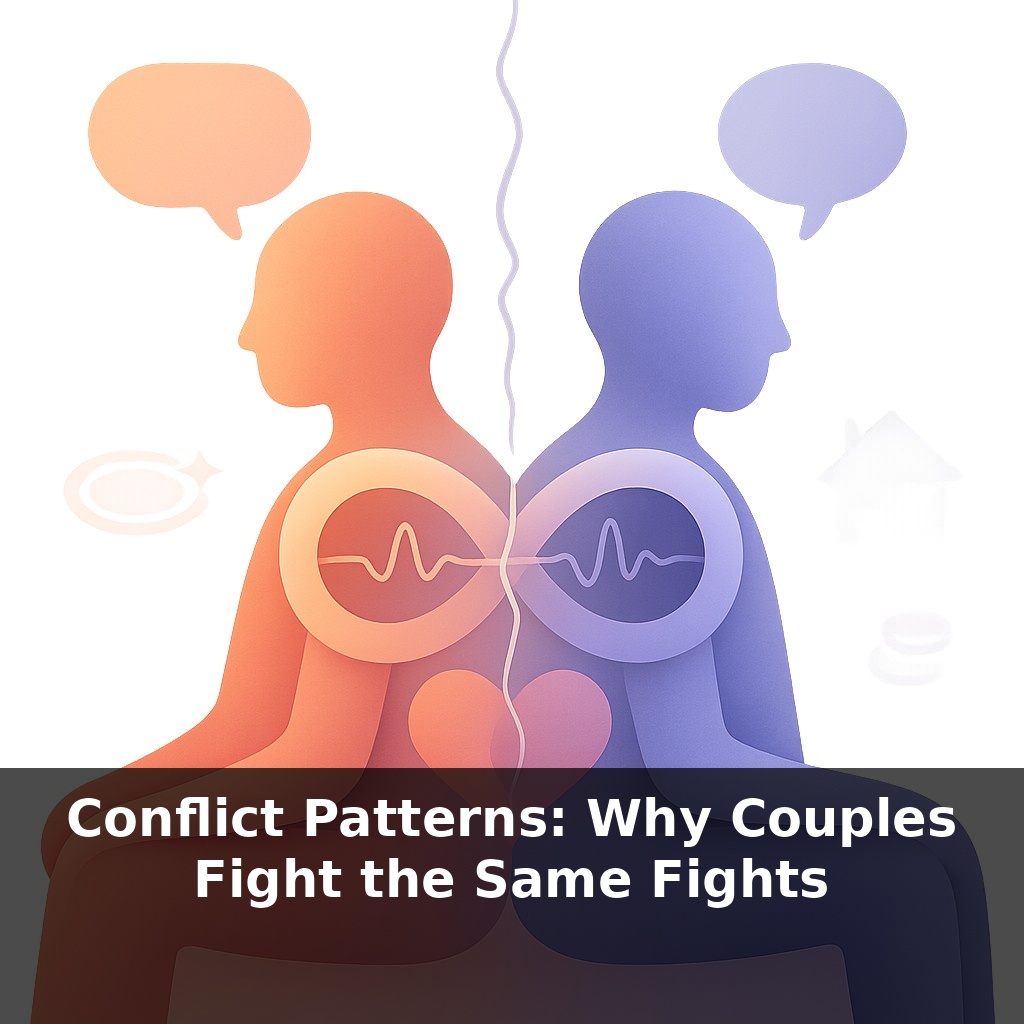
“About two‑thirds of the arguments couples have will never actually be ‘solved.’ Here’s the strange part: many of those fights aren’t really about the dirty dishes, the budget, or the in‑laws. In this episode, we’re going to tug on the hidden threads underneath those repeat battles.”
Roughly 80% of distressed couples get stuck in the same dance: one pushes, the other pulls away. That demand‑and‑withdraw pattern isn’t random—it’s the nervous system doing exactly what it was wired to do under threat. The problem is, your brain can’t tell the difference between, “You never help around the house” and “There’s a tiger in the room.” Once your heart rate spikes past about 95 beats per minute, your capacity for empathy and nuance plummets. You’re not “bad at communicating”; you’re flooded. And when you’re flooded, you reach for whatever move you’ve used a hundred times before, even if it fails every single time. In this episode, we’ll zoom in on that flooded moment and slow it down, so you can see the split‑second choices that quietly keep your worst patterns alive—and how small tweaks there can change the entire trajectory of a fight.
Some researchers estimate that nearly 70% of couple conflicts are “perpetual”—not mistakes to fix once, but ongoing friction points shaped by personality, history, and daily stress. That sounds discouraging until you notice something: even “stuck” couples still have micro-moments when things go slightly better. A softer tone, a tiny joke, a sigh instead of a slam. Those aren’t accidents; they’re clues to a different pathway. In this episode, we’ll treat those tiny exceptions like trail markers, helping you map what actually shifts the dynamic between you—even when the topic never really changes.
“John Gottman can watch a 15‑minute disagreement and predict divorce with close to 90% accuracy—not by what couples fight about, but by *how* they fight. That tells us something uncomfortable: most of what determines where an argument goes is already baked into the pattern long before this particular conversation starts.
Those patterns usually sit on three layers.
First, attachment needs. Under complaints like “You’re always on your phone” or “You never back me up with the kids” are usually questions like: “Do I matter to you?” “Can I count on you?” “Am I allowed to be myself here?” Two people can be arguing about screen time while actually fighting about entirely different invisible questions. When those questions clash—one person needing closeness, the other needing space—the same surface fight reloads with a new topic.
Second, unspoken emotion. Many partners have one or two emotions they’re comfortable showing and several they bury. Anger often covers fear; sarcasm often hides shame; cold logic can be a way to hide hurt. If you grew up learning that sadness was “weak,” you may only let irritation leak out. Your partner reacts to the irritation, not realizing it’s sitting on top of something softer. Over time, you both end up sparring with each other’s armor instead of what the armor is protecting.
Third, entrenched “conflict scripts.” These are the moves you watched growing up, absorbed in past relationships, or practiced alone: shutting down, lecturing, joking, over‑explaining, counter‑attacking. Under stress, your brain grabs that script automatically. If your script is “convince harder” and your partner’s script is “retreat to feel safe,” the stage is set for the same argument to re‑enact itself on schedule.
Here’s the tricky part: each partner’s moves *make sense* inside their own logic. Criticism might feel like “finally being honest.” Withdrawal might feel like “preventing things from getting worse.” The problem is the *fit* between those logics. Like two apps trying to sync with different default settings, every update on one side triggers an error on the other.
What actually disrupts the loop isn’t perfect harmony; it’s learning to spot the moment when your script is about to run, name what’s underneath it, and try a slightly different move—even if your partner hasn’t changed theirs yet.
Think of two partners running different “operating systems” in the same relationship. One grew up in a family where raised voices meant, “We’re engaged, we care.” The other learned that the slightest tension meant danger, so calm distance felt safer. Fast‑forward to adult life: when conflict appears, Partner A turns volume up to show investment, Partner B turns volume down to stay regulated. Each person’s behavior is a *solution* in their own internal logic—and a *problem* in the other’s.
Concrete example: Sam starts asking pointed questions about money after a stressful day. To Sam, it’s being proactive. To Jordan, it lands as interrogation, so Jordan gives short, careful answers and glances at their phone. Sam now “sees” avoidance and pushes harder; Jordan feels cornered and shuts down more. Their deeper needs—Sam’s for teamwork, Jordan’s for safety—never even make it onto the table.
Breaking that cycle starts with catching the *micro‑flip*: the exact second when “I’m trying to connect” turns into “I’m bracing for impact.”
Future tools won’t just flag conflict; they’ll coach timing. Smart rings may learn your “pre‑fight signature” and suggest a 5‑minute pause *before* the spiral. Apps could replay a tough conversation like game footage, highlighting the 10 seconds where you could have chosen a softer response. As more cultures are studied, we’ll likely discover different “fight dialects”—like accents in communication—shifting therapy from “What’s wrong?” to “What’s your couple’s native language?”
Long‑term change comes from tiny, repeated experiments, not one perfect talk. Treat each tense moment like learning a new recipe: you’ll burn a few, adjust the seasoning, slowly recognize the signs before it boils over. Your challenge this week: notice *one* early cue you’re escalating, and practice pausing there. That’s where a new pattern can quietly begin.