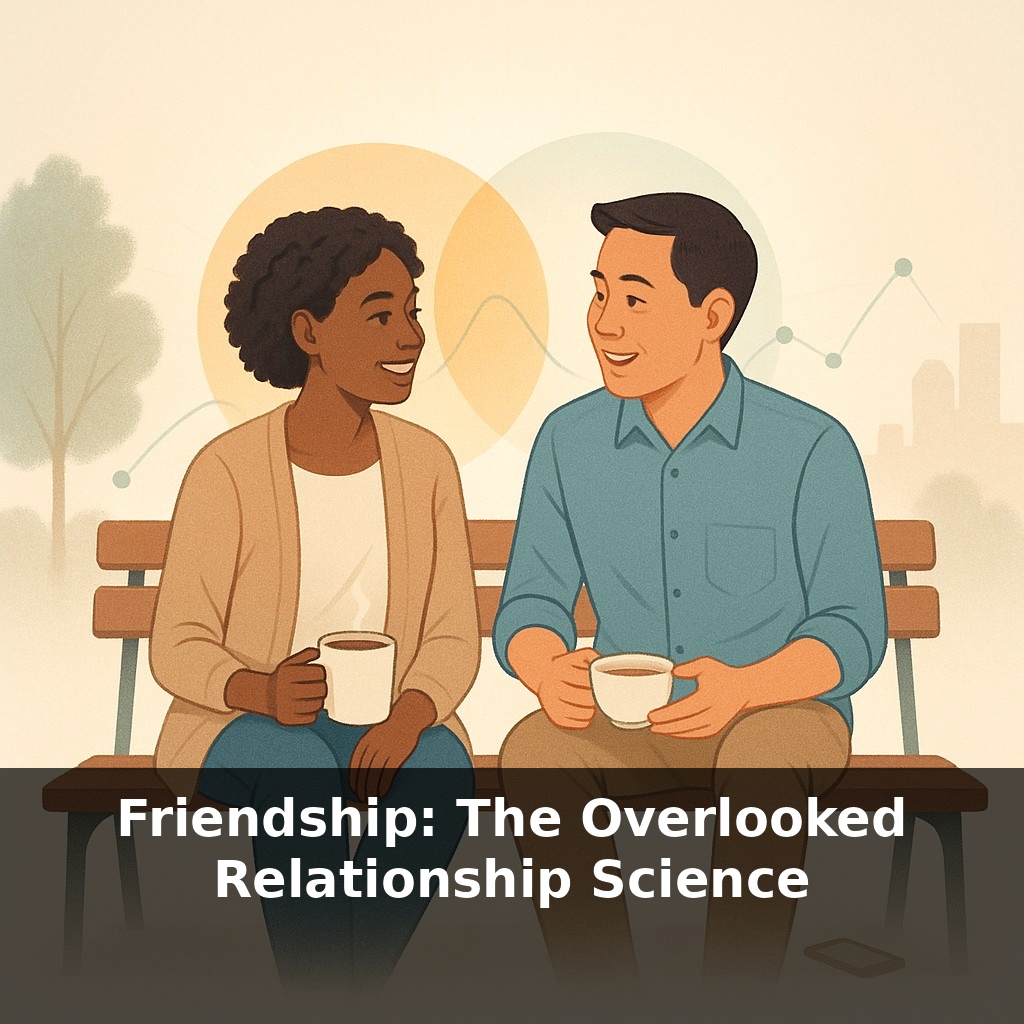
Right now, the average American spends less time with friends each week than scrolling on their phone in a single evening. Yet, in study after study, close friendships predict our health and happiness more reliably than income, exercise, or even a good night’s sleep.
We tend to treat friendship as “extra credit” in adult life—nice to have, but negotiable when work is busy or family needs spike. Yet researchers who track people across decades keep running into the same quiet headline: whose faces you see regularly is reshaping your brain, your stress response, even how long you’re likely to live.
In this episode, we’re going to treat friendship less like a fuzzy feeling and more like a system you’re running every day—mostly on autopilot. Who gets quick replies from you? Who gets postponed “until things calm down”? Which friendships quietly energize you, and which leave you oddly flat, like a phone that says 40% battery but dies after one text thread?
The goal isn’t to rank your friends; it’s to see the invisible patterns that make some bonds deepen while others slowly drain away.
Researchers have an unromantic phrase for how most friendships change: “relationship drift.” Not a blow-up, not a betrayal—just two people gradually moving out of each other’s daily orbit. Work schedules shift, someone starts nights or travels more, another has a baby or relocates, and suddenly “we should catch up” becomes a kind of polite fiction. What’s striking in the data is how predictable this drift is. Without deliberate effort, even warm, long-standing connections lose detail in your mind, the way a rarely opened app eventually gets offloaded from your phone to save space.
Here’s the unflattering truth the data keeps showing: left alone, your social world doesn’t stay “neutral”—it tilts toward distance. One Dutch longitudinal study tracked people for years and found that nearly half of their friendships had faded after seven years, not because of fights, but because nothing much happened to keep them alive.
So researchers started asking: what separates the few friendships that intensify from the many that flatten out? Three levers show up across studies.
First, **time density**. It’s not just “how long you’ve known each other,” but how often your lives actually intersect now. Regular micro-contacts—sending a link with “this is so you,” a 5‑minute voice note, a quick walk after work—act like tiny deposits in a shared emotional account. When a crisis hits, those accounts determine who you instinctively turn to, and who feels oddly out of date.
Second, **asymmetric effort**. Most of us can name at least one friend where we think, “If I stopped reaching out, would we ever talk?” Research on reciprocity shows that when one person consistently initiates, plans, and follows up, their sense of closeness quietly drops, even if they never say so. The relationship might look intact from the outside, but under the surface, trust in its longevity is eroding.
Third, **depth calibration**. Studies on emotional disclosure find that friendships grow when vulnerability is roughly matched. If one person is sharing job fears, family tension, late‑night worries, and the other stays at the level of shows and memes, the gap eventually feels lopsided. Not wrong—just misaligned for a “close” tier.
A useful way to think about this is how your phone’s operating system manages background apps. You only get so much memory. The people you interact with frequently get full color, real‑time updates; everyone else slowly downgrades to low‑resolution snapshots and old assumptions. You still “care,” but you’re relating to a cached version of them.
This isn’t a moral failure; it’s a cognitive limit. The research on network size suggests most of us can only maintain rich, up‑to‑date mental models of a small number of people. That means every upgrade has an invisible cost: moving someone closer almost always means someone else moves a little further out, unless you consciously rebalance where your time, attention, and openness are going.
Think about the last three people you’d call with really good news. Now compare them to the last three people you actually spent time with this month. For many of us, those lists don’t fully match—your “inner circle on paper” and your “inner circle in practice” have drifted apart. That gap is where the science gets interesting.
One pattern researchers see: friendships often pivot around specific “anchors”—a weekly game, a shared project, a standing commute, the same daycare pickup window. When the anchor disappears, contact usually drops unless you consciously install a new one. It’s not the depth of conversation that goes first; it’s the predictability of contact.
Here’s where a tech analogy helps: think of one friendship as a tiny shared calendar app. When you both add recurring events—second‑Sunday brunch, Thursday study sprint—the “app” keeps syncing. When nothing recurs, you’re relying on manual updates, and the connection quietly glitches more often, no matter how much you still care.
Friendship science is about to leave the lab and walk into policy. Social prescribing, friendship-focused apps, and redesigned public spaces hint at a future where “Who are your people?” becomes as routine a checkup question as blood pressure. The deeper twist: as AI companions improve, we’ll face choices about outsourcing micro‑moments of connection—like handing your social life to a slow autopilot. The real frontier may be learning to use these tools to steer us back toward humans, not away.
So the real experiment isn’t “do you have enough friends?” but “are you using the ones you have on purpose?” Future research is already tracking how tiny shifts—one extra shared walk, one honest check‑in—reshape well‑being curves. Think of this week as a live beta test: tweak one small habit, then notice whose names naturally rise to the top of your day.
Here’s your challenge this week: Choose one “dormant” friend (someone you haven’t talked to in 6+ months) and send them a 3-sentence voice note today that includes a specific shared memory, a genuine compliment, and one concrete invitation (e.g., “15-minute catch-up Thursday?”). Then, pick one current friend and schedule a recurring “friendship ritual” before the week ends—like a 20-minute Wednesday walk-and-talk or a Sunday night meme swap. Finally, do one “micro-boost” each day for five days—comment thoughtfully on a friend’s post, send a quick “this made me think of you” link, or reply to a story with something more than an emoji.