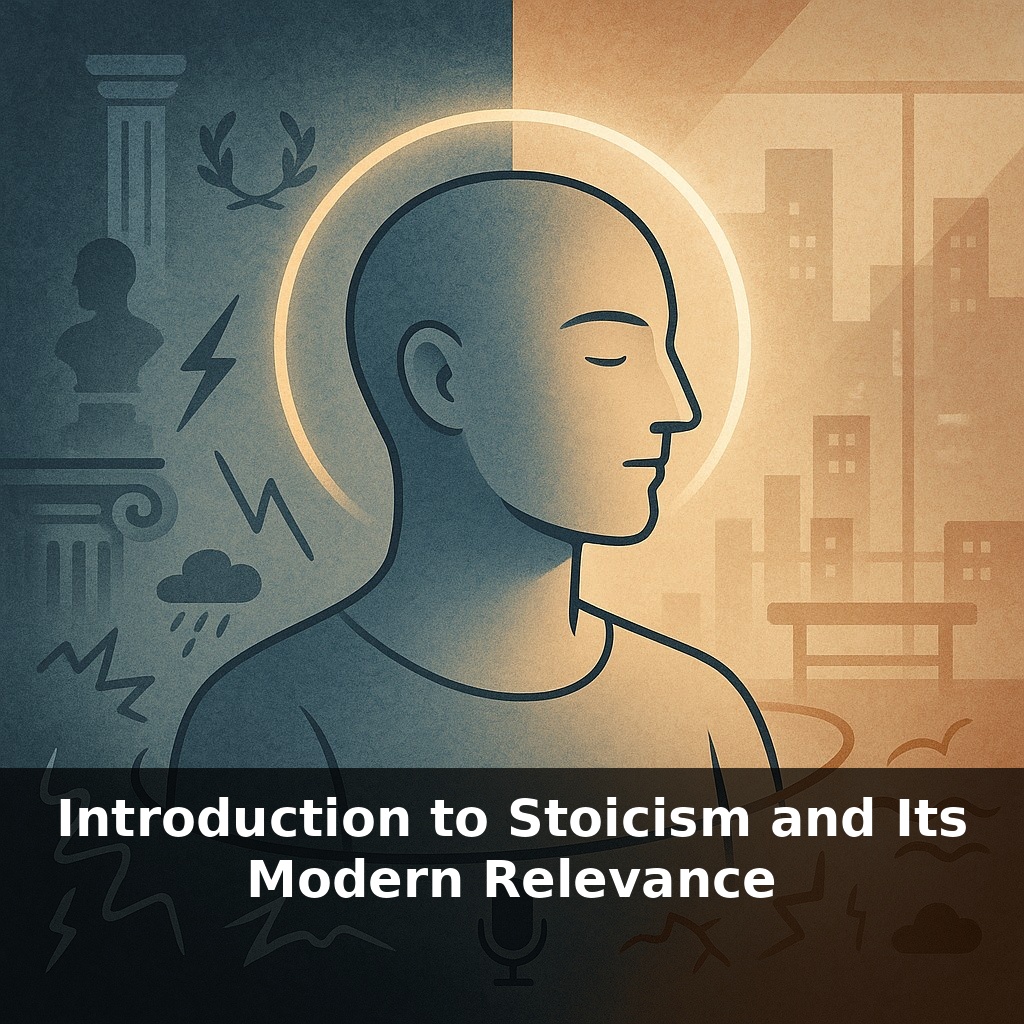
Introduction to Stoicism and Its Modern Relevance
📝 Transcript
A Roman emperor, a former slave, and a wealthy politician all swore by the same mental habit: control your reactions, not the world. Fast‑forward to today: CEOs, athletes, and soldiers quietly use that same habit as their secret weapon against chaos.
Most philosophies stay trapped in textbooks; Stoicism escaped. It shows up in locker rooms before championships, in boardrooms during layoffs, and on quiet walks when someone decides not to send that angry text. At its core are four demanding standards: wisdom, courage, justice, and temperance—not as abstract ideals, but as daily performance metrics for your character. Marcus Aurelius wrestled with them between military reports. Seneca refined them while navigating cut‑throat politics. Epictetus taught them after surviving enslavement. Today, therapists notice how Stoic exercises resemble cognitive tools that help people unstick their thinking. Like updating your phone’s operating system, Stoicism doesn’t delete your problems; it changes how your whole “mental device” runs while those problems are on the screen.
Modern interest in this ancient school isn’t just nostalgia; it’s a response to a very current problem: overwhelm. Constant news alerts, office politics, financial pressure, and relationship friction all compete for your limited attention. Where many self‑help trends offer hype or vague positivity, this tradition offers a clear structure: a few core ideas, tested over centuries, that you can actually practice between meetings or on your commute. Its surviving texts read less like mystical poetry and more like field notes from people under pressure, asking: “Given this mess, what’s the best move I can still make?”
If you strip Stoicism down to its moving parts, you keep bumping into one simple distinction: what depends on you, and what doesn’t. Ancient teachers didn’t leave this as a slogan; they drilled into the details of daily life. Your opinions, choices, priorities, and deliberate actions? On you. Other people’s moods, your genetic lottery ticket, the stock market, surprise illness, or sudden praise? Not on you, even though they affect you.
This cuts against how we’re wired to react. Someone cuts you off in traffic and your attention clings to the other driver. A colleague gets credit for your idea and your mind runs simulations of what they should have done. Stoic writers noticed how much inner energy leaks into these unwinnable fights. Their proposal wasn’t to ignore injustice or rudeness, but to route your effort where it can actually move the needle: your response, your standards, your next step.
From that starting point, their four virtues become more like categories of decisions than lofty labels. Each choice you face—send the sharp email or not, speak up in the meeting or stay silent, scroll another hour or sleep—can be viewed through these lenses. “What’s the wise move here?” may yield a different answer than “What’s the comfortable move?” “What’s the just move?” often clashes with “What keeps me liked?” Over time, they argued, repeatedly choosing in favor of the former shapes character the way repeated gym sessions shape muscle.
Another layer: they treated attention as a scarce resource. Marcus Aurelius complains in his notebook not about conquering provinces, but about getting yanked off track by irritation, vanity, and worry. That sounds familiar in a world of infinite feeds and notifications. The discipline is to notice when your focus has been hijacked by something outside your control, then gently escort it back to what is still yours to influence right now.
You can see why modern performers under pressure gravitate to this. A tennis player can’t control the wind or the crowd, only their breathing and shot selection. A founder can’t control market shocks, only the clarity of their decisions and how honestly they treat their team. The same applies on a smaller scale when you’re dealing with a tense family text thread or waiting on medical results. The situation is not optional; how you show up in it is.
Think about a tough workday: inbox stacked, a tense message from your boss, and a last‑minute schedule change that ruins your plans. Old habit: race to fix everything while replaying every slight. A different move: pause, sort the situation into two lists—what’s negotiable, what isn’t—and act only on the first. That’s where those ancient “field notes” quietly plug into daily life.
A soldier on deployment can’t pick the mission, but can decide how prepared, sober, and honest to be with the team. A parent can’t program their child’s personality, but can set clear boundaries, apologize when wrong, and model calm under pressure. A founder can’t slow a downturn, but can choose transparent updates instead of spin.
One way to picture it: like changing the notification rules on your phone. Markets, moods, and headlines still ping, but you choose which signals deserve a response, and when. The point isn’t to feel nothing; it’s to stop letting every alert dictate your next move.
Stoic ideas may quietly reshape how we design our days. Instead of adding more hacks and apps, future tools could default to short pauses before big decisions, like a built‑in circuit breaker for knee‑jerk replies. Workplaces might treat emotional composure as a trainable skill, not a personality trait, weaving brief reflection drills into meetings. Even social media could evolve: fewer outrage loops, more prompts that ask, “What outcome do you actually want here?” before you tap “post.”
Treat this less like adopting a label and more like testing a new training plan. Start where frictions already live: a recurring conflict, a stubborn habit, a fear you keep side‑stepping. Let those be your “practice field.” Over time, patterns emerge—like footprints in wet cement—revealing who you’re becoming each time you choose your next move.
To go deeper, here are 3 next steps: (1) Pick up William B. Irvine’s *A Guide to the Good Life* and read just the chapter on “Negative Visualization” tonight, then try a 5‑minute “practice loss” visualization about something you value (your job, health, or a relationship) while on a walk. (2) Install the “Stoa” or “Daily Stoic” app and enable a single daily Stoic quote notification, treating it as your cue to pause, reframe one frustration through the dichotomy of control, and then move on. (3) Go to the Modern Stoicism site (modernstoicism.com), download their free “Stoic Week” handbook, and commit to following just Day 1’s exercises tomorrow, treating it as a mini one‑day experiment in living like a Stoic.
From this course

The Stoic Path: Transform Your Inner World
5 episodesUnlock all episodes
Full access to 5 episodes and everything on OwlUp.
Subscribe — $1.99/monthLess than a coffee ☕ · Cancel anytime