Right now, your brain is quietly editing reality. A tiny shift in what you believe you control can cut stress levels dramatically. You’re stuck in traffic, blindsided at work, ghosted by a friend—same events, totally different life, depending on one hidden mental habit.
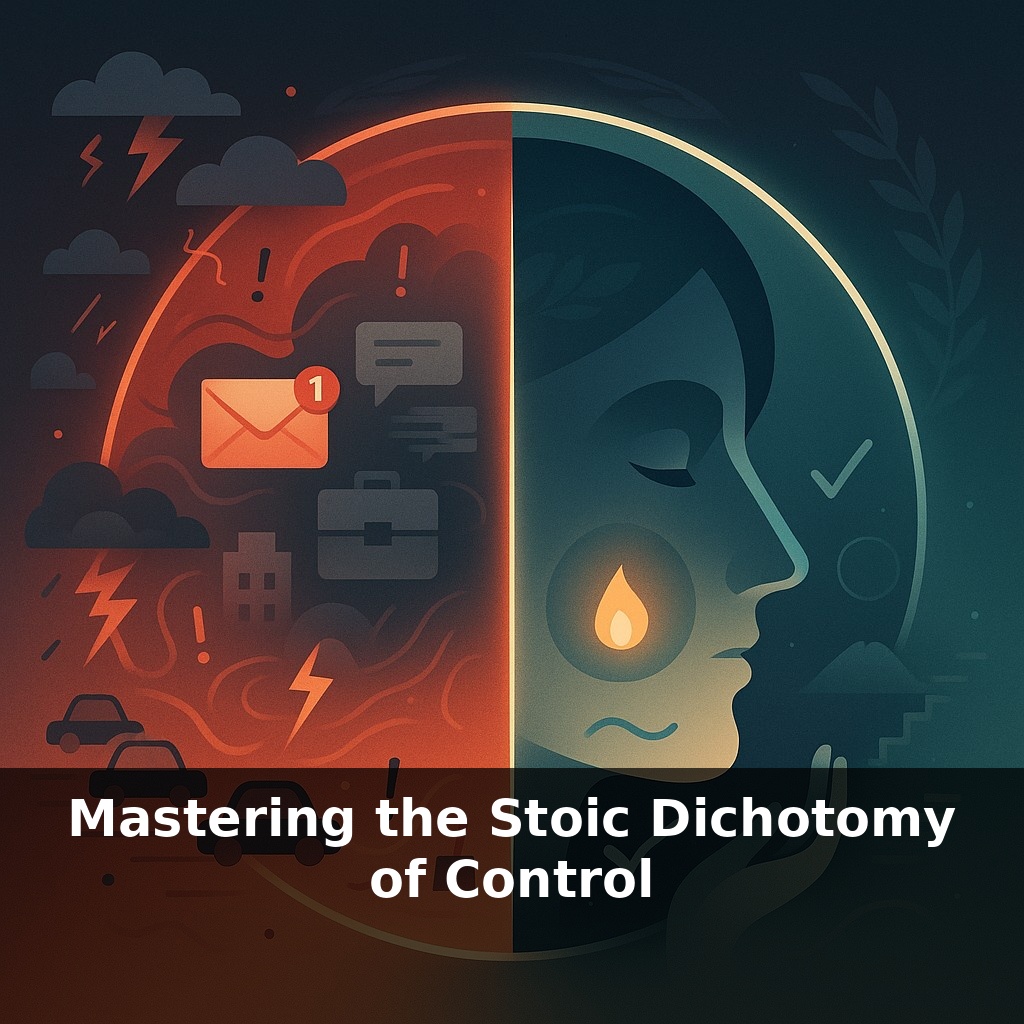
So let’s zoom in on what that hidden habit actually changes in your day. Two people get the same email: “We need to talk.” One spends hours spiraling through worst‑case scenarios, replaying old mistakes like a playlist on loop. The other feels a spike of worry, then quietly asks: “What part of this is mine to do?” Same words on the screen, but one turns it into a courtroom where they’re always on trial, the other into a to‑do list they can act on.
This is the Stoic move: not pretending everything is fine, but sorting each moment into two piles—what’s up to you, and what isn’t—and refusing to bargain with that line. It’s less about being calm and more about being precise. Over time, this precision reshapes how your attention flows through the day, which threats feel real, and which dramas simply don’t get a second audition in your mind.
Most of us treat that inner line—what’s ours vs. not—as fuzzy, negotiable. We say we “know” we can’t control people, traffic, markets, but then argue with them all day in our heads. The Stoics went the opposite direction: they drew that line in ink, then organized their whole life around it. Modern data backs them up. In MRI labs and stress surveys, people who consistently return to “what’s mine to steer right now?” show quieter fear centers and clearer decisions. This isn’t about becoming detached; it’s about building a stable base you can stand on when everything else is moving.
Most people first hear “focus on what you can control” and think, “Fine, I’ll just *try harder* not to care.” That’s not what the Stoics meant, and it’s why the idea often fails in practice. They weren’t preaching apathy; they were doing something more surgical: dividing each situation into layers and assigning responsibility only for the innermost one.
Start with the classic Stoic list of what *is* fully yours: your judgments, choices, and deliberate actions. That’s what Epictetus kept pointing to with *prohairesis*—not vague willpower, but the specific moment you endorse a thought or intention. The email, the traffic, the raised voice in a meeting all hit you as sensations and impressions; *then* there’s a micro‑choice: “What story do I tell about this, and what do I do next?”
Outside that inner ring, everything else is mixed: influenced by you, but not owned by you. Your performance in a job interview? Largely yours. The hiring decision? Not. Your preparation for a difficult conversation? Yours. Whether they forgive you? Not. The Stoic claim is radical because it refuses to slide outcomes back into the “mine” pile, even when they feel tied to your identity.
Modern research maps onto this distinction. People with a strong internal locus of control don’t magically bend reality; they simply keep bringing their attention back to those inner‑ring choices. Over weeks, that repetition shows up physically: in lower amygdala reactivity, in calmer stress scores, in less frantic compensating behavior. You experience fewer “I’m failing at life” moments and more “I didn’t like that result; what’s the next smart move?” moments.
Here’s the tricky part: the mind hates empty space. When you stop rehearsing what you *can’t* control, you need somewhere for that freed‑up energy to go. This is where Stoicism becomes less like a belief system and more like a training regime. You deliberately fill the gap with controllable skills: clearer thinking, better questions, small courageous actions.
Think of your attention like a thermostat in a smart home system: you choose the target temperature—your standards for effort and integrity—then keep adjusting your own settings, even as the outside forecast ignores your preferences. Over time, the habit of checking the “settings” instead of screaming at the “weather” becomes its own form of quiet power.
You can see this most clearly in ordinary, slightly uncomfortable moments. You send a carefully worded message and watch the “typing…” bubble appear, then disappear. Instantly, your mind drafts narratives: “They’re annoyed,” “I messed up,” “This will blow up later.” That fork in the road—keep predicting, or return to what’s actually yours—is where the practice lives.
Or take a quarterly review where your manager sounds lukewarm. One path: replay the conversation for hours, trying to retroactively control how they see you. Another: extract the specific behaviors mentioned, turn them into skills to improve, and let their private opinion be exactly that—private.
Same with health. You can’t command perfect lab results, but you can govern your training schedule, your sleep, your nutrition. Investors face it too: you don’t command markets, you command your research process and risk choices. Over time, the “mine / not‑mine” sorting becomes less like self-help and more like a quiet operational rule for running your life.
In a few years, your “sense of control” may be as trackable as your steps or heart rate. Early apps are already pairing neurofeedback with control-maps that light up when you mentally grab at outcomes, like a dashboard warning when you redline an engine. As these tools mature, leaders could rehearse high‑stakes talks with live control‑load readouts, course‑correcting in real time instead of post‑mortem guesswork about what derailed them.
Notice how this split between “mine” and “not‑mine” quietly reshapes identity. You stop auditioning for every passing opinion and start acting more like a careful coder refactoring old scripts: keeping what runs cleanly, rewriting what crashes you. Over time, the question “What’s truly up to me here?” becomes less a mantra than a default lens.
Start with this tiny habit: When you catch yourself worrying about something in the future (like an email reply, a meeting, or someone’s opinion), quietly say out loud or in your head, “Not up to me,” and then move just your attention to the very next physical action you *are* doing (like feeling your feet on the floor or your fingers on the keyboard). Each time, tag it with: “This is up to me.” Don’t try to fix the whole worry; just practice that tiny switch from “not up to me” to noticing one thing that is.