About half of what stresses you today won’t matter a year from now—yet your body reacts as if it’s an emergency. Stuck in traffic, side‑eying your bank app, replaying that awkward meeting… your mind is training itself. The only question is: training for what?
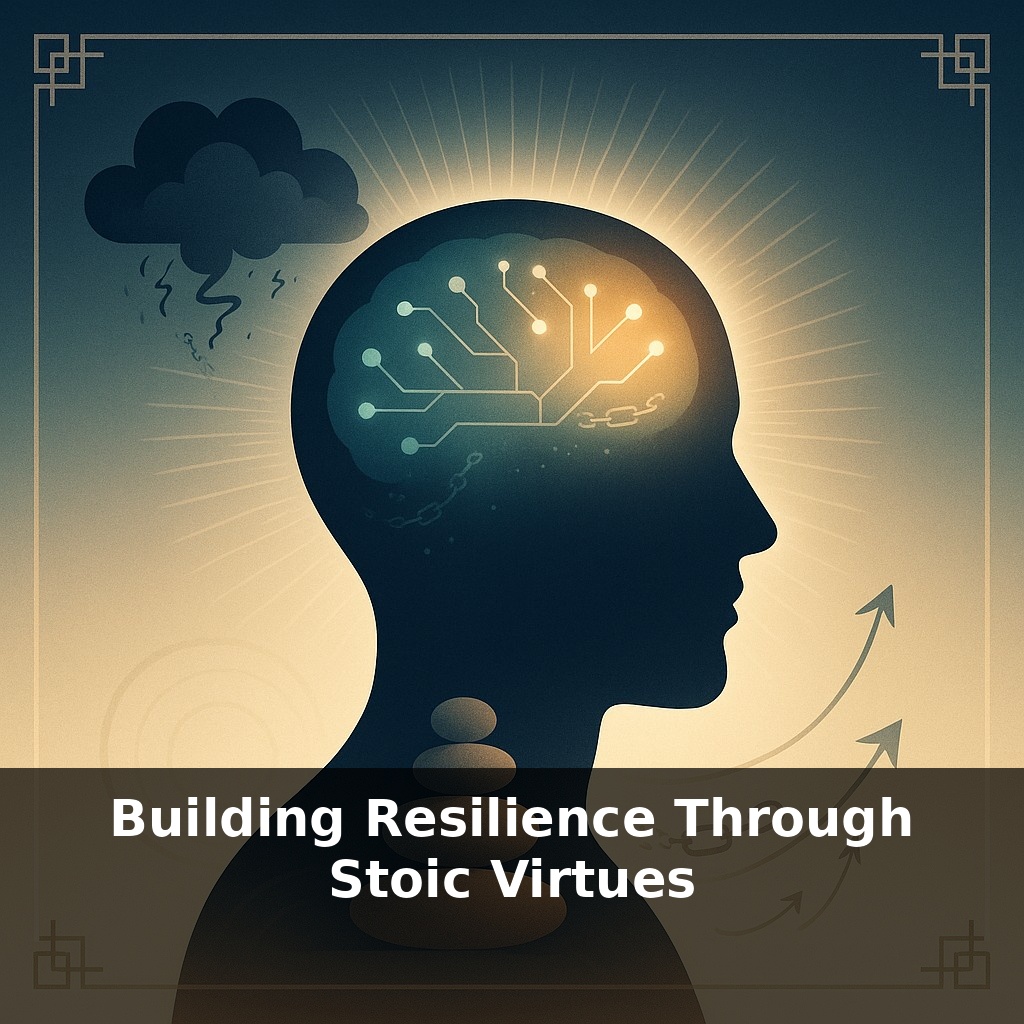
Neuroscientists can now watch resilience being built in real time. In one study, people practiced a simple re-framing exercise for just 20 minutes a day over two weeks; their brains showed measurable changes in regions linked to emotional regulation, and their reported distress dropped by nearly 30 %. The Stoics were doing the same thing—minus the lab coat and fMRI. They weren’t chasing “peace” as a mood, but training four specific capacities: wisdom to see clearly, courage to act under threat, justice to stay fair under pressure, and temperance to hold the line when impulses surge. Modern psychology has different names for these, but the result is the same: people who deliberately practice them don’t just feel better; they recover faster, choose better, and crack less under the same pressure that breaks others.
Therapists now translate these virtues into concrete drills. One study found that writing a brief daily reflection on a difficult event and your response to it cut rumination scores by 27 % in a month. Value‑based goal setting shows similar effects: when people tie one small action per day to a core value, persistence on hard tasks rises by about 20–30 %. Even five minutes matters. A 2019 trial had participants do a short evening review plus one planned “virtuous” action next day; after three weeks, they reported fewer impulsive decisions and more follow‑through on what actually mattered.
CBT’s founder, Aaron Beck, openly credited Epictetus for the core move you’ll practice here: step back from the first reaction, examine the thought, then choose a better one. That’s where the four Stoic virtues stop being abstract labels and start becoming a practical operating system.
Think of them as four “levers” you can deliberately pull in difficult moments. Each lever maps to skills psychologists now measure and train.
Start with wisdom as pattern-recognition. In one 2018 study on “cognitive reappraisal skill,” participants who could generate at least 3 alternative interpretations of a stressful event in under 2 minutes showed about 35 % lower negative affect when hit with new stressors. A Stoic way to build this: after a setback, force yourself to list 3 other possible stories than your default one. Not “positive spin,” just plausible alternatives.
Courage shows up today as approach behavior under threat. Exposure therapists use graded steps: you do the easiest scary thing first, then the next. Research on exposure-based protocols suggests that 8–12 sessions can cut specific phobias by 60–80 %. Stoic practice mirrors this with voluntary discomfort. You deliberately do one controlled, honest difficulty each day—saying the thing you’re avoiding, taking the cold shower, making the tough phone call—so your brain stops treating discomfort as a stop sign.
Justice appears in studies on prosocial behavior and well-being. Large surveys (like the World Values Survey) consistently find that people who rate “fairness” and “service” as central to their identity report higher life satisfaction, even when controlling for income. For a Stoic, acting justly isn’t a bonus; it’s a stabilizer. When you anchor decisions to “What’s fair to all sides?” you reduce the mental noise of regret and second-guessing.
Temperance aligns with impulse control. In delay-discounting experiments, people who can consistently choose a $100 reward next month over $60 today tend to have better health markers and financial stability. Stoic temperance drills—like setting a 10-minute delay before any tempting but questionable action—train that same circuitry.
Pulling these four levers repeatedly doesn’t numb you; it makes you a more precise instrument under pressure.
A practical way to see these virtues in action is to tie each one to a tiny, countable behavior. For wisdom, pick one recurring frustration—say, email overload—and for 7 days, write down exactly 3 different useful ways to interpret that situation before you respond. By the end of the week, you’ll have 21 alternatives to your usual story, and likely at least 2–3 concrete process tweaks you wouldn’t have seen otherwise. For courage, choose a single “micro‑exposure” that takes under 5 minutes: initiating a hard conversation, asking a direct question in meetings, or sharing an honest opinion once per day. Track how many reps you do; aim for 5–10 in a week. For justice, commit to one specific act of fairness daily—crediting a colleague’s idea in front of others, or dividing speaking time equally in a 30‑minute call. For temperance, set one numeric limit—for example, 20 minutes of social media at night—and keep score for 10 days. Your wins and misses are your training data.
Your challenge this week: run a 7‑day “virtue audit” on your digital life. Day 1–2, tag each app you open with one primary virtue it supports or undermines. Day 3–4, delete or time‑cap 1 app that consistently pulls you away from your chosen virtues. Day 5–7, design a 10‑minute “virtue block” on your calendar—1 concrete act aligned with each virtue. At week’s end, keep only the practices you’d be willing to repeat for 30 days.
Treat this as a long game. Studies on habit formation suggest 66 days is a realistic average to lock in a new pattern. So choose just 1–2 virtue drills and commit to 10 weeks of practice. Put them in your calendar, track at least 70 total reps, and review every 14 days. Consistency, not intensity, is what quietly rewires how you show up under pressure.
Start with this tiny habit: When you notice your mind start spinning about something you can’t control (like a colleague’s reaction, the news, or traffic), quietly say to yourself, “Control / No control,” and move just one worry into the “No control” bucket. Then, take one slow breath and decide on a single tiny thing you *can* do next (like sending one email, standing up to stretch, or filling your water glass). This 10-second pause is you practicing Stoic wisdom and courage in real time, not in theory.