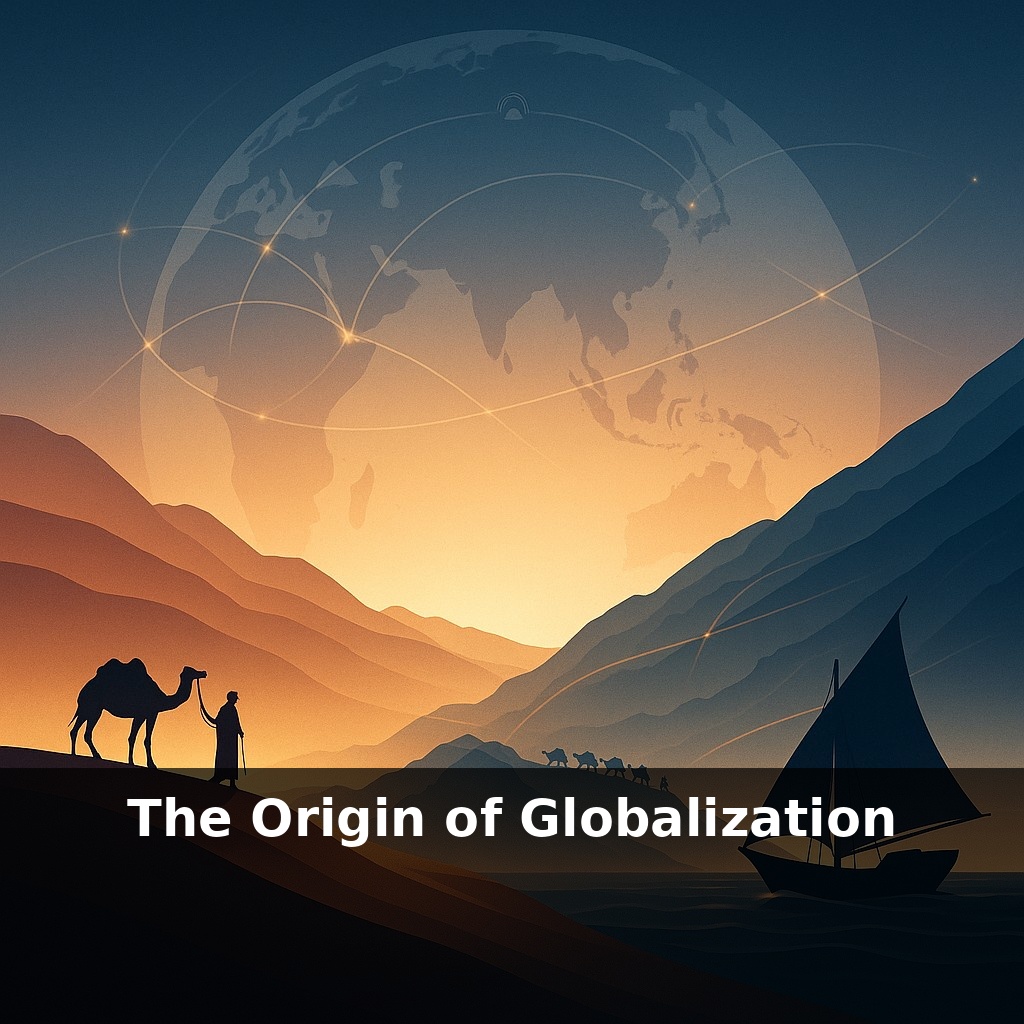
Camels kneel at dawn in the Sahara, a Chinese caravan slips through a mountain pass, and a sailor in the Indian Ocean waits for the monsoon wind. Here’s the twist: this isn’t three stories. It’s one system—and it began shaping your life long before nation‑states existed.
Your phone buzzes with a notification from across the world and it feels instant, natural, almost trivial. But the habit behind that buzz—reaching far beyond your neighborhood for something you want—was trained into humans thousands of years ago. Long before stock exchanges and streaming platforms, people were already obsessed with distant marvels: pepper that burned the tongue in Rome, lapis lazuli that colored temples in Egypt, incense that perfumed altars in Mesopotamia.
Think of a crowded street market today: voices overlap, scents collide, strangers brush past. Now stretch that market across continents and centuries. In this episode, we’ll trace how scattered local exchanges gradually stitched together into the long-distance links that made later global empires—and, eventually, your everyday life—possible.
To see how early this story starts, follow the trail of “impossible” things turning up in the wrong places. Chinese silk buried in a Germanic grave. Roman coins washed up in southern India. West African gold dazzling courts in North Africa and the Middle East. Each object is a breadcrumb from a journey no single traveler ever completed, passed hand to hand like a relay baton. Some traveled in royal caravans, others in the packs of obscure merchants, but together they reveal a quiet revolution: communities learning to depend on faraway strangers for the things they desired most.
Stand at any one point on those early routes and the world still looks local. A farmer in the Ganges valley grows pepper for a nearby town. A herder in Central Asia trades a horse for grain in the next oasis. What turns these small, local decisions into something much bigger is the moment people start betting on places they have never seen.
That bet begins with **technologies of movement and memory**. The camel saddle (perfected in Arabia by the first millennium BCE) suddenly makes it economical to move heavy loads across brutal deserts. In Central Asia, compact, sturdy horses bred for endurance carry riders who can cover astonishing distances. On the seas, small tweaks to hull design and the lateen sail let ships tack against the wind rather than wait helplessly for it. These aren’t flashy inventions like steam engines; they’re quiet upgrades that make each journey slightly less risky, slightly more profitable.
Alongside them grow **technologies of trust**. Standardized weights and measures appear in marketplaces from Mesopotamia to the Indus. Seals stamped into lumps of clay or wax act like signatures, guaranteeing whose goods these are. Much later, in the Indian Ocean, merchant families in places like Gujarat and Aden write letters of credit so a partner can pick up cargo in a distant port without hauling chests of silver. You could call it early paperwork, but for traders, it’s more like a portable reputation.
States notice. Rulers tax this movement, protect it, and sometimes hijack it. The Han dynasty posts troops at key Silk Road passes; the Kushan kings in Central Asia mint coins that imitate Roman styles to reassure foreign merchants; Axum in Ethiopia builds a port at Adulis that plugs inland African routes into Red Sea shipping. Each power tries to bend the traffic its way, but none fully control it. When one route becomes dangerous or overtaxed, caravans simply detour, rewarding more tolerant cities.
All of this reshapes culture as much as commerce. Buddhist monks ride merchant networks from India into Central Asia and China; Islamic scholars later crisscross the Sahara with traders; artistic motifs—from vine scrolls to haloed saints—jump religions and languages as artisans borrow what sells. The result is not a single, unified culture, but a growing familiarity with foreignness itself: distant gods, fabrics, and flavors becoming part of everyday talk.
Stand at a port like ancient Muziris in south India or Alexandria in Egypt, and you’d hear globalization in sound before you ever saw it: dockworkers shouting in different languages, brokers switching tongues mid‑sentence, scribes copying prices and debts in multiple scripts. Pepper might be weighed in one system, taxed in another, and paid for with coins stamped with a foreign king’s face.
Consider how taste itself becomes a record of connection. A Roman banquet table loaded with black pepper from India, glassware echoing Near Eastern styles, and perhaps a sauce using fermented fish inspired by Greek methods is really a collage of distant experiments. In China, craving for aromatic resins from Arabia and East Africa quietly reorients trade priorities, the way today a new gadget can reroute entire supply chains.
Now zoom in on the people who live between worlds: translators, caravan guides, ship pilots who know the reefs by heart. Their memories—of safe harbors, honest partners, dangerous clans—are as critical as any map, an unwritten archive steering what moves where.
Today’s tools—AI, fiber‑optic cables, satellite chains—play a similar role to those quiet ancient upgrades, but at blistering speed and scale. A glitch in an undersea cable can ripple like a sudden frost through harvests of data, stunting whole digital “crops” of transactions and messages. Your challenge this week: trace one everyday item you use back two steps in its supply chain, then ask which invisible links—and failures—you’re currently betting your life on.
Globalization’s roots are less a single road and more a slow‑growing web. With each new route, a fresh thread appeared: shared myths of distant riches, hybrid recipes, blended rituals. Like colors bleeding together on a wet canvas, these contacts didn’t erase local identities—they layered them, creating a world where “far away” steadily moved closer.
Here’s your challenge this week: pick one product in your home that clearly reflects modern globalization (for example, a smartphone assembled in China with rare earths from Africa and design from California), then spend 30 minutes tracing at least three steps of its global journey using labels, company websites, and trade data tools like UN Comtrade or the Observatory of Economic Complexity. Map those steps on a simple world map (paper or digital), marking where resources come from, where assembly happens, and where the company is headquartered. Finally, write a 3–4 sentence “origin story” for that product in plain language that you could read aloud to a friend to explain how centuries of trade, empire, and technological change made that item possible.