Right now, when a factory in one country pauses for a day, workers on the other side of the planet can lose their jobs. A coffee you buy, a phone you upgrade, even a movie you stream—each depends on strangers in places you may never visit, quietly steering your economy.
So in this episode, we zoom out from daily headlines about tariffs, chip bans, or shipping delays and ask a deeper question: how did we end up with an economy where a policy speech in Washington can nudge interest rates in Lagos, or a port closure in Asia reshapes job prospects in Poland? Behind these links lies a long history of countries specializing, negotiating rules, and building institutions to make cross-border exchange less risky and more profitable. That history is not just about abstract “markets”; it’s about barges and broadband, container ships and code, colonial legacies and Cold War rivalries. As we trace that story, we’ll see how decisions made decades ago still echo in the price of your groceries, the security of your paycheck, and the bargain your government strikes between efficiency and resilience.
To make sense of today’s tangle of connections, we’ll move in three steps. First, we’ll trace how technologies—from telegraphs to fiber-optic cables—shrunk distance and made it normal to launch a product in multiple countries at once. Then we’ll follow the money: how cross-border lending, currency markets, and investment funds linked household savings in one country to factory floors in another. Finally, we’ll zoom in on the turning points—crises, trade deals, and political shocks—that periodically rewired who depends on whom, and on what terms.
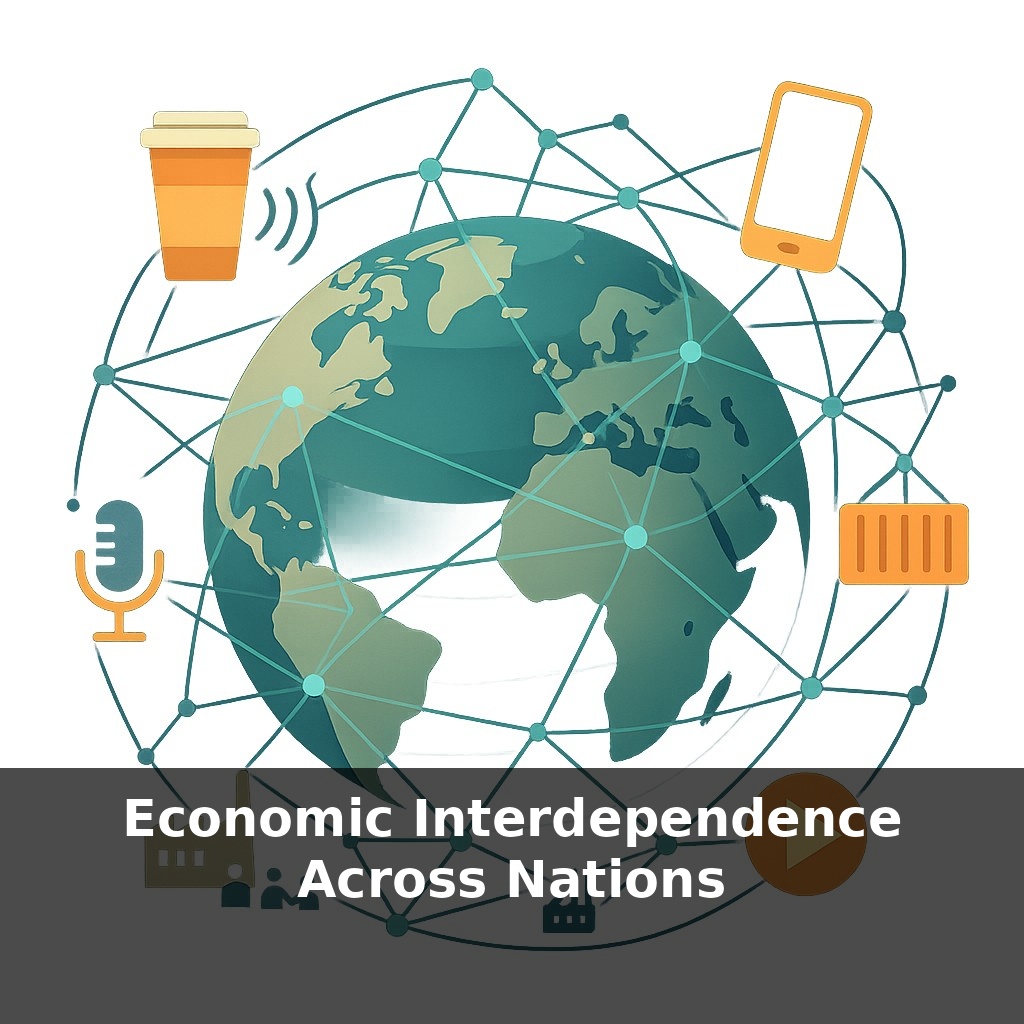
Walk into almost any factory making phones, cars, or even sneakers, and you’re really stepping into a global choreography. A typical smartphone might rely on rare earths from Africa, design teams in California, assembly in Vietnam, testing in South Korea, and logistics software written in India—none of which belong to a single firm or even a single country. What ties them together isn’t just trade; it’s an intricate pattern of contracts, standards, and expectations that economists call global value chains, or GVCs.
These chains exist because of comparative advantage, but not in the old textbook sense of “one country makes cloth, another makes wine.” Now, countries specialize in slices of production: chip design, precision machining, legal services, digital advertising. Roughly 70% of what crosses borders today are not finished goods, but parts, components, and machines that will be used to make something else. When a car plant shuts down for lack of a $5 sensor, that invisible 70% suddenly becomes very visible.
Finance layered on top of this trade web has deepened the ties. A pension fund in Canada might own bonds issued by a Brazilian infrastructure firm that depends on steel imports from Turkey. A policy rate change by the European Central Bank can alter borrowing costs for firms in Nairobi within hours as investors rebalance portfolios. Capital doesn’t just chase higher returns; it also carries risk in both directions, amplifying booms and transmitting crises.
Technology has done something similar for services. The quiet expansion of undersea cables and cloud data centers means that tasks once locked inside national borders—radiology reads, software updates, customer support—now move almost as easily as emails. Services have grown from 9% of world trade in 1970 to nearly a quarter today, and that understates their role, because so many “goods” depend on embedded services like design, logistics, and finance.
This dense lattice of trade, finance, and technology has had dramatic consequences. Participation in GVCs helped more than half of developing-country exporters plug into larger markets, contributing to a historic reduction in extreme poverty since 1990. Firms exposed to foreign competition and export markets tend to be 15–25% more productive than those serving only local customers, as they adopt better management, upgrade technology, and meet tighter standards.
Yet these gains come with strategic vulnerabilities: a pandemic, sanctions, or cyberattack in one node can cascade quickly. That’s why governments now debate “friend-shoring,” export controls, and industrial policies that favor resilience over pure efficiency. The paradox is that the very networks that made growth faster and cheaper have also made disruption more contagious.
Your challenge this week: pick a single everyday item you use—your laptop, your T‑shirt, or your morning coffee. For seven days, trace one new layer of its international story each day. Day 1, find where it was assembled. Day 2, dig into where one key input likely came from. Day 3, look up which company financed or branded it. Day 4, check what software or services it relies on. Day 5, find a recent news story about a policy or crisis that could affect it. Day 6, map at least three countries tied to that object. Day 7, ask yourself: if one of those countries faced a major shock, how would this small part of your life change?
Keep notes. At the end, you won’t just “know” that economies are intertwined; you’ll have a concrete map of how your own routine is stitched into distant decisions, workers, and risks.
Open your banking app and scroll through your recent purchases. Each line is a clue. That streaming subscription might route your payment through an Irish subsidiary, report earnings in the U.S., and pay royalties to a studio with investors in Singapore. A ride-hailing trip can link a driver in your city to servers in another continent and a venture fund halfway around the world. Even a simple grocery run now quietly triggers foreign currency trades, licensing fees, and risk calculations by insurers and logistics firms you’ll never meet.
To see how deep this goes, think about a delayed package. It’s not just “stuck in transit”; it might be waiting for customs clearance governed by one treaty, inspected under safety rules set by another, and repriced because an algorithm just updated fuel surcharges after an event thousands of miles away. One small delay is really dozens of microscopic negotiations unfolding in real time—most of them invisible unless you know where to look.
Geopolitics is now tugging at the same threads that technology just finished weaving. As countries race for chips, vaccines, and green tech, interdependence is turning into leverage: export bans, data restrictions, and subsidy battles quietly reshape who depends on whom. Climate goals add another twist—solar panels, battery minerals, and carbon border taxes may redraw trade maps as sharply as past wars did, but through spreadsheets and standards instead of tanks and trenches.
Where this goes next isn’t scripted. New tools—AI, 3D printing, green tech—can both tighten and loosen ties, like new paths worn across an old city. Some streets will fade; others will turn into highways of ideas, talent, and capital. As those routes shift, every policy choice becomes less a wall or a bridge, and more a bet on which future neighbors you’ll rely on.
Before next week, ask yourself: 1. “Looking at one product I use every day (like my phone, coffee, or clothing), how many countries’ labor, resources, and regulations are actually embedded in it—and how would my choices change if I really saw those links?” 2. “If a trade shock hit one of the key countries my job, investments, or community depends on (say China for electronics or Brazil for commodities), where in my own life would I feel that impact first, and what’s one concrete step I can take today to reduce that vulnerability?” 3. “Given what I now know about supply chains and global value chains, is there one purchase or financial decision I can make this week that better aligns with my values about fair labor, environmental standards, or economic resilience—and what specific information do I still need to make that choice confidently?”