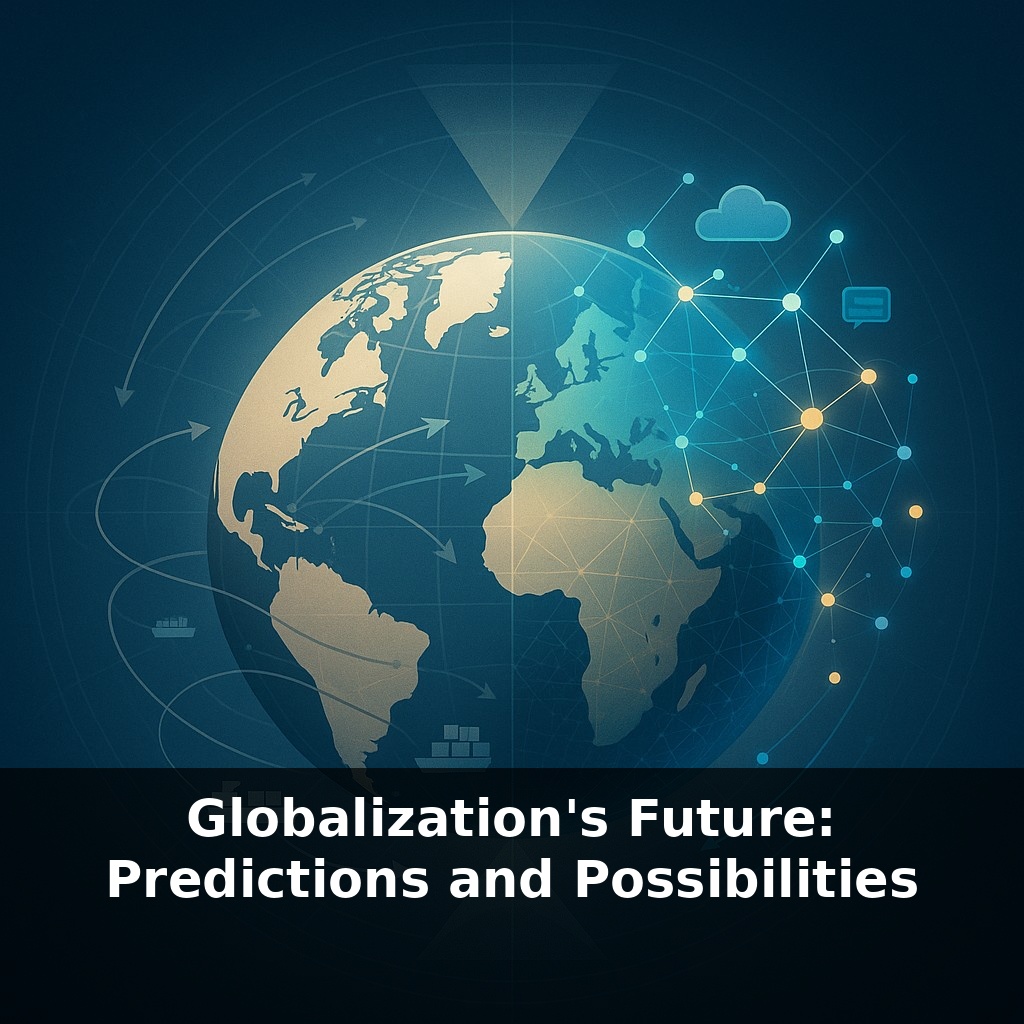
About half of everything traded in the world now passes through global value chains—yet many people say “globalization is over.” So how can it be both shrinking and expanding? In this episode, we step into that tension and explore what globalization’s next chapter might really look like.
Services are now racing ahead of goods in global trade—growing about 60% faster since 2015—yet most people still picture containers on ships when they hear “globalization.” In this episode, we zoom in on that quiet shift and ask what happens when the world’s connections move from steel and plastic to code and carbon footprints. We’ll explore why a handful of superstar exporters still dominate, and how digital platforms might finally crack that concentration. We’ll follow supply chains as they bend into more regional shapes, stitched together by over 3,600 trade agreements rather than one big global deal. And we’ll trace how climate policy, tech innovation, and shifting power are nudging us toward a more “sustainable globalization” that doesn’t end the story, but redraws its map—less about offshoring everything, more about redesigning how we trade, produce, and cooperate.
Power in this new phase won’t just flow from who makes the most stuff, but from who sets the rules and owns the infrastructure behind those flows. Think standards for carbon accounting, control over cloud servers and undersea cables, or influence in writing the fine print of digital trade rules. A software update in one country’s privacy law can now reshape business models on another continent. And as governments subsidize green industries and critical tech, some “national security” priorities will sit uneasily beside the promise of open, borderless exchange.
Here’s the twist: even as headlines scream about “decoupling” and “deglobalization,” cross‑border data flows now grow faster than trade in goods, and climate policy is quietly becoming trade policy. The next phase isn’t fewer connections; it’s different kinds of connections, running on different rules.
Start with who participates. Today, the top 1% of exporters still control more than half of world exports—but that grip is under pressure. A craft studio in Nairobi selling 3D‑printed jewelry via an online marketplace, or a two‑person fintech startup in Bogotá writing code for a bank in Madrid, are tiny in volume yet huge in what they signal: a long tail of new entrants enabled by e‑commerce, digital payments, and remote work. As more small firms plug into cross‑border services, the map of winners and losers inside countries may shift—less about a few giant exporters, more about whether millions of smaller players get reliable internet, digital skills, and fair platform rules.
Next, look at *what* moves. Even in a service‑heavy world, trade will still run on copper, cobalt, rare earths, and fiber‑optic glass. The push for electric vehicles, data centers, and renewable grids is turning minerals into the new oil—strategic, contested, and politically sensitive. Countries from Indonesia to Chile are asking not just to export raw materials, but to host battery plants, refineries, and data infrastructure. That could lock in new forms of dependency or open paths to more balanced development, depending on how bargains are struck.
Then, consider *how* rules are enforced. Border tariffs are only one lever now. Governments are experimenting with carbon border adjustments, cybersecurity requirements, data‑localization demands, and product‑design mandates that effectively export their regulatory choices abroad. A climate rule in Brussels can reshape factory investments in Vietnam; a data law in Delhi can influence where a U.S. firm builds its next server farm.
If the 1990s were about “more trade, cheaper stuff,” the coming decades are more likely to ask: *trade with whom, under whose rules, and at what planetary cost?* The answers will determine whether this updated system feels like a widening of opportunity or a new layer of invisible walls.
A Kenyan telemedicine startup treating patients in Europe over encrypted video, paid instantly through a global fintech app. A Vietnamese game studio releasing a hit title on app stores worldwide, updating it overnight in response to player data. A Portuguese firm renting out excess solar power capacity to a neighbor country through a real‑time digital marketplace. These are the kinds of cross‑border ties that signal where globalization is heading next.
On the sustainability front, large apparel brands are experimenting with tagging garments with unique digital IDs, so a shirt can be tracked from cotton field to recycling plant. That makes it easier to reward suppliers with lower emissions—or cut ties when abuses surface. Meanwhile, cities rather than national capitals are striking their own climate and data‑sharing pacts, linking ports, transit systems, and power grids into informal networks that matter as much as some treaties.
Analogy: like a forest that looks still from afar but is alive with roots, fungi, and nutrients exchanging below the surface, the next model of globalization will be dense, local‑to‑global, and hard to map with old trade charts.
Boards and citizens will face trickier choices: do you buy from the cheapest bidder, or the one whose factories you’d accept next door? Expect “traceability” labels—on data, energy, and minerals—to matter like nutrition labels on food. Young workers may stitch careers across time zones rather than employers, treating countries like project hubs. Politics will lag, then lurch, as voters notice their pensions, power bills, and job ads all depend on distant code and contested copper.
As these shifts unfold, the fault lines won’t just run between countries but within them—between workers who can “export” skills from a kitchen table and those tied to shrinking local markets, between cities wired like global train stations and regions left as sidings. The open question is whether the next phase stitches these gaps or quietly hardens them.
Start with this tiny habit: When you open a news app or social feed, pause and search for one headline that mentions “supply chain,” “reshoring,” or “trade tensions,” and tap it instead of your usual default story. While you read just the first two paragraphs, quickly ask yourself: “Who wins from this change in globalization, and who loses?” If a country or company is mentioned (like Vietnam, Mexico, or TSMC), take 10 seconds to mentally note how their role in the global economy is shifting. Over time, this tiny swap will train your brain to automatically spot the patterns in globalization’s next phase.