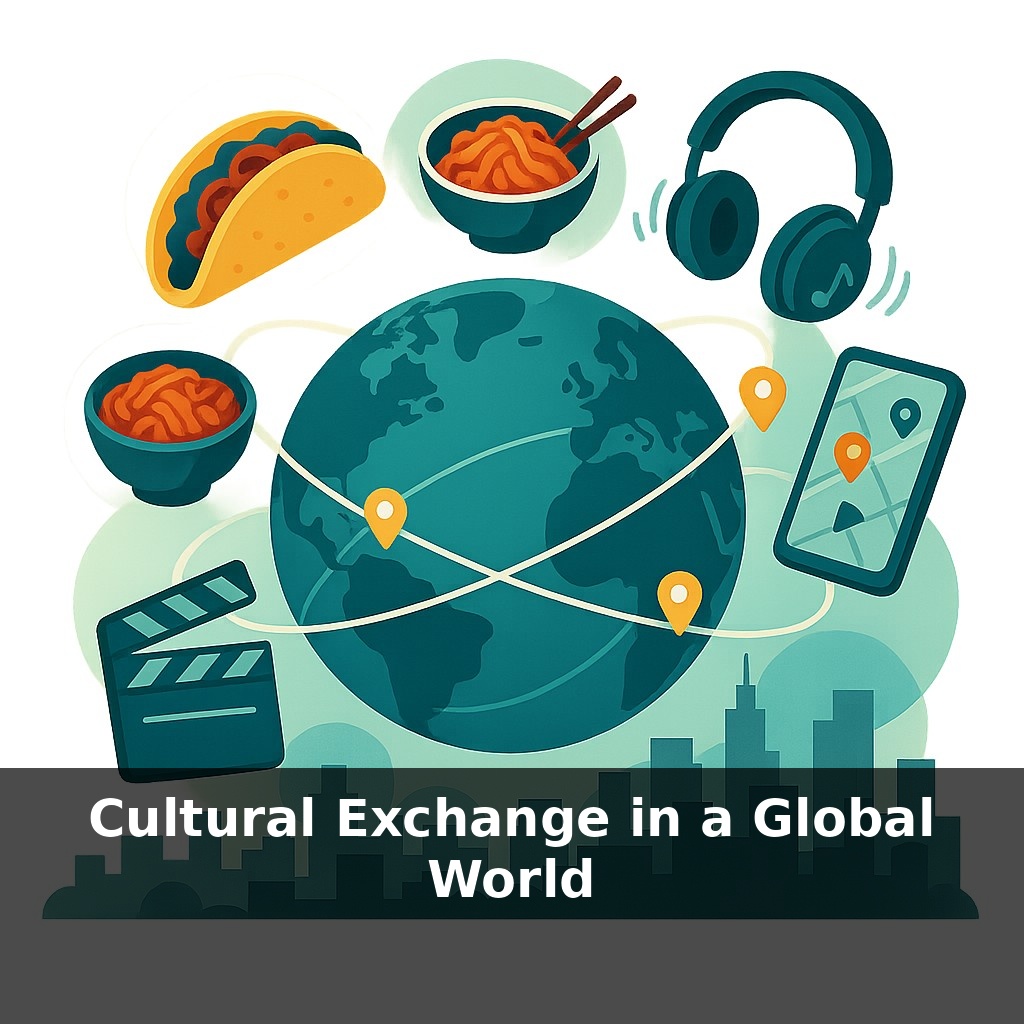
A song in Korean tops charts in Brazil. A Mexican taco truck in Berlin serves kimchi fillings. A Nollywood film trends in London. None of this is an accident. In a world wired together, cultures aren’t blending into one flavor—they’re exchanging recipes in real time.
Step off a plane, open your phone, and you’re already “there” and “elsewhere” at once. Your map app suggests a Syrian restaurant in a Scandinavian city. Your timeline queues up a Senegalese producer remixing a Japanese game soundtrack. None of this feels exotic anymore—it’s just Tuesday.
What’s changed isn’t only the volume of cross‑border traffic, but who gets to participate and on what terms. Migrants carry hometown habits into new neighborhoods, tourists chase “authenticity” yet leave subtle footprints behind, and streaming platforms quietly rewrite what counts as mainstream. A dance challenge born in Lagos can shape style in Los Angeles before local radio even catches up.
In this episode, we’ll follow these paths of movement—people, products, and platforms—to see how they carve channels where new cultural currents flow.
Zoom in on the numbers and the patterns sharpen. Those 281 million people living outside their birth countries don’t just send remittances; they re‑stock neighborhood shelves with spices, snack brands, and stories. The 1.4 billion annual tourists don’t just pose for photos; they trigger new café menus, street signs in extra languages, and side gigs as local guides. Meanwhile, recommendation algorithms quietly ferry a Turkish drama into a Peruvian living room, or a Chilean gamer’s stream into a Thai dorm. And as all this happens, UNESCO’s list of living traditions grows—proof that, even amid constant remixing, roots still matter.
Stand in any big-city supermarket and scan the shelves: Korean instant noodles beside Italian pasta, Nigerian cassava flour near American pancake mix, Japanese soy sauce next to Mexican salsas. That aisle is a quiet record of countless negotiations—who tried what, who liked it enough to reorder, who tweaked it to fit a different kitchen.
The key pattern isn’t replacement but layering. When hip‑hop lands in France, it doesn’t just copy U.S. lyrics; it mutates into French rap that weaves in local slang and politics. When Bollywood borrows Hollywood’s superhero template, it adds song‑and‑dance sequences and regional mythologies. These aren’t side effects of globalization; they’re its main engine. Cultural traffic becomes raw material, not a finished script.
Digital networks speed this up and also flip old hierarchies. For decades, Hollywood studios and Western labels decided what “traveled.” Now, a K‑Pop group can debut choreography on YouTube, watch fans in Chile and Egypt post response videos within hours, then fold that feedback into the next tour. Brazilian funk DJs remix Angolan kuduro rhythms; South African amapiano producers sample U.S. R&B vocals and send them back onto American dance floors. Influence moves sideways and diagonally, not just from “center” to “periphery.”
Yet hybrid success usually depends on reading local context precisely. Global fast‑food chains redesign menus country by country: paneer burgers in India, teriyaki flavors in Japan, plant‑based options in northern Europe. Netflix quietly adjusts subtitles, dubbing styles, and promotional art so the same series feels familiar in São Paulo, subtle in Seoul, edgy in Madrid. The product travels; the packaging speaks local.
Meanwhile, states and communities are not passive. Governments fund film funds, translation grants, and music export offices to push their stories outward, while festivals, language schools, and heritage days invite others in on their terms. UNESCO listings often spark new pride—and new businesses: traditional weaving co‑ops selling online, food tours built around old recipes, youth groups reviving endangered dances and streaming them for distant fans.
The tension is ongoing: commercial pressure to smooth out differences versus everyday efforts to keep accents, rituals, and small details alive—often by threading them straight into the next global remix.
In São Paulo, a Japanese‑Brazilian chef layers Amazonian fish onto sushi rice and tops it with lime and cilantro; the dish travels via Instagram, then reappears re‑interpreted in a Lisbon pop‑up. In Nairobi, fashion designers cut kitenge fabrics into sharp streetwear silhouettes and ship limited drops to Seoul. A Colombian producer splices Andean flutes into electronic tracks and lands in a gamer’s playlist in Warsaw. These aren’t side notes to “big” global culture—they are the lab where tomorrow’s mainstream is prototyped.
Think of these projects like street art appearing overnight on a blank wall: each new piece partly covers, partly converses with the last, and passersby slowly decide which colors stay. UNESCO listings sometimes show up as motifs in these experiments—a traditional embroidery pattern on a Paris runway, a ritual chant sampled in a climate‑justice anthem—quietly proving that safeguarding and reinventing can happen in the same breath.
As AI subtitles sync voices across languages and VR drops you into distant street parades, “far away” starts feeling like “next door.” Local school projects might pair kids with partner classes abroad to co-create songs, comics, or mini‑films, testing how shared stories emerge. Cities could treat neighborhoods like open studios, funding cross‑cultural residencies the way they fund parks. Your playlist, dinner plate, and newsfeed become draft maps of identities still under construction.
Your daily choices quietly steer this mosaic’s future. A meme you share, a recipe you tweak, a concert you attend—each acts like a small brushstroke on a shared canvas. Your challenge this week: follow one song, dish, or design back through three countries or communities, then ask: what thread could you add next?