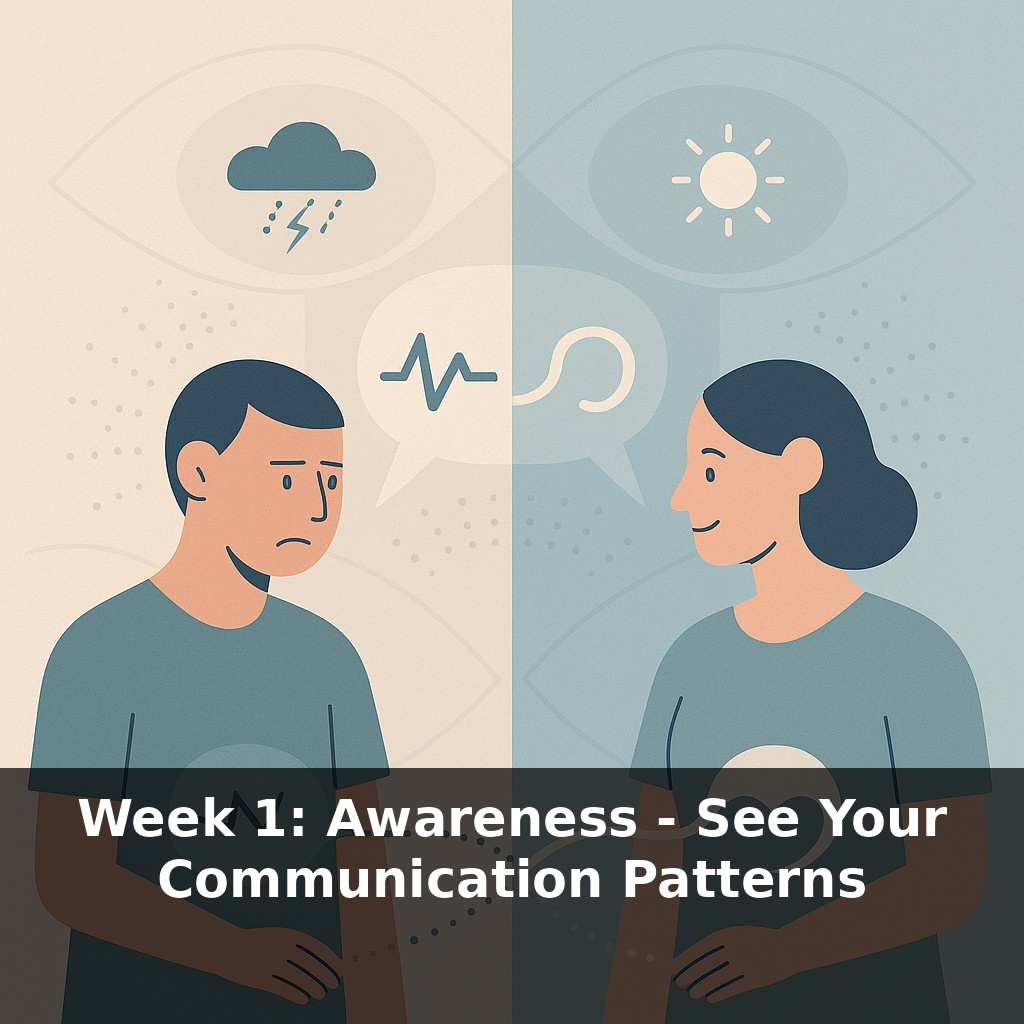
Week 1: Awareness - See Your Communication Patterns
📝 Transcript
You can predict whether a couple will stay together by how they argue—sometimes in just a few minutes. Two people, same topic, totally different futures. One spiral ends in slammed doors; the other in a small joke, a sigh, a reset. Same conflict. Different communication script.
Most people think, “We just need to communicate better,” as if that’s one single skill you either have or don’t. But communication isn’t one skill; it’s a bundle of tiny, repeatable moves you’ve practiced for years—often without realizing it. You already have a “default script” for how you start a sensitive topic, how you respond when you feel misunderstood, how you shut down a conversation when it feels too much.
This week isn’t about fixing anything yet. It’s about getting curious: What’s actually happening in those moments, step by step? We’ll zoom in on the small cues most people overlook—tone shifts, response delays, message timing, the words you always reach for under stress. As you start to notice these micro-moves, you’ll see that your conflicts aren’t random explosions; they’re reruns. And reruns, once recognized, can be rewritten.
Think of this week as running a quiet “system diagnostic” on how you relate to people you care about. We’re not changing settings yet—just seeing what’s actually installed. Research shows that much of what shapes connection happens *before* the obvious tense moment: in how you enter a room, glance at your phone mid-conversation, respond to a delayed text, or decide whether to bring something up at all. These small choices form patterns over time. When you start to notice *where* you speed up, go silent, joke, or deflect, you’re finally looking at the wiring behind the blowups, not just the sparks.
If 60–93% of message meaning rides on non-verbal cues, then most of what you “say” never shows up in your words at all. That silent layer is where many of your relationship habits actually live.
This week is about catching those habits in the wild.
Research on metacommunication—talking *about* how you interact—shows that simply being able to name what you’re doing (“I’m starting to shut down right now”) is a turning point. Not because the moment magically improves, but because you’ve shifted from *being inside* the script to *observing* it. That tiny shift moves you from autopilot to manual control.
To do that, you need raw data, not vague impressions like “we always fight about the same stuff.” Look for repeated *sequences*, not isolated moments. For example:
- You send a message, don’t get a quick reply, feel a spike of anxiety, and then send a sharper follow-up. - Your partner raises a concern, your shoulders tighten, you crack a joke, they get more serious, you get quieter. - A friend offers feedback, you say “it’s fine,” change the topic, then replay the comment for hours in your head.
What matters is the *order*: stimulus → feeling → move. Over and over.
Text and digital channels matter here too. Without tone or facial cues, you may rely on timing, punctuation, or message length as emotional signals (“they answered with one word, they must be annoyed”). Online, your “non-verbal” layer becomes: how fast you respond, whether you use voice notes or walls of text, if you leave people on read, whether you add “lol” to soften a point.
Think of it like debugging an app: you aren’t rewriting the whole codebase this week; you’re logging what actually runs when you press certain buttons. Where do you escalate? Where do you retreat? Where do you try to fix, explain, convince, or smooth over?
You don’t need to judge any of it yet. Curiosity beats self-criticism here. The goal is simple: by the end of the week, you should be able to describe two or three of your go-to sequences in specific, behavioral language—enough that someone else could almost “act out” your usual moves without ever having met you.
Notice where your “script” shows up when nothing dramatic is happening. You ask a partner, “What do you want to do this weekend?” They say, “I don’t know.” What happens next—do you instantly fill the silence with suggestions, quietly resent that they never plan, or drop the topic and later tell yourself they don’t care? That chain is part of your pattern.
Or take digital life: you send a meme to reconnect with a friend you’ve drifted from. They “like” it but don’t reply. Do you send another meme, conclude they’re done with you, or decide to wait until they initiate? Each of those is a well-rehearsed move, not a one-off.
A tech analogy helps here: your reactions are like default app settings. You didn’t consciously choose most of them; they shipped with your history—family, past partners, culture. This week, you’re toggling on the “developer view”: instead of just tapping the screen, you’re watching which background processes start running the second someone hesitates, frowns, or types “can we talk?”
As AI gets woven into daily life, the “developer view” of your relating won’t just live in your head. Tools that read vocal tone, facial tension, or typing rhythm could highlight the exact sentence where a chat starts tilting defensive, like a spell-check underlining emotional risk. In cross-cultural teams, onboarding may include a live “style map” showing how your habits land in other norms, turning what used to be years of trial-and-error into a faster, kinder learning curve.
As you zoom out on these habits, you may notice they’re not just about stress; they also shape how you share good news, ask for help, or show affection. Your “everyday phrasing” becomes a kind of emotional budget—where you invest detail, where you go quiet, where you overspend on reassurance. Awareness is how you start reallocating it on purpose.
Here’s your challenge this week: For the next 7 days, pick one recurring conversation (like your morning check-in with a partner, a daily Slack thread with your team, or bedtime with your kids) and record *exactly* what you say in that same interaction each day—verbatim, right after it happens. Then, at the end of each day, highlight three phrases you repeated or three moments where you interrupted, defended, over-explained, or shut down. By Sunday, circle the ONE pattern that shows up the most and give it a sticky-note name (like “The Fixer,” “The Pleaser,” or “The Lecturer”) and stick it somewhere you’ll see before your next conversation.
Unlock all episodes
Full access to 8 episodes and everything on OwlUp.
Subscribe — $1.99/monthLess than a coffee ☕ · Cancel anytime