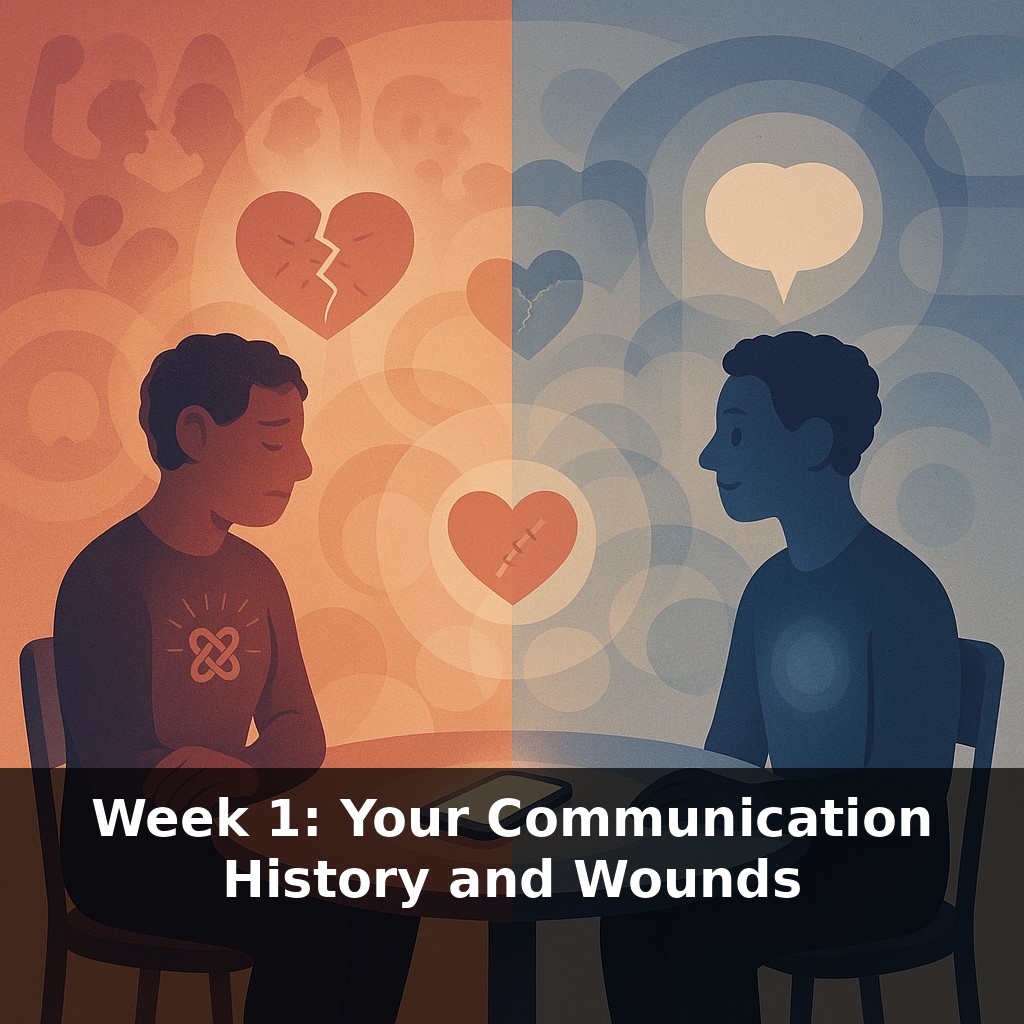
About a third of adults walk into every conversation already braced for hurt—and don’t even realize it. You’re at dinner, your partner glances at their phone, and your chest tightens. Same moment, two people, totally different stories. That gap between reality and story? That’s where we’re going.
Maybe you learned to scan every room for tension because, as a kid, raised voices meant something bad was coming. Or you became the “peacekeeper,” smoothing everything over before anyone got upset. Those patterns didn’t appear out of nowhere; they were smart survival strategies for the environment you grew up in. The problem is, many of us are still using those same strategies in totally different situations—like trying to cook every meal on high heat because that’s how you avoided dinner burning once. This week, we’re not blaming your past or your caregivers. We’re doing something more powerful: tracing the origin story of your communication style, so you can see which habits still protect you—and which ones quietly sabotage your relationships today.
This isn’t about digging up your past just to feel sad or blame anyone. It’s about noticing how specific moments trained your nervous system. Maybe you flinched when adults whispered behind closed doors, so now a partner saying “we need to talk” sends your mind racing. Or praise only came when you were helpful, so you still over-explain, apologize, or rush to fix things in every conflict. Think of this week as opening an old settings menu: we’re not judging what you find, just observing what was installed, who it once served, and whether it still fits the relationships you want now.
Think about the way you tend to show up in hard conversations: do you go quiet and compliant, get sharp and logical, crack jokes, plead your case, or go on the attack? Research suggests these aren’t random quirks—they often map onto how your early relationships wired your expectations.
Attachment researchers talk about three common insecure patterns. If you tilt *anxious*, you may over-communicate, chase reassurance, reread texts, or panic when someone takes too long to respond. If you tilt *avoidant*, you might downplay your needs, keep things “surface-level,” or shut down when anyone gets too emotional. If you’re more *disorganized*, you can feel an intense pull toward closeness and, at the same time, a reflex to push people away the moment conflict appears.
None of these labels are life sentences; they’re working hypotheses about how your younger self tried to stay safe and connected. What matters for this week is noticing how those patterns show up in tiny, practical ways: the words you choose, the timing of your replies, how long you hold eye contact, how quickly your voice gets louder—or smaller.
Here’s where implicit memory comes in. You might not *remember* specific arguments, but your body remembers how it felt to be dismissed, punished, or ignored. That memory can hijack current interactions. A neutral “Can we talk later?” can land like “You’re in trouble.” A simple “No, I’m tired” can sound like “You’re too much” if that was the message you repeatedly absorbed.
Neuroscience adds another layer: every time you react the same way—defend, withdraw, appease—you strengthen that neural pathway. It becomes the default route your brain takes under stress because it’s fast and familiar, not because it’s accurate or helpful.
The encouraging part: those pathways can be changed, but not by force or self-criticism. They shift through awareness plus new, repeated experiences. That starts with tracking *triggers* (specific words, tones, facial expressions) and your *micro-reactions* (tight jaw, urge to explain, impulse to walk away). Instead of assuming “this is just how I am,” you begin to see, “this is how I was trained to respond—and training can be updated.”
Some clues are loud—like slamming doors or yelling. Others are subtle: a sigh before someone answers, a pause before “fine,” a slight eye-roll when you share an idea. Those tiny cues often light up old templates and pull you into familiar roles: fixer, prosecutor, ghost, clown, good child.
Maybe you notice you speak in “softeners”—*just checking, maybe it’s stupid but…*—around confident people, yet sound curt or superior with those who seem unsure. Or you shut down only with authority figures, while staying open and relaxed with friends. Same person, different audience, different script.
Think of it like default keyboard shortcuts on a computer: Control + C always copies, whether you mean to or not. Once you spot which combos trigger which responses—raised voice + late reply = panic, or silence + stiff posture = anger—you can begin to insert a pause and choose a different action, instead of letting your oldest programming hit “send” for you.
Those old scripts don’t just shape one hard talk; they quietly steer careers, parenting, and even how you negotiate money or ask for help. As trauma-informed cultures grow, people who can name their history—and update it—will navigate tension more cleanly. Think of it like rebalancing an investment portfolio: you inherited certain “relational assets” and “debts,” but you aren’t stuck with them. Each small, conscious choice is like redirecting a dollar—over time, the whole picture changes.
You don’t have to excavate every childhood scene to move forward. Start smaller: notice the moment your jaw tightens, the breath you hold, the story that flashes by. Treat each reaction like a breadcrumb, not a verdict. Over time, those crumbs sketch a map. Follow it with curiosity and you’re already walking a different relational path.
Before next week, ask yourself: When I think back to arguments or tense moments in my family growing up, what did I learn—silently or directly—about what was “safe” or “not okay” to say, and how do I still follow those rules today? In my current relationships, when I feel myself shutting down, getting defensive, or overexplaining, what specific words, tones, or facial expressions from the other person seem to trigger that reaction—and what old story from my past might that be tapping into? If someone I trust gently asked, “What communication wound do you most want to heal first?” what honest answer would I give them right now, and what’s one real conversation from this week where I’m willing to experiment with showing up 5% differently?