Right now, your brain can think about four times faster than anyone around you can talk. So here’s the twist: most of your conversations are happening in the gap. In those silent mental margins, are you truly listening—or just quietly preparing your next move?
You’ve already seen how much can leak into those mental margins. This week, we’re going to zoom in on what actually fills that space when someone is talking to you. Is it curiosity—or counterarguments, to‑do lists, quiet resentment, or self‑doubt?
Presence in conversation isn’t just “being nice”; it’s a cognitive skill with real consequences. A phone face‑down on the table, a browser tab quietly blinking, a TV murmuring in the background—each one shaves off a slice of your attention and, with it, a slice of connection. Modern life has normalized this divided focus so much that full attention now feels strangely intense, even intimate.
Think of your attention like a shared bank account for every relationship you care about. Where you consistently invest it, trust accrues. Where you drip it out in fragments, emotional overdrafts appear—misunderstandings, conflict, distance.
Scientists can actually measure what happens when your attention lands fully on someone. In brain scans, regions linked to empathy and language light up more when you stay with a speaker instead of drifting. Heart rates subtly sync. People remember details better, and conflicts de‑escalate faster. In hospitals and call centers, simple changes—like removing background screens, training steady eye contact, and pausing before responding—have boosted trust scores and satisfaction. Yet most of us still treat presence like a luxury, not a practice. This week, we’ll treat it as trainable: something you can deliberately strengthen, rep, and refine in everyday conversations.
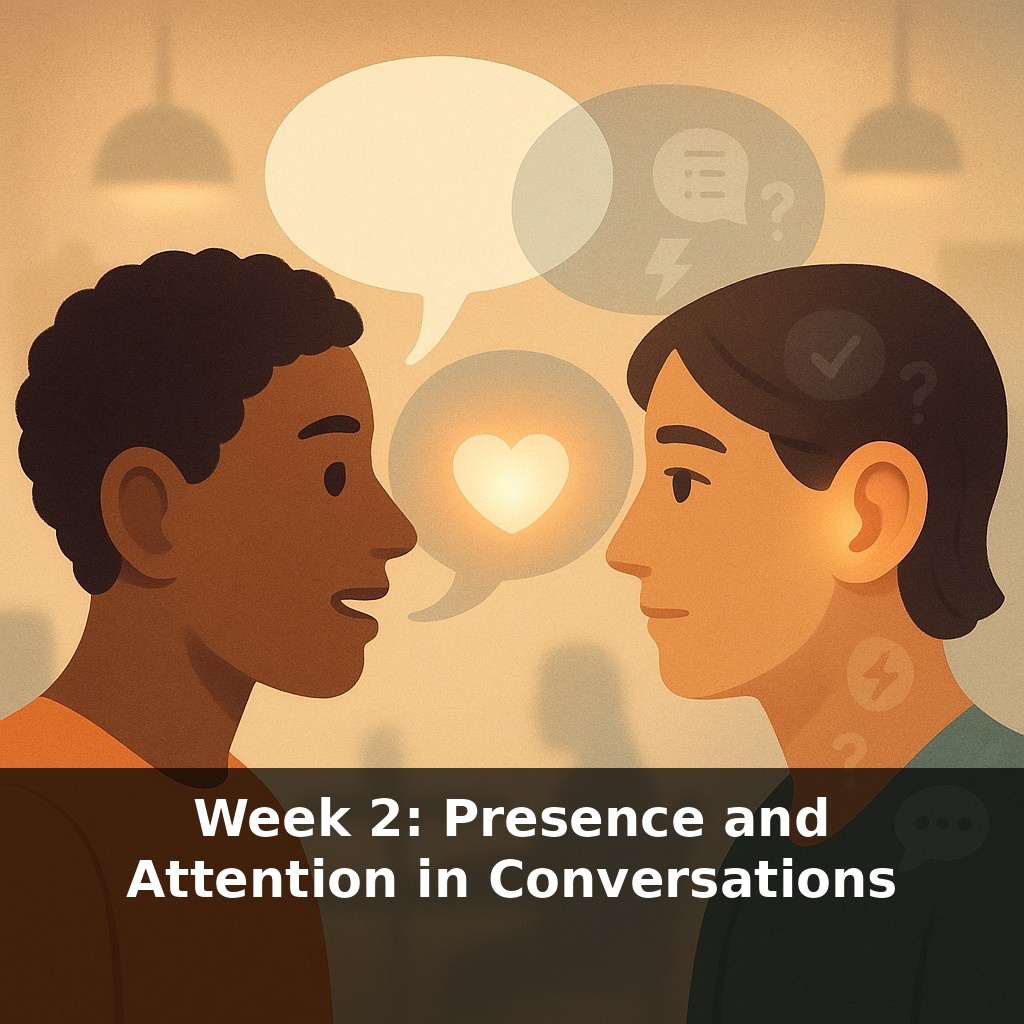
When researchers study high‑quality conversations, one pattern keeps popping up: the best listeners manage three kinds of attention at the same time—inner, outer, and environmental.
Inner attention is what’s happening inside you while the other person talks. You can’t stop thoughts, but you can notice their tone. Do you secretly start building a defense brief, rehearsing advice, or replaying something unrelated? The goal isn’t to be thought‑free; it’s to catch when your inner channel hijacks the shared one. A quick internal label—“planning,” “judging,” “worrying”—often loosens its grip just enough to bring you back.
Outer attention is what you place on the other person. Skilled communicators don’t just hear words; they track micro‑pauses, shifts in posture, changes in pace. These aren’t clues to “analyze” so much as signals of where the real meaning is. Someone might say, “It’s fine,” but their shoulders drop on the word “fine.” Another person speeds up on the part they’re afraid you’ll reject. Outer attention lets you register those small fractures and choose curiosity instead of cruising past them.
Environmental attention is your relationship with distractions. Here, design beats willpower. People who seem naturally attentive often just rig their surroundings well: notifications off during key talks, laptop lids closed for sensitive topics, phones physically out of reach when stakes are high. In one study, simply having a phone visible on the table—no buzzing, no screen lighting up—was enough to make conversations feel less close and less meaningful. Your brain keeps a tiny watchful process running: “Might that thing need me?” That background vigilance steals bandwidth you could spend tracking nuance.
Now shift from one‑off moments to patterns. Who in your life gets your cleanest channel, and who gets the choppy, half‑buffering version? Many people give razor‑sharp presence to clients, patients, or bosses, then offer loved ones whatever is left. Over time, others stop bringing you the kinds of conversations that require tenderness or nuance. It’s not punishment; it’s conservation. People instinctively route their most vulnerable topics toward the listeners who feel least leaky.
There’s also timing. Some parts of the day are naturally “noisy” inside you—right after work, right before bed, right after scrolling. Starting a delicate talk in those windows is like trying to hold a meeting on a construction site. You can upgrade a lot of relational friction simply by choosing better moments or, when that’s impossible, by naming your limits: “I want to give this more focus than I have right now. Can we talk in twenty minutes?” Respectful deferrals often feel more caring than half‑present yeses.
Finally, presence has a direction: are you listening to fix, to win, or to understand? Fixing mode scans for problems and solutions. Winning mode hunts for leverage: “Where can I prove my point?” Understanding mode asks, “What is it like to be them right now?” You can’t live in understanding mode 100% of the time, but even toggling into it for a few minutes often softens stalemates. People relax when they sense you’re not secretly preparing a verdict.
Your challenge this week: once a day, pick one conversation that matters—even briefly—and deliberately upgrade all three kinds of attention. Before it starts, check your inner channel: what’s already loud in there? Adjust your environment: silence one notification, move one device, or change one seat so you face the person more fully. Then, during the talk, switch from fixing or winning into understanding for just two extra questions. Notice what shifts: in what they share, in how you feel, and in how the conversation ends.
Think of a tense project update at work. Your manager rattles through deadlines, but their voice dips on one task. Inner attention notices your own spike of defensiveness: “They think I’m behind.” You silently label it—“defense”—and choose one clarifying question instead of shutting down. Outer attention picks up how their shoulders ease as they answer; you’ve shifted the tone without a big speech.
Now swap in a friend venting about a breakup. Environmental attention kicks in: you slide your laptop shut, turn your chair toward them, and let a few beats of silence hang after they speak. Those few seconds—where you resist filling space—often invite the real story.
Or picture a doctor with a patient. They silence their pager for three minutes, then ask, “What’s the part of this that worries you most?” That tiny, focused window can uncover fears that never show up in lab results, but completely change the care plan.
One tech CEO treats key one‑on‑ones like live demos: single screen, one tab, full screen on the person. It’s a visible promise—“You’re the feature right now, not the notification.”
Soon, your “default setting” in dialogue may matter as much as your résumé. As routine exchanges shift to AI, humans will be judged less on quick answers and more on how safe others feel opening up around them. Think of your interactions like a personal portfolio: each focused talk is a long‑term investment, each distracted one a tiny withdrawal. Over months, people quietly reallocate their honesty toward whoever shows up as consistently undivided, especially when stakes rise.
You won’t perfect this in a week, but you can start altering your communication “settings.” Think of each deliberate pause, each silenced notification, as a tiny software update to how you relate. Over time, these micro‑updates can turn routine exchanges into places where people feel unexpectedly clear, respected, and willing to bring you more of their real story.
To go deeper, here are 3 next steps: 1) Block off 10 minutes today to practice focused listening using the free “Insight Timer” app—search for a short guided meditation on “presence in conversation,” then immediately call or voice-note a friend and consciously mirror back what they’re saying before you respond. 2) Read the “Listening” and “Being vs. Doing” sections from *The Art of Communicating* by Thich Nhat Hanh, and experiment tonight by having one device-free meal where you put your phone in another room and give the other person your full visual attention (eye contact, nodding, no multitasking). 3) Install the “Forest” app or use the “Focus” mode on your phone to create a 25-minute “deep presence” block tomorrow, during which you have one important conversation (work or personal) and use a sticky note with just three cues in front of you: “Pause before replying,” “Notice their tone,” and “Ask one curious follow-up.”