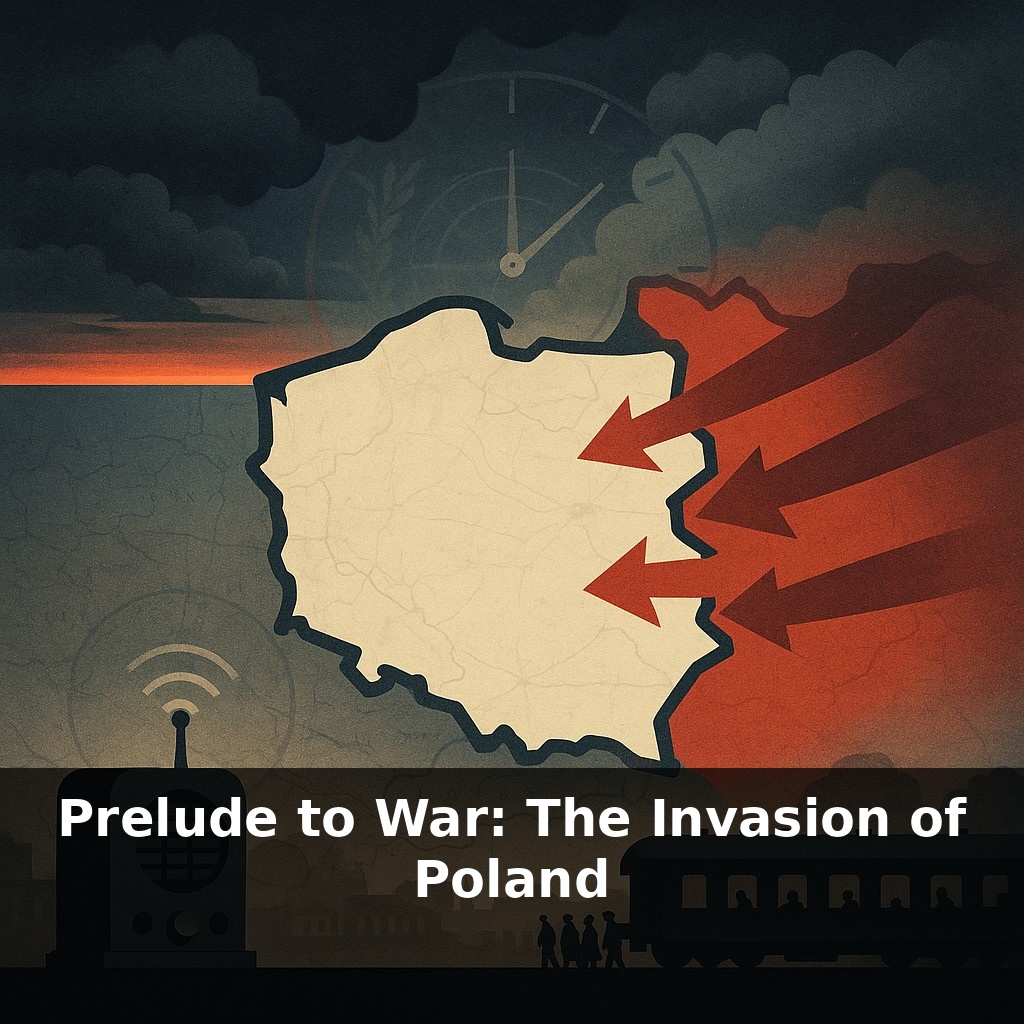
Dawn breaks, and within hours, an entire country’s future is collapsing. Radios crackle with confused orders, civilians crowd train stations, foreign leaders trade urgent cables—yet the system built to keep the peace just…watches. How does a world built to stop war slide into one anyway?
In the weeks before German troops crossed the Polish border, the crisis didn’t look like a lightning strike so much as a storm that might still blow over. Headlines swung daily between alarming and reassuring. Diplomatic cables read like weather reports: “high pressure” from Berlin, “unsettled conditions” in Danzig, a “possibility of clearing skies” if talks held. Many leaders clung to the hope that this was just another squall—loud, dangerous, but ultimately passing as previous showdowns had. Yet beneath these forecasts, hard preparations were underway: secret troop movements, staged border incidents, and propaganda framing Poland as the aggressor. On paper, alliances and guarantees seemed solid; in practice, they worked like umbrellas in a hurricane—symbolically useful, but quickly overwhelmed once the first bombs fell.
In late August 1939, Europe felt less like a continent on the brink than a gambler’s table crowded with risky bets. London and Paris had drawn a line by pledging to defend Poland, but they were still haggling over details like military coordination and supply routes. Warsaw, fearing internal panic, delayed full mobilization and hoped firmness might still deter Hitler. In Berlin, however, timetables were already inked in: rail schedules for troop transports, fuel allotments for Panzer divisions, target lists for the Luftwaffe. Publicly, everyone talked about peace; privately, planners checked their watches.
Just before dawn on 1 September 1939, German shells hit the Polish garrison at Westerplatte, and within minutes aircraft were striking rail junctions, communication hubs, and cities deep behind the frontier. It felt less like a single border clash and more like a row of dominoes tipping over simultaneously. This was the point: not a slow push, but a shock that collapsed Poland’s ability to react in sequence.
The German plan hinged on speed and depth. Armored divisions didn’t simply punch a hole; they drove fast toward rivers, road crossings, and command centers, trying to slice the Polish state into isolated pockets. Motorized infantry followed to widen the gaps and seal off units that were still trying to organize. Overhead, bombers and fighters went after bridges, rail lines, and telephone exchanges, not just troops in the field. The goal was psychological as much as tactical: make every message arrive too late, every order obsolete on arrival.
Polish commanders faced a brutal dilemma: defend the long border and risk being split apart, or fall back and concede politically vital territory almost immediately. They tried a middle course—holding key areas while planning counterattacks—but the tempo of events kept outrunning their decisions. Some units fought stubborn local actions, even winning engagements, but success in one sector meant little when neighboring formations were already being outflanked or encircled.
Here, the limits of external support became painfully clear. Declarations in distant capitals did not translate into immediate pressure on German spearheads. On the ground, Polish soldiers encountered an enemy that seemed to move in layers: tanks first, then infantry, then artillery setting up to crush any remaining resistance. It was closer to a fast-moving storm front than a neat battle line—thunder already overhead while the horizon still looked deceptively calm.
Within days, large Polish formations were cut off from each other, forced into fighting as isolated groups rather than a coordinated army. Retreat routes that might have allowed an organized withdrawal became narrow corridors under constant aerial and ground attack. The collapse wasn’t instantaneous; it was a series of forced improvisations, each made under worsening conditions, until the original defense plan was barely recognizable.
German planners had rehearsed this kind of campaign in their heads for years, studying how to turn technology, timing, and fear into a single weapon. Rather than thinking in terms of neat front lines, they mapped how long it took a unit to react, how quickly a road would clog, how rumors might spread through a town after the first low-flying bombers passed. They were less interested in where Polish units were on a map than in how disconnected they could make those units feel from one another.
One way to picture the effect—at the level of ordinary people—is to think of a sudden mountain storm: clear sky at breakfast, dark clouds by noon, and by late afternoon every path down the slope looks risky. Villagers in one district heard that roads were cut; in another, that “our side” was already collapsing, whether true or not. Local officials had to choose between burning records or trying to keep schools open, between organizing defense or arranging evacuations. As news from the front grew patchier, mayors, priests, and railway clerks became de facto crisis managers, improvising in place while the larger structure above them fractured.
1939 still shadows modern strategy. Rapid thrusts now might use malware instead of armor, drones instead of dive-bombers, but the logic is similar: hit nerve centers before leaders grasp the pattern. States hedge by hardening networks, dispersing decision-making, and rehearsing crisis playbooks—like firefighters drilling for a blaze that could start in several buildings at once, with wind and embers leaping unpredictably across town. The lesson endures: speed multiplies power when judgment lags behind events.
Your challenge this week: pick a current tension or potential flashpoint in today’s world and trace, step by step, how a “fast crisis” could unfold there in 72 hours—military, cyber, economic, and information shocks together. Then, sketch what kinds of advance cooperation or safeguards might slow that tempo just enough for wiser decisions to catch up.
In the end, Poland’s fall wasn’t just about who had more tanks; it was about who shaped the tempo and story of the crisis first. Later campaigns—and even postwar planning in NATO and the Warsaw Pact—quietly absorbed that lesson. Today, early-warning centers, joint drills, and “red lines” are all attempts to add brakes where 1939 had almost none.
Here’s your challenge this week: Pick one city mentioned in the invasion of Poland—like Warsaw, Westerplatte, or Gdańsk—and spend 20 focused minutes exploring an online interactive map or archival photos of how it looked in 1939 versus today. Then, choose one real person from that campaign (a Polish defender, a civilian in Warsaw, or a German or Soviet soldier) and read at least one first‑hand account, diary entry, or letter connected to them. Finally, share a 3–4 sentence summary of what surprised you most with one friend, family member, or online community, explicitly connecting it to how modern wars begin or are justified today.