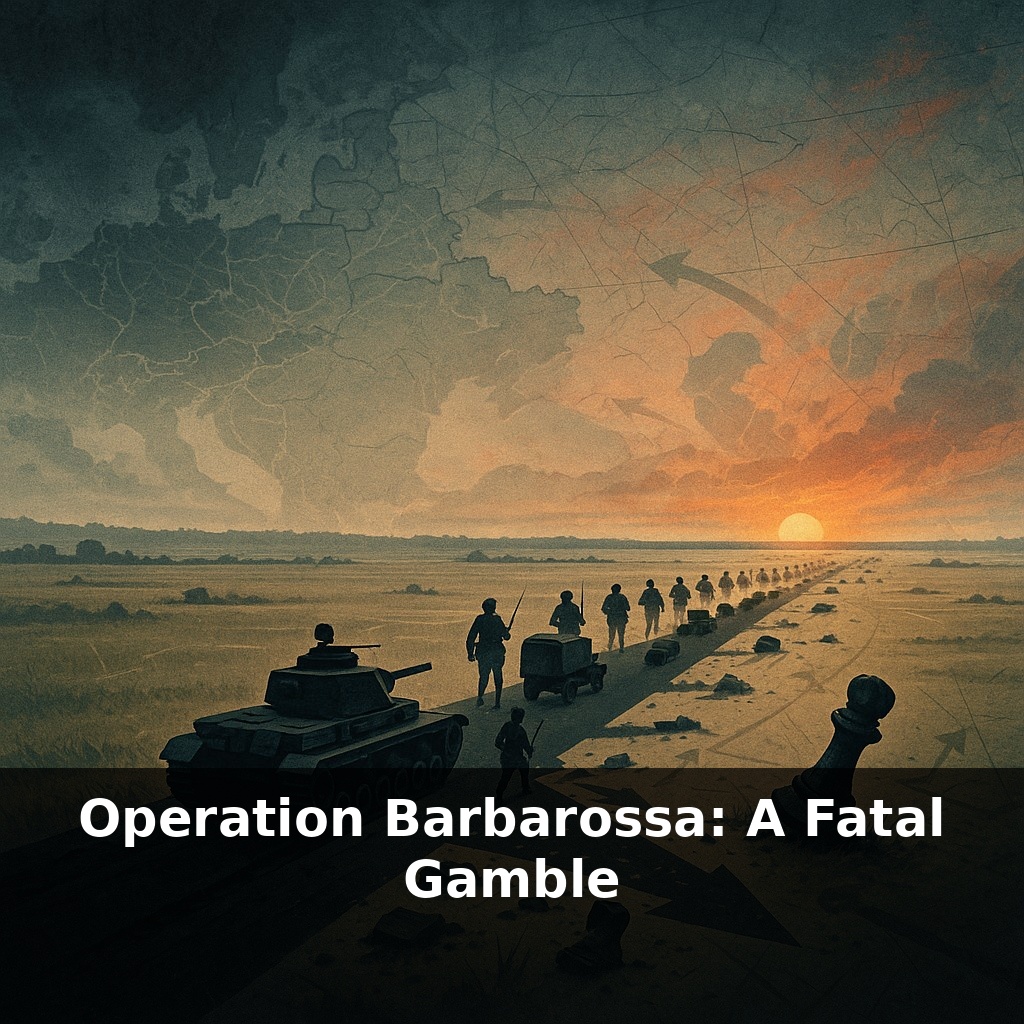
Guns roar at dawn as nearly four million soldiers surge east—yet the man who launched them had never seen the Russian steppe. In this episode, we’ll step into that moment when confidence drowned out caution, and a quick victory quietly turned into a slow catastrophe.
The odd thing is this: on paper, Barbarossa almost made sense. France had fallen in weeks. Poland had collapsed even faster. The Wehrmacht looked unstoppable, like a storm front that had never met a mountain range. German leaders convinced themselves the Soviet Union was just another fragile state waiting to be knocked over—an Asian “colossus with feet of clay,” as one Nazi official put it. Intelligence that contradicted this belief was trimmed away, ignored, or twisted to fit the plan. Inside war rooms, maps shrank distances, erased mud, and turned supply lines into neat arrows instead of vulnerable lifelines. As we go deeper into this episode, we’ll track how those clean lines on paper collided with factories on rails, endless reserves, and a climate that answered no one’s timetable.
Yet beyond those neat arrows lay a messier reality: a foe able to trade space for time. As German spearheads drove forward, the Soviets yielded ground but torched crops, wrecked rail lines, and pulled back vital machinery. Entire factories were dismantled, loaded onto trains, and sent thousands of kilometers east, reassembling like a mechanical forest regrowing after a wildfire. This wasn’t just retreat; it was a deliberate bet that endurance could outlast shock. Our task now is to follow that bet—how scorched earth, relocation, and sheer scale slowly tilted the balance against the invaders.
The first cracks appeared almost immediately—but they were easy to miss from Berlin.
In the opening weeks, German armoured spearheads reported dazzling advances and colossal encirclements. Yet behind those triumphant figures, supply officers were already warning: fuel columns lagged, spare parts vanished, horses collapsed from exhaustion. The plan had assumed short, decisive battles near the frontier; instead, formations kept driving deeper, chasing fresh Soviet units that refused to disintegrate on schedule.
Here the scale of the campaign stopped being an abstraction and became a constraint. Each extra day of movement lengthened the lifeline back to railheads in former Polish and Baltic territory. Those railways themselves needed conversion from Soviet wide gauge to European standard. That meant engineers crawling forward behind the advance, literally unbolting the enemy’s tracks and laying new ones. It was as if a touring orchestra had to rebuild the concert hall in every city before playing a single note.
Meanwhile, German planners had gambled on destroying the bulk of Soviet forces in one sweeping summer. But every time a “final” pocket was closed, new Soviet armies emerged further east, drawing on a manpower pool far beyond prewar estimates. Draft offices in Siberian and Central Asian towns fed divisions westward; reserves that many in Berlin insisted did not exist started showing up in combat reports.
Crucially, the campaign lacked a single, stable priority. Hitler oscillated between seizing economic targets—Ukraine’s grain, the Donbas coal, the Caucasus oil—and capturing political ones like Leningrad and Moscow. Each shift yanked armoured groups north or south, burning precious fuel and time. Operationally, this meant the invaders were strongest when they needed to pivot, not when they needed to deliver a knockout blow.
By late autumn, forward units were living off captured Soviet depots that grew thinner the further they advanced. Winter clothing, antifreeze, lubricants for extreme cold—these had been deferred, because victory was expected before they were needed. When temperatures plunged, engines seized, artillery recoils froze, and infantry tried to fight in uniforms tailored for France.
The Soviets, by contrast, were beginning to fight a different kind of war. New tanks and aircraft from reassembled plants rolled westward. Fresh divisions arrived by rail to sectors the Germans had assumed were quiet. The front stopped being a line to be broken and turned into a vast grinder, in which industrial output and replacement rates mattered more than tactical brilliance.
As 1941 turned into 1942, the logic of the conflict flipped: from a campaign of decision to a contest of endurance, one in which the original German bet—on speed over depth, and shock over staying power—could no longer be won.
German planners had recent “proof” their model worked: Poland swept aside in weeks, Norway taken with audacity, France collapsing in a dazzling summer. Those cases became a comforting pattern. The outlier—the grinding stalemate of World War I in the east—was treated as ancient history rather than a warning. When some officers raised concerns about distance, track gauges, or fuel, their objections sounded, in that context, like pessimism rather than prudence.
By contrast, Soviet leaders drew on very different mental files: memories of 1812, when another invader advanced rapidly, only to be worn down by depth and time. They were also watching current numbers more than past triumphs: daily evacuation tallies, new draft cohorts, fresh rifle deliveries from reassembled plants. Where German staff work tended to ask, “How do we win fast?” Soviet planners increasingly asked, “What keeps us in the fight next month?”
In modern terms, this was the clash between a project designed only to meet its launch date, and one structured to survive delays, shortages, and repeated shocks.
Barbarossa’s failure still whispers warnings. Modern planners face different tools—satellites, real‑time data, globalized supply chains—yet the core risk endures: mistaking early success for proof that reality matches the plan. Cyber attacks on logistics, climate‑driven cold snaps, or misinformation about an adversary’s reserves can all turn a “short campaign” into a draining slog, like a sudden headwind turning a smooth flight into a fuel‑critical emergency diversion.
Barbarossa’s failure suggests a quieter lesson: big choices age badly when they ignore limits. Weather, distance, and production acted like a slow tide, tugging at every bold promise inked on a map. When we plan today—military, corporate, even personal—the real test is whether our timelines survive friction, not how impressive they look at launch.
To go deeper, here are 3 next steps: 1) Pull up an online, zoomable map of the Eastern Front (the “Army Group North, Center, South – June–Dec 1941” map on WW2DB or TheMapArchive is great) and trace the actual advance routes mentioned in the episode, pausing to compare the planned objectives (Leningrad, Moscow, Ukraine) with where the spearheads stalled. 2) Read the first two chapters of David Stahel’s *Operation Barbarossa and Germany’s Defeat in the East* or the Barbarossa chapter in Richard Overy’s *Russia’s War*, and jot down every example of Hitler overruling his generals that the podcast referenced, then match those to the book’s explanation of why they were strategically disastrous. 3) Open YouTube and watch a reputable animated campaign overview—like Potential History or Eastory’s Barbarossa timeline—right after the episode, and pause at key turning points (Smolensk, Kiev encirclement, the drive on Moscow) to compare how the narrator’s “fatal gamble” framing lines up with actual casualty figures and logistical breakdowns shown on screen.