Gunfire cracks, engines roar, and dozens of soldiers stare at a gray horizon—waiting for ships that might never come. Britain stands on the edge of defeat, yet within days, a desperate retreat will be praised as a kind of miracle. How does a disaster become a lifeline?
The strange thing about Dunkirk is that no one set out to create a “miracle.” There was no grand blueprint, no perfectly drilled plan waiting in a drawer at the Admiralty. There was confusion, clashing priorities, and a narrowing strip of French coastline filling with exhausted men. Orders changed by the hour. Generals argued. Politicians hesitated. And yet, in the middle of that uncertainty, people at every level started making fast, imperfect decisions: diverting ships, redrawing evacuation zones, phoning civilian boat owners in the middle of the night. It was less like a single heroic charge and more like an improvised orchestra, where each new instrument joined just in time, following a tune that hadn’t quite been written yet—but had to be played flawlessly, because the audience’s survival depended on it.
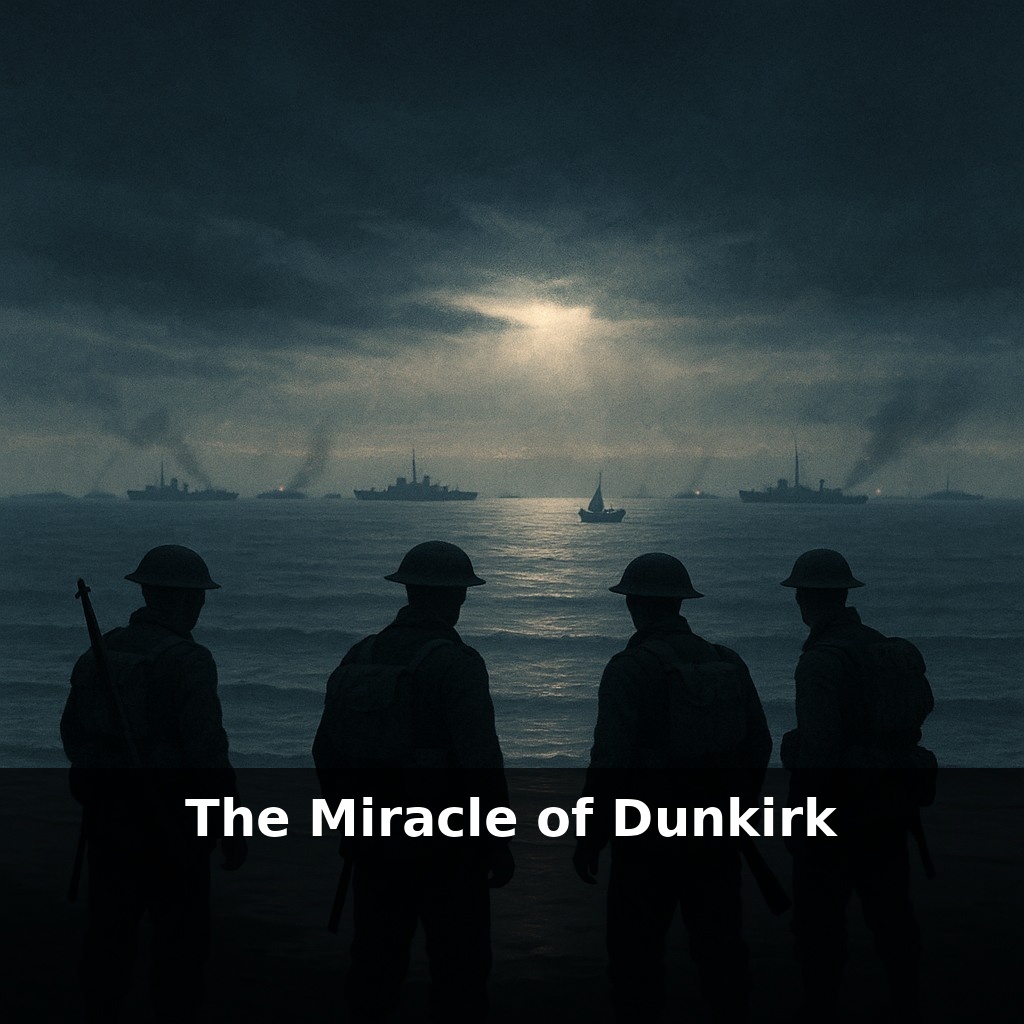
By late May 1940, that “orchestra” was playing against a brutal clock. German armored divisions had sliced through Belgium and northern France with shocking speed, cutting off the British Expeditionary Force and many French units from the rest of their armies. A long, exposed pocket formed around Dunkirk—a shallow, sandy bottleneck with limited port facilities and tides that stranded large ships far from shore. On land, ammunition and food were running low; in the air, German bombers hunted for targets; at sea, mines and submarines lurked. It was like watching a storm surge creep toward a thin, fragile seawall—every hour lost meant less ground left to stand on.
If you zoom in on what actually happened between 26 May and 4 June, the “miracle” looks less like a single event and more like a chain of uncomfortable trade-offs.
First, planners quietly abandoned the hope of holding a solid front line. The priority flipped: not “win this battle” but “get as many trained soldiers as possible off this patch of coast.” That meant leaving behind almost everything that made those soldiers effective: thousands of artillery pieces, tens of thousands of vehicles, mountains of ammunition and fuel. The British Expeditionary Force was, in a matter of days, stripped down from a modern mechanized army to a crowd of infantry in worn boots and mismatched kit.
Second, the Royal Navy had to rethink what a “fleet” looked like. Destroyers and larger warships could only come in so close before grounding or presenting perfect targets. So planners leaned into numbers instead of size: hundreds of small, shallow-draft boats shuttling men from the surf to deeper water, where bigger ships waited. Coordination was messy and losses were real, but the sheer volume of hulls on the water began to matter more than any individual vessel.
In the air, another uncomfortable shift took place. Many soldiers scanning the sky over the beach decided the RAF simply wasn’t there. In truth, fighter squadrons were often sent to engage German aircraft inland, before they reached the coast, trading visible reassurance for higher odds of actually reducing bombing runs. Pilots paid for that choice: more than a hundred British aircraft were lost in the effort to blunt the Luftwaffe’s pressure.
Weather joined the list of unlikely collaborators. On several key days, low cloud and haze dulled German air power just enough to let embarkation lines form and hold. It didn’t stop the danger, but it changed the tempo, buying scattered hours in which tens of thousands could cross the narrow sea.
And over all of this hung a political dilemma: how long to keep evacuating foreign allies when British ports were becoming crowded with troops and fear of invasion was rising. British authorities ultimately resumed and extended evacuation for French soldiers, even as they knew that most of France would soon be occupied.
Your challenge this week: pick one project, team, or personal situation that currently feels like it’s “going wrong,” and, for seven days, track every trade-off you or others actually make under pressure. Not the ones you wish you were making—the real ones: what you choose to save, what you quietly abandon, which risks you accept, which optics you’re willing to look bad on. At the end of the week, map them out. Where are you, in practice, prioritizing “people you can carry forward” over “equipment you’re losing”? Where are you fighting for the symbolic destroyer instead of the swarm of small boats?
You’re not recreating Dunkirk. You’re looking for the moment when you stop trying to win the original plan and start trying to preserve the capacity to fight another day.
A useful way to test your own “Dunkirk thinking” is to look at moments when people deliberately chose what to lose. In 2008, for instance, some startups under extreme financial stress stopped chasing every new feature and ruthlessly cut product lines, preserving just the engineers and codebases most likely to survive the downturn. On paper, it looked like failure; a few years later, those “evacuated” cores became billion‑dollar businesses. In medicine, triage in an overwhelmed emergency room forces staff to pour attention into patients who can benefit most, even when that means letting less critical tasks—and sometimes entire treatment plans—go unfinished. Nature does something similar: in a drought, a tree sheds leaves to keep its trunk and deepest roots alive. If you think about your own week, where are you clinging to “equipment”—processes, status, grand plans—at the expense of the people, skills, and relationships you’ll actually need for the next phase?
Dunkirk’s deeper legacy sits in how we plan for the next crisis, not how we remember the last. Today’s militaries model “Dunkirk-style” bottlenecks with software, testing what happens if ports fail or allies collapse. Urban planners borrow similar thinking for wildfire escapes or flood routes, redrawing maps when a single blocked bridge could trap thousands like water in a cul‑de‑sac. The question quietly shifts from “Can this system work?” to “How does it fail—and who can we still get out when it does?”
Dunkirk hints at an uncomfortable question: in your own crises, what are you willing to strand on the beach so something more vital can cross the channel? Treat your plans like a river in flood—expect banks to overflow, then decide in advance which fields you’re prepared to let go under. Survival, personal or political, often starts with that quiet, unsentimental choice.
Start with this tiny habit: When you feel stuck or overwhelmed in your day (like everything’s going wrong), whisper to yourself, “Dunkirk spirit—what’s my little boat move?” and then do one 30-second “rescue” task for someone else—like sending a quick encouraging message, forwarding a helpful link, or offering a tiny favor. This mirrors the civilian boats crossing the Channel: small, ordinary efforts that add up to something big. Over time, you’ll train your brain to respond to crises not with panic, but with purposeful, bite-sized courage.