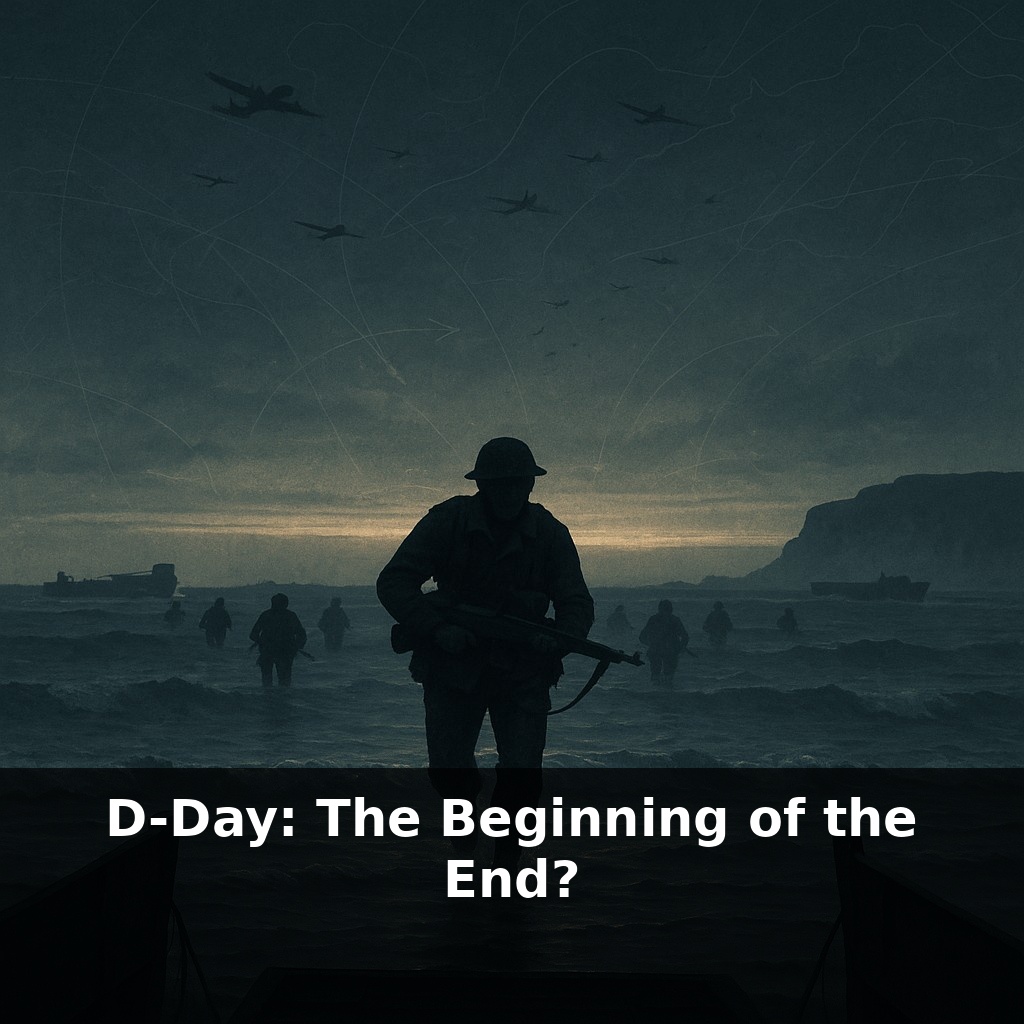
Before sunrise on a single June morning, more people crossed one stretch of French coastline under fire than live in many small cities. Some waded ashore. Others dropped from dark skies. All knew this: if they failed that day, the war in Europe might drag on for years.
They called it “Overlord” for a reason. This wasn’t just another offensive; it was an attempt to flip the entire logic of the war in a single, violent stroke. For nearly five years, Nazi Germany had dictated the tempo in Europe. Now, on one narrow coast, the Allies meant to seize the initiative and never give it back.
What made this day different wasn’t only the scale, but the stakes. Success would give the Allies a permanent foothold in Western Europe, a place from which tanks, fuel, food, and men could pour in faster than Germany could push them out. Failure would mean thousands dead for nothing, shattered morale at home, and a priceless gift of time to Hitler—time to finish new weapons, fortify his borders, and maybe even split the uneasy alliance between the Western powers and the Soviet Union. D-Day was a gamble not just on tactics, but on how quickly history itself could be forced to turn.
Yet even calling it a “gamble” undersells how meticulously the risk was prepared. For months beforehand, planners choreographed tides, moonlight, and weather forecasts, then layered on deception operations so elaborate they bordered on theater. Fake armies appeared on maps, phantom radio chatter hummed, and inflatable tanks sat where spies could see them. While war factories in America and Britain ran like relentless conveyor belts, analysts tried to read a paranoid dictator’s mind from hundreds of miles away. The assault on that coast was just the visible tip of an immense, submerged effort.
The turning point began in the dark.
Hours before any landing craft dropped its ramp, more than 23,000 airborne soldiers were already in the air, crammed into vibrating planes and silent gliders. Their job was to land behind the shoreline and quietly seize bridges, crossroads, and causeways—small patches of ground that, on a map, looked almost trivial. On the ground, they were the locks on a door the amphibious troops were about to try to kick open. If those locks stayed shut—if roads stayed blown or flooded—the men coming off the beaches could be trapped under enemy fire with nowhere to advance.
Meanwhile, offshore, a steel armada stretched across the horizon. Battleships and cruisers began hurling shells inland, trying to smash gun emplacements before they could rake the shallows. Closer in, specialized tanks—some that floated, some that carried bridges or flamethrowers—were supposed to roll straight off their landing craft and turn raw sand into a usable battlefield. Not all of them made it; in some sectors, many sank or were destroyed before they ever fired a shot, leaving infantry to cross open ground with almost nothing but grit and small-arms fire.
The five landing zones did not unfold as a single, tidy narrative. At some, defenders were thin, fortifications incomplete, and units pushed inland faster than their officers dared hope. At others, especially where cliffs and bunkers dominated the shoreline, first waves were torn apart so badly that senior commanders considered pulling back entirely. Orders had to bend or break: engineers turned from careful demolition plans to simply blowing paths through obstacles under direct fire; junior officers pieced together ad hoc companies from whoever was alive and nearby.
By evening, no one had taken the grand objectives drawn on pre-invasion maps. But enough footholds existed—enough high ground held, enough exits off the beaches pried open—that the day had done its real work. The shoreline was no longer a line; it was a series of widening wedges driven into occupied territory, each one a place through which more men, more tanks, more supplies could begin to flow. History’s tempo had not reversed in a single stroke, but the direction of pressure had.
For many of the people involved, the turning point wasn’t a map-arrow but a moment. A radio operator hearing, through static, that a nearby unit was still alive. A French farmer watching unfamiliar uniforms emerge from hedgerows he’d crossed his whole life. A German officer realizing the messages on his desk no longer matched the assumptions in his head.
Strategically, this is where the invasion becomes the beginning of the end: once a continuous stream of fuel, ammunition, and vehicles could pass through those narrow footholds, the basic math of the war shifted. Industrial capacity in North America and Britain could now be translated, day after day, into pressure on the ground—trucks on cramped lanes, bulldozers carving new ones, portable harbors turning open water into temporary ports.
Coordinating this was like conducting a 150,000-piece orchestra: signals officers keeping tempo, logistics units carrying the rhythm, frontline commanders improvising when sections fell out of tune. The “music” wasn’t smooth, but it was relentless, and from that day on, it played toward Berlin.
Tanks and landing craft are gone, but the pattern they created lingers. Today’s planners study that day when distant factories, rival services, and wary governments acted in sync. Disaster relief convoys, vaccine campaigns, even satellite networks quietly echo its logic: secure a fragile foothold, then widen it. The moral burden endures too—each new crisis asks whether we’ll accept the cost of acting early, or wait until the shoreline is crowded again.
In that sense, the landings are less a final act than a case study in tipping points: how a single, costly push can make retreat harder than advance. Modern crises—cyber attacks, climate shocks, pandemics—pose softer beaches but similar choices. The question that lingers is whether we’ll recognize our next “June 6” while it still looks small on the map.
Before next week, ask yourself: How would my understanding of D‑Day change if I looked at it through the eyes of a single paratrooper dropped behind Utah Beach or a French civilian in a Norman village that morning—what details of fear, hope, or confusion come into focus when I slow down and imagine their hour‑by‑hour experience? When I hear the casualty numbers and the scale of Operation Overlord, which specific moments or decisions mentioned in the episode (like the risky airborne drops, the weather delay, or the choice of beaches) feel most morally complicated to me, and why? After listening, what is one concrete thing I can do today to keep this from staying “just a story”—for example, looking up the name and story of one soldier or resistance member mentioned, or finding the exact location of one beach on a map and picturing what happened there?