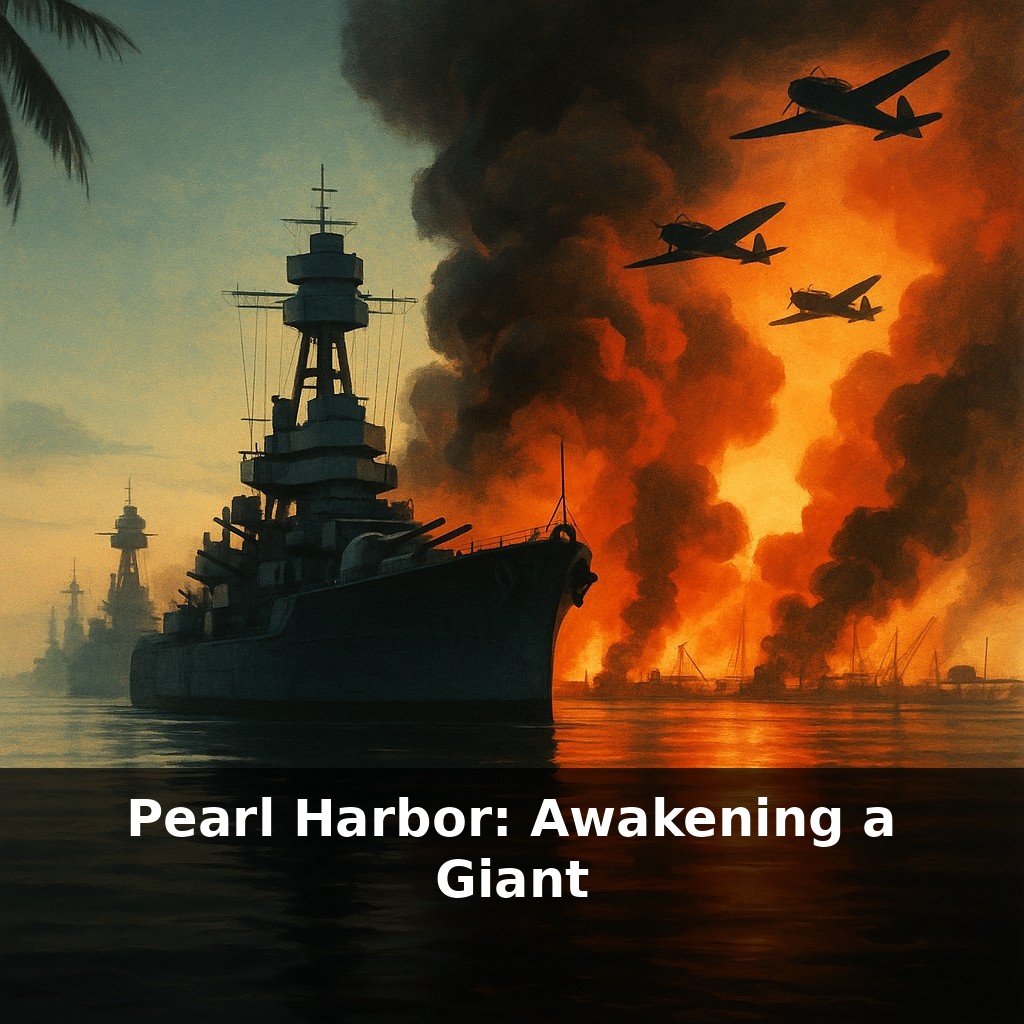
At breakfast time in Hawai‘i, American sailors saw planes overhead and thought they were part of a drill. Minutes later, flames, explosions, and chaos. A single morning’s shock would flip U.S. opinion from hesitant and divided to almost unanimously ready for total war.
By mid-1941, Pearl Harbor was more than a tropical outpost; it was the steel heartbeat of America’s Pacific presence—dry docks humming, fuel tanks brimming, battleships lined up along “Battleship Row” like parked freight trains between runs. Washington and Tokyo were still trading cables and diplomatic phrases, but beneath the polite language, pressure built like magma under a crust: U.S. embargoes squeezing Japan’s access to oil and metals, Japanese forces driving deeper into China and eyeing Southeast Asia’s resources. Military planners on both sides studied each other’s moves in memos and war games, yet most still assumed any showdown would come later, after more negotiations, more signaling, more time. That quiet assumption—that there was still room to maneuver—would be the first casualty on the morning of 7 December.
Across the Pacific, Japanese leaders were running out of room on the board. Their empire stretched from Manchuria to French Indochina, but fuel tanks were draining fast, and every month of negotiation with Washington tightened the noose on their war machine. Inside Tokyo’s war councils, naval officers pushed a hard bet: cripple the U.S. Pacific Fleet early, then grab the resources of Southeast Asia before America could recover. Others argued for caution, warning that waking a larger, richer adversary could turn a sharp regional war into a drawn-out, unwinnable struggle. Pearl Harbor became the chosen gamble.
Japanese planners knew they were taking on a richer opponent, so they tried to rewrite the script with precision and timing. The attack plan was rehearsed obsessively: pilots drilled low‑altitude torpedo runs in shallow bays back home, engineers designed special fins so torpedoes wouldn’t plunge uselessly into Pearl Harbor’s relatively shallow water, and intelligence teams built detailed models of the harbor from photographs and consular reports. Six aircraft carriers—then the most powerful concentration of naval airpower in history—slipped across the North Pacific in radio silence, hoping winter storms and distance would keep them invisible.
The target list revealed Tokyo’s real priorities. Carriers were at the top, airfields close behind. Battleships mattered for prestige and firepower, but Japanese commanders understood that whoever controlled the sky over the Pacific would decide the war at sea. On the morning of 7 December, waves of bombers and torpedo planes fanned out toward airstrips as well as “Battleship Row,” aiming to pin American aircraft to the ground before they could scramble.
Some choices that day quietly shaped everything that followed. Japan did not schedule a third wave to hit fuel depots, dry docks, and repair shops—the unglamorous backbone of naval power. Striking them might have turned Pearl Harbor into a long‑term wreck. Instead, fear of losing more elite pilots, worries about American defenses waking up, and the long sail home pushed Admiral Nagumo to withdraw after two waves. Important submarines also survived in their pens, giving the United States a weapon for choking Japan’s own sea lanes later.
When news reached Washington, the effect inside the government was swift clarity more than shock. Years of debates about budgets, priorities, and whether to focus on Europe or Asia suddenly met a hard deadline. Within hours, military and political leaders were mapping out global war rather than regional crisis, linking Pacific decisions to aid for Britain, Soviet resistance, and industrial mobilization at home.
Your challenge this week: each time you face a decision, note what tempting “first‑wave” target you’re focused on—and then force yourself to list the less visible systems in the background that might matter more over the long run. At week’s end, review: how often did your instinct aim for drama instead of infrastructure?
Think of the attack like a sudden storm that rips roofs off houses but leaves the power plant intact. The skyline looks shattered, yet the city can still turn the lights back on and rebuild. The real turning point wasn’t just the wreckage in the harbor; it was the machinery behind it that stayed alive: shipyards that could weld, refit, and innovate; factories on the mainland that could pivot from cars to bombers; training bases that could turn civilians into pilots and mechanics at scale. That’s why the same nation stunned on a Sunday morning was launching new carriers and island‑hopping across the Pacific within a few years.
You can see a similar pattern in how some companies survive devastating product failures while others never recover. The survivors usually kept their “dry docks” healthy: strong logistics, adaptable teams, and flexible manufacturing. When a shock hit, they didn’t just patch the damage; they used the crisis to retool faster than rivals who had chased showpiece wins and neglected their foundations.
Pearl Harbor’s deeper legacy is how it reshaped thinking about vulnerability. Today, planners worry less about dazzling blows and more about quiet weak points: hacked satellites, corrupted code, fragile supply chains. Deterrence now means convincing rivals that even if the “harbor” is hit—ports, grids, data centers—backup systems will keep functioning. That logic spills into civilian life too, from hospitals with redundant networks to firms mapping which single failure could freeze their whole operation.
History’s twist is that shocks like 7 December don’t just close chapters; they open toolkits. From radar refinements to convoy tactics and codebreaking, governments learned to treat each blow as data, not only tragedy. The open question for us is similar: when our plans are upended, do we merely rebuild the same walls, or redesign the whole map?
To go deeper, here are 3 next steps: (1) Watch the 2001 PBS documentary “Tora! Tora! Tora!: The Real Story of Pearl Harbor” (available for rent/streaming) and pause to compare its timeline with what the episode described about missed warnings and intelligence signals. (2) Grab a copy of Gordon W. Prange’s “At Dawn We Slept” or Roberta Wohlstetter’s “Pearl Harbor: Warning and Decision” and read just the chapters on pre-attack intelligence; while you read, cross-check specific dates and decisions against the episode’s narrative to see how interpretation changes the story. (3) Open Google Earth or a Pearl Harbor interactive map from the National Park Service website and trace the Japanese attack waves, ship positions, and airfields mentioned in the episode so you can literally “walk through” the morning of December 7, 1941 from multiple vantage points.