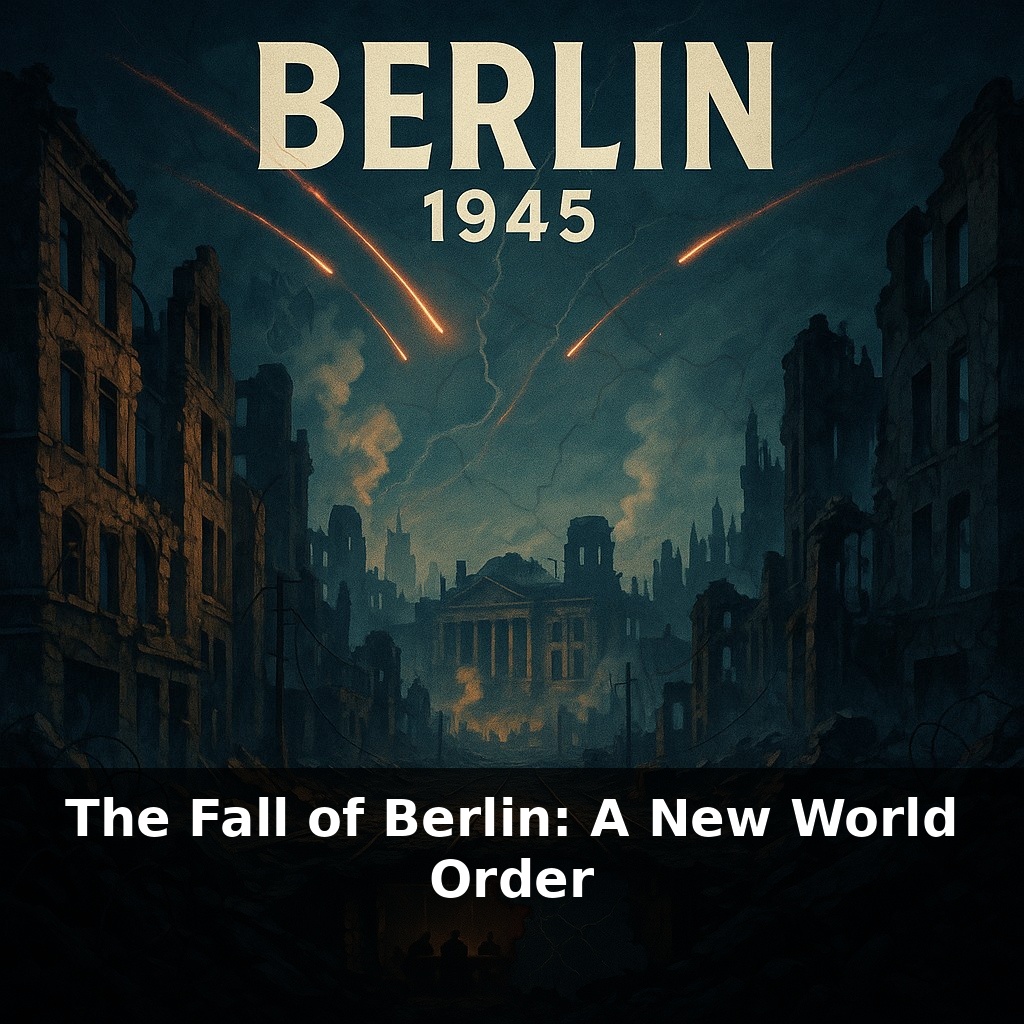
On a spring night in 1945, fireworks lit Berlin’s sky—but they weren’t for a celebration. Soviet shells traced burning arcs over a dying capital while, deep underground, a dictator signed his last orders. Here’s the twist: in crushing one empire, the world accidentally built a new divide.
By late April 1945, Berlin was less a city than a shattered maze. Whole neighborhoods were reduced to brick dust and twisted tram lines, yet hundreds of thousands of civilians still sheltered in basements, clutching radios and rumors. Above them, Soviet artillery inched closer block by block, turning streets into lethal corridors where every doorway could be a last stand. Inside the Führerbunker, maps no longer matched reality; units Hitler ordered into action had already been destroyed or overrun. For many Berliners, the war shrank to the few meters between their cellar, the nearest water pump, and the ruins of a corner shop—life reduced to the narrow rhythm of survival while giant armies collided overhead, like dark storm fronts grinding across a single, doomed point on the map.
Above those cellars and command maps, something else was happening: lines were being drawn that would outlast the smoke. Soviet troops weren’t just fighting street to street; they were racing Western Allies for leverage over the future. Each bridge seized, each district occupied, would later translate into zones on an occupation map and, eventually, frontiers in the Cold War. In conference rooms far from the rubble, planners were already thinking in percentages—who would control which regions, which industries, which ports—like gardeners deciding where to plant hedges that, once grown, would be almost impossible to move.
By mid-April, Berlin became the focal point of a gigantic pincer. Marshal Zhukov’s 1st Belorussian Front attacked from the north and east, while Konev’s 1st Ukrainian Front surged from the south. Between them moved more than two million Soviet soldiers, thousands of tanks, and a torrent of artillery—an industrial-scale push designed to finish the war in Europe before the Western Allies could reshape the endgame.
That race was political as much as military. In theory, Allied leaders had already agreed on spheres of control. In practice, each Soviet regiment that planted a red banner on a town hall added another bargaining chip for Stalin. Eisenhower, weighing lives against prestige, chose not to hurl American and British forces toward the capital. Instead, he focused on cutting Germany in half along the Elbe, trapping remaining German armies and limiting casualties, even if it meant ceding the symbolic prize of Berlin.
Inside the collapsing Reich, the defense looked powerful on paper: remnants of Wehrmacht divisions, SS units, and flak batteries. In reality, the line was patched together with police, sailors without ships, and teenage Volkssturm drafted from classrooms. They fought from subway stations, anti-tank ditches, and hastily fortified intersections. Every block was contested, but the imbalance was brutal: Soviet armor and artillery ground down pockets of resistance in days that once would have taken weeks.
As fighting closed in around the government quarter, the regime imploded. Hitler’s suicide on April 30 was followed within hours by Joseph Goebbels’, and by the surrender of the city’s remaining commanders. On May 2, a Soviet flag rose above the Reichstag ruins, an image that would echo for decades as shorthand for both liberation and the start of Soviet dominance in Eastern Europe.
Yet the guns falling silent didn’t simplify the map; they complicated it. The same city that had been a battlefield became a laboratory for a new order. German soldiers went from combatants to prisoners by the hundreds of thousands. Borders, currencies, and administrations were all suddenly negotiable. The defeat of one dictatorship opened a space where two rival visions—American liberal capitalism and Soviet socialism—would soon harden into a global standoff, with Berlin stuck directly on the fault line.
In the weeks after the guns stopped, Berlin’s ruins became a kind of political laboratory. Four different uniforms—Soviet, American, British, French—walked the same broken streets, each posting signs in their own language, issuing their own passes, reopening schools with different textbooks. One apartment block might fall in the Soviet sector, the next in the American, like property lines suddenly drawn through people’s stairwells and supper tables. Daily life turned into a puzzle: which checkpoint let you reach an aunt, a job, a food queue?
The Potsdam decisions filtered down into mundane details. A factory could be stripped for reparations on a Monday, then cited as “vital infrastructure” by another power on Friday. Radio stations multiplied, each broadcasting a different version of recent history. Even street names shifted—some erased Nazi heroes, others honored new ideological ones. It was as if a familiar melody—“Berlin”—was being rearranged in four competing musical styles, with residents forced to adapt to whichever rhythm controlled their block that week.
Berlin’s fall didn’t just freeze a line on a map; it tested how fast rules, fears, and alliances could solidify. The city’s later airlift, wall, and spy games turned it into a pressure gauge for the entire Cold War. Today, planners still study 1945 to ask: when a capital collapses, who writes the software of the new system—laws, narratives, currencies? Like a river abruptly forced into canals, power doesn’t disappear; it finds new channels, sometimes bursting banks decades later.
Your challenge this week: pick a modern city in the news—Kyiv, Gaza, Taipei, Moscow, Washington—and follow one story about it for seven days. Track not just battles or protests, but who arrives, who leaves, which flags, logos, or languages appear. You’re watching for a quiet Berlin-style clue: how power prepares the world that comes after.
History’s hinge moments rarely feel tidy. Berlin’s fall shows how endings spill forward, like aftershocks rippling through decades of policy, fear, and hope. When you see footage of a capital today—its skylines, parades, or ruins—you’re glimpsing more than a place under stress; you’re seeing a draft version of tomorrow’s map, waiting for someone to ink in the borders.