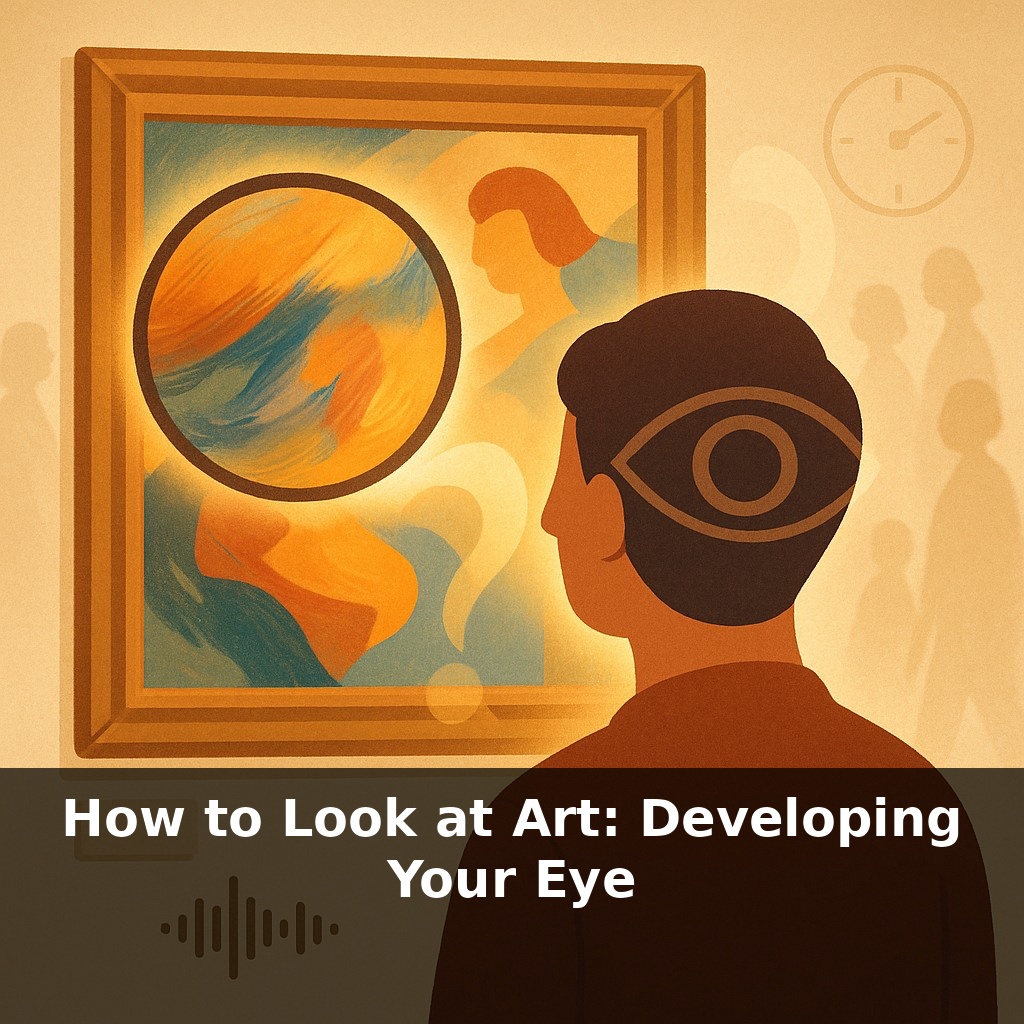
How to Look at Art: Developing Your Eye
📝 Transcript
In museums, people often spend less than half a minute with a masterpiece—about the time it takes to check a text. You walk past a painting, glance, nod, move on. Yet that single quick look can’t reveal the hidden decisions, stories, and emotions woven into the work.
Instead of racing past artworks, this episode is about training your eye to *stay*—and to see more each time you look. Effective viewing has two parts that work together: close visual attention, and curious questioning.
First, you’ll learn to slow your gaze down and scan systematically: tracing edges, comparing colors, noticing where your eye is pulled and why. We’ll use specific tools—like counting distinct color areas, tracking diagonals, and timing a full 90 seconds in front of a single piece—to make this concrete.
Then we’ll connect those observations to context: who made this, when, with what materials, and for which audience. You’ll see how even basic details—a date, a title, a medium—can radically shift what you notice. By the end, you’ll have a simple, repeatable method for turning any quick glance into a deeper encounter.
Standing longer is only part of the shift. To develop your eye, you’ll also start layering *structured* observation and context. Think of this as moving from “I like it/don’t like it” to “I notice, I connect, I conclude.” In practice, that might mean spending 90 seconds just mapping where lines intersect, then another 60 reading the wall label, then 30 more re-scanning with that detail in mind—barely 3 minutes total. Over a visit with 10 works, that’s about 30 minutes of focused looking, enough for your brain to build richer visual memories and more confident interpretations.
Start by giving your looking some structure. One simple framework is **See – Think – Wonder**, but we’ll make it more concrete and numeric so you can actually use it in front of a work.
**1. SEE: 60 seconds of data-gathering**
Stand at a distance where you can take in the whole piece. Set a 60‑second timer.
- For the first **20 seconds**, track **line and direction**. Silently count at least **5 different types of lines**: straight, curved, broken, thick, thin, diagonal, vertical, horizontal. Notice where they cluster. - Next **20 seconds**, focus on **scale and proportion**. Estimate: what single object is largest? What’s smallest? If a person stepped into this image, where would they fit? Mentally compare: “This figure is about 3× taller than that table.” - Last **20 seconds**, attend to **texture and surface**. Ask: does this look smooth, rough, glossy, matte? Can you spot at least **3 different surface qualities**?
You’re not interpreting yet—only collecting visual facts until the timer ends.
**2. THINK: 60–90 seconds connecting the dots**
Now you start forming hypotheses, grounded in what you just saw.
- Look again for **compositional hotspots**—areas your eye keeps jumping back to. Try to identify **3 hotspots** and ask: what formal trick is used there—contrast, brightness, detail, isolation? - Consider **cause and effect**: “Because this area is brightest and most detailed, it *feels* important.” Make **2–3 short ‘because’ statements** linking what you see to what you feel or think. - Check for **visual hierarchies**. Rank **3 elements** from “most important” to “least important,” based purely on placement, size, or contrast.
You’re building a tentative map of what the work is doing visually.
**3. WONDER: 60 seconds of questions plus context**
Only now turn to the title, date, and materials.
- Read the basic info once, then look back at the work and generate **at least 3 “why” questions**: “Why choose this material in that year?” “Why this scale for this subject?” - Let each question send your eyes back to a specific area. For example, if it’s oil on canvas from 1863, you might re‑examine how the medium handles light or skin. - Capture **one possible answer** per question—short, provisional, and revisable.
Across just **3–4 minutes**, you’ve layered raw seeing, structured thinking, and context‑driven wondering. Repeating this even with **5 works per visit** gives your brain dozens of practiced fixations on key areas, nudging you closer to the expert pattern of looking.
A useful way to test this method is with a single, well-known work you can pull up on your phone or laptop. Take Van Gogh’s *Bedroom in Arles* or Kehinde Wiley’s *Napoleon Leading the Army over the Alps*. Set a 3‑minute timer and run through the See–Think–Wonder steps once, then repeat immediately with a new 3‑minute timer.
On round two, push your observation further with **quantities**. In the “See” phase, estimate **how many** distinct objects occupy the foreground (maybe 4–6) versus background (perhaps 10–15). In “Think,” try assigning **rough percentages** of the canvas to major color families—“about 40% blues, 30% neutrals, 20% warm accents, 10% ‘other.’” In “Wonder,” connect those numbers to intent: what might it mean that over half the surface is cool color, or that only 5–10% is truly dark?
Like a doctor learning to read X‑rays, you’re training your perception through repeated, quantified scans, so each pass reveals structures you previously glossed over.
Future tools will extend your trained eye rather than replace it. In the next decade, expect AR glasses that let you tap to reveal underdrawings, earlier drafts, or pigment maps in under 0.5 seconds. Phone-based eye‑tracking may log which 3–5 zones you skip and nudge you back with tailored prompts. As medical and engineering schools add 10–20 hours of structured art observation, your See–Think–Wonder habits will become part of a broader “visual literacy” skill set valued far beyond museums.
Practice this method outside museums: pause 90 seconds on a movie frame, a billboard, or a game screenshot and run a mini See–Think–Wonder. Do this with just 2 images a day for 10 days and you’ll have 20 “micro‑sessions” of training. Your challenge this week: log those 20, then note 3 changes in what you notice first.
From this course
Understanding Art: A Journey Through Visual History
7 episodesUnlock all episodes
Full access to 7 episodes and everything on OwlUp.
Subscribe — $1.99/monthLess than a coffee ☕ · Cancel anytime