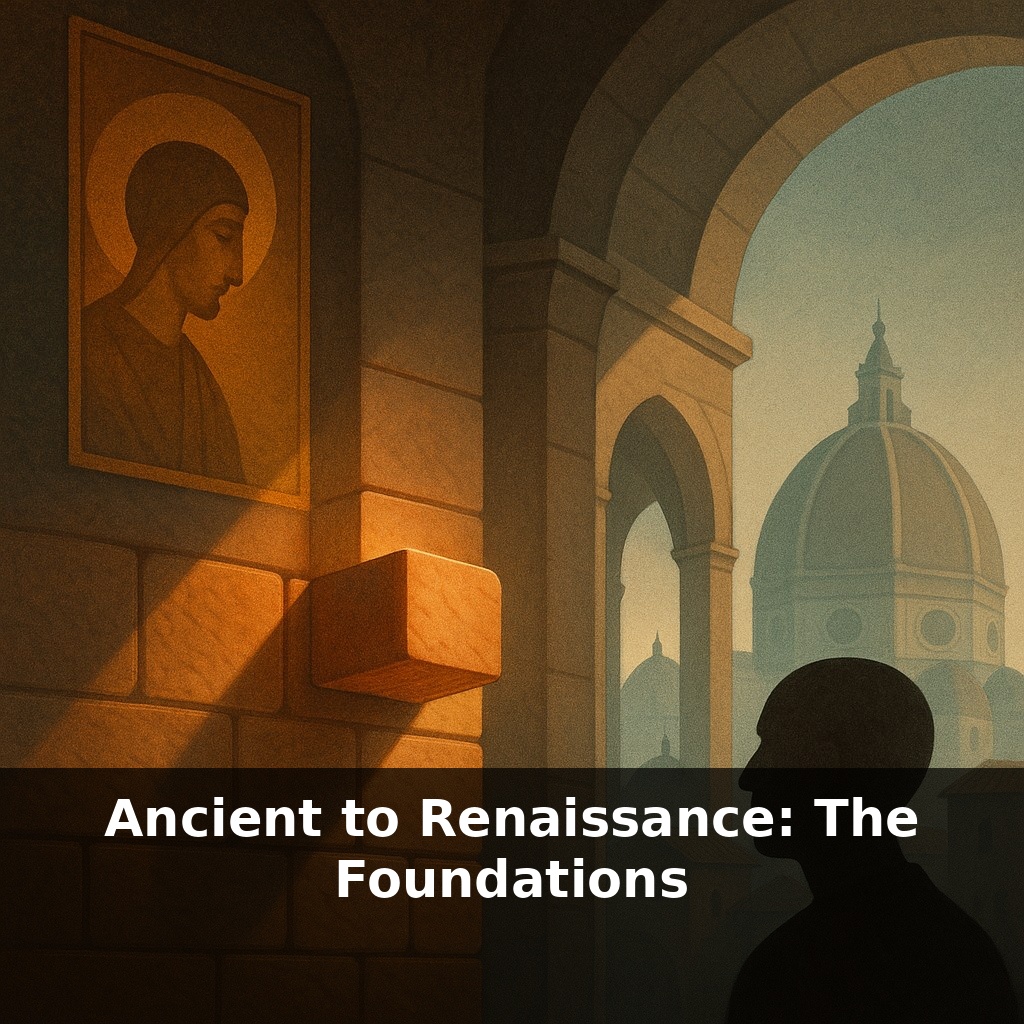
A single brick, laid in Florence six centuries ago, is still shaping how you see movies today. In this episode, we drop into a cathedral workshop, step into a dim chapel in Padua, and watch artists slowly abandon gods’ eye symbols for our human point of view.
Stand in front of any Renaissance painting and you’re looking at the endpoint of a very long experiment: thousands of years of artists testing how to turn messy reality into meaningful images. Before Giotto worried about where light was coming from, Egyptian artists were locking bodies into timeless profiles; before Brunelleschi puzzled over his dome, Greek sculptors were twisting marble into lifelike motion. Across those centuries, the job of the artist quietly shifted—from visual priest and record‑keeper to observer, analyst, and storyteller of everyday human experience. In this episode, we’ll trace how three big breakthroughs—natural light, believable space, and convincing bodies—emerged from slow, practical problem‑solving: how to decorate tomb walls, how to guide worshippers, how to make stone and paint feel alive. Along the way, you’ll see why a fresco in Padua and a brick dome in Florence belong to the same revolution.
To see how deep this experiment runs, rewind far before domes and chapels. Early Egyptian and Mesopotamian images weren’t trying to “look real” the way a selfie does; they were designed to work, like carefully coded rituals. A profile head with frontal eye, a king towering over enemies—these were visual rules, repeated for centuries to keep cosmic order in place. Greek and Roman artists then stretched those rules toward observation: athletes twisting, drapery clinging to muscle, portraits hinting at personality. By the Middle Ages, those layers quietly coexisted in churches, manuscripts, and city squares.
Step inside a medieval church and the first thing you’d notice isn’t a single masterpiece, but a dense collage of images: painted walls, carved portals, jeweled reliquaries, tiny saints glowing in manuscript margins. Art was everywhere because images were doing heavy lifting—teaching, warning, commemorating, dazzling—long before most people could read.
By the 1200s, those images began to change in small but telling ways. Figures lean slightly, faces trade rigid masks for tentative emotion, settings hint at depth instead of flat gold. None of this explodes overnight; it’s more like a slow change in the weather. Patrons still want clear religious messages, but they’re also paying for recognizable donors kneeling in the corner, for local landmarks tucked into Jerusalem scenes, for stories that feel closer to lived experience.
Giotto steps into this climate with the Arena Chapel. His frescoes don’t just narrate; they organize attention. Architectural frames function almost like stage sets, grouping characters into readable clusters. The way a grieving figure curves over a body directs your eye without needing arrows or captions. Light, instead of flat color blocks, helps separate foreground from background, main actor from onlooker. These are design solutions to practical problems: how do you make a crowded wall intelligible from the back of a dim chapel?
A century later, Masaccio pushes that logic further in “Holy Trinity.” The architecture he paints is carefully constructed so that, if you stood at the intended viewing spot, the illusion of a stone chapel snaps into alignment. This isn’t just clever geometry; it’s a contract with the viewer. Your position in front of the painting suddenly matters. Stand here, see this. Move, and the spell weakens.
At the same time, builders like Brunelleschi confront equally concrete puzzles: how to span a huge space without collapsing, how to lift materials high above the city, how to keep weight distributed. His double-shell dome solves structural issues, but it also reshapes the skyline and, with it, how people imagine their place in the world—Florence crowned not by a fortress, but by a vast, ordered curve rising over daily life.
By the late 1400s, artists fuse these strands—clarity of storytelling, control of the viewer’s position, and daring engineering—into a toolkit later generations will treat as “normal.” But at the time, each fresco, panel, and brick vault is an experiment, nudging images away from inherited formulas toward a more negotiated relationship with the viewer’s body, eye, and movement.
Think of these shifts less as genius “lightbulb moments” and more as careful recipe testing in a kitchen that spans centuries. Egyptian artisans repeat reliable combinations—profile heads, rigid stances—like a trusted stew that must taste the same for every ritual. Later, Greek sculptors start tweaking ingredients: rotating a shoulder, bending a knee, carving veins over muscle. By Giotto’s time, painters are experimenting with timing and heat—how fast plaster dries, how thin color must be to blend before the surface sets. That’s why fresco workshops behave almost like professional bakeries: assistants grind pigments, lay fresh plaster in sections, and the master steps in for the crucial final touches. In the 1400s, oil painting arrives as a slower, more forgiving medium; artists can glaze, scrape, revise. Leonardo uses this flexibility to test how skin stretches over bone, how a smile shifts with tiny changes at the corners of the mouth. Technical curiosity and belief systems feed each other: new tools enable new images, and new ideas demand tools that don’t yet exist.
Future tools won’t just preserve old images; they’ll keep asking new questions. 3‑D scans can log every crack like a patient’s medical chart, while AI compares centuries of photos the way meteorologists track shifting weather fronts. Virtual reconstructions may reunite altarpieces split across museums, letting us “walk” through lost chapels. Even exhibition design could update in real time, testing how different layouts change where visitors pause, cluster, or simply walk past.
Your challenge this week: treat your day like a museum we haven’t mapped yet. Each time you catch yourself framing something—a selfie angle, a window view, a game screen—pause and ask: what did I leave out, and why? By next episode, you’ll start to notice how your own “exhibitions” quietly edit reality into meaning.