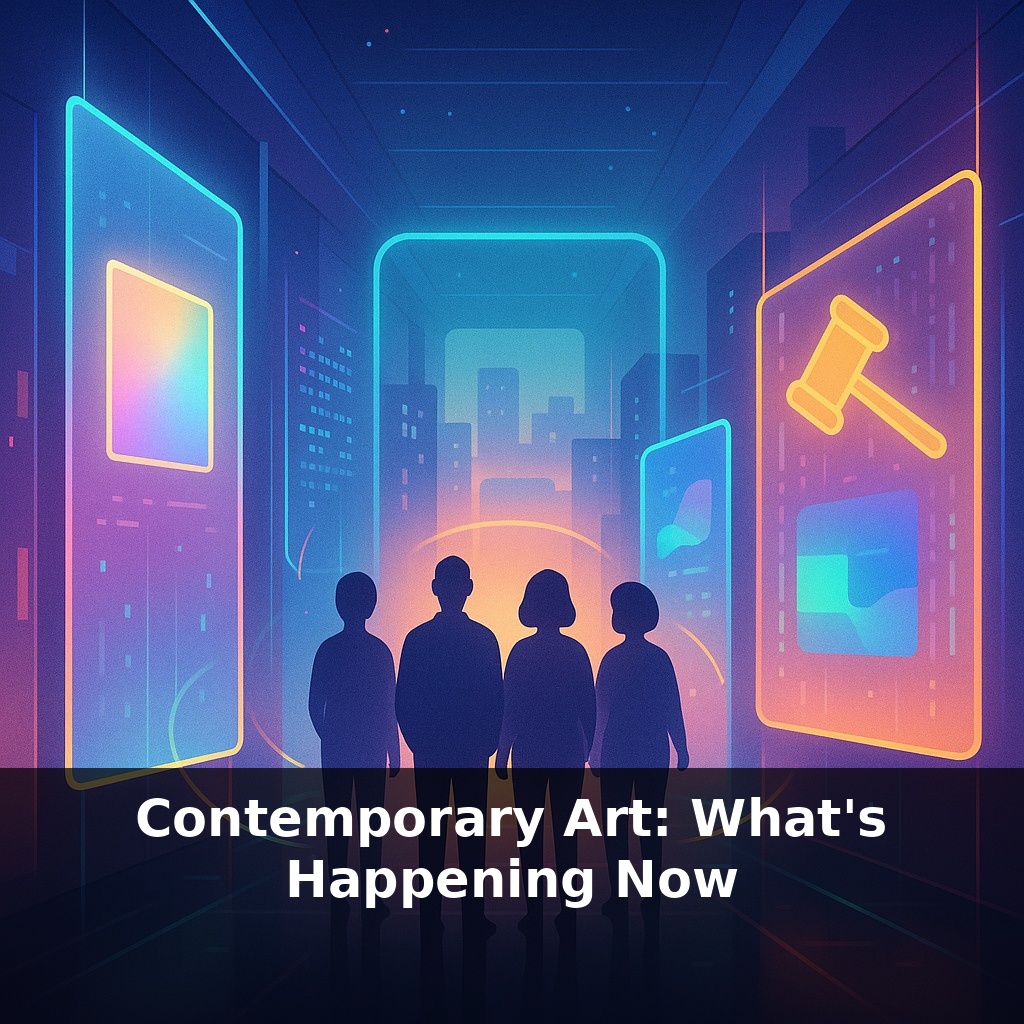
A JPEG file sells at Christie’s for over sixty million dollars. In Tokyo, crowds line up not for paintings, but for rooms of shifting light that react as they move. Contemporary art isn’t on the wall anymore—it’s inside our screens, our cities, and sometimes our own data.
In this episode, stay with that crowded Tokyo hallway or the auction room full of glowing screens—and zoom out. Those scenes aren’t exceptions; they’re signals. Contemporary art right now is less about “what does it look like?” and more about “what system is it plugged into?” Social media feeds, data centers, climate models, protest movements, supply chains—these are today’s equivalent of paint and marble.
You’ll meet artists who train algorithms like you’d sourdough starters, feeding them images until they develop a distinct “taste.” Others design exhibitions that behave like weather systems, never quite the same twice, shaped by each visitor’s movement or voice. We’ll track how curators, coders, collectors, and casual viewers all end up co-authoring the work—and why that makes walking into a contemporary show feel less like entering a quiet library and more like stepping into a live, unfolding conversation.
Walk into a studio today and you might find motion-capture suits, game engines, or a whiteboard full of climate data instead of easels. Many artists think less in terms of “objects” and more in terms of systems: who participates, who’s left out, what flows of money, attention, or power a work taps into. Some treat a museum like a lab, testing how people move, post, or argue around a piece. Others collaborate with scientists or activists, using art as a kind of public R&D, where prototypes take the form of performances, hacked devices, or temporary communities that appear, then vanish.
Step into a major biennial or scroll a digital art platform and you’ll notice something: there is no single “contemporary look.” In the same room you might see a hand‑woven tapestry about colonial history, a VR piece built in a game engine, and a performance where the “artwork” is a group of strangers cooking and eating together. Style matters less than the questions being asked: Who controls images? Who gets seen? What counts as evidence, or truth, or care?
One strong current is socially engaged art. Instead of making objects about an issue, artists build projects with the people directly affected. Tania Bruguera, for example, has worked with immigrant communities to set up temporary “schools” for civic action, where the artwork is the network of skills and trust that forms. You don’t just look at it; you live inside it for a while.
Another thread runs through identity and representation. Artists like Kerry James Marshall or Zanele Muholi insist on filling galleries with Black lives and queer lives on their own terms—not as symbols, but as specific, complicated people. Others work with archives or family photos, cutting, layering, or re‑staging them to ask who wrote the official version of history and what’s missing from the frame.
Then there’s the environmental turn. Some artists treat the gallery like a small ecosystem, using living plants, fungi, even polluted water to visualize slow, planetary change. Others work far from museums, collaborating with scientists or local residents to monitor coastlines, restore habitats, or make visible the infrastructures—mines, cables, cargo routes—that hide behind our devices. The “finished piece” might be a video, a legal proposal, a seed bank, or a map.
A recurring question under all this: how do you make art in a world that’s already overflowing with images and information? Many contemporary artists respond less by adding more noise than by re‑routing what’s already there—sampling, remixing, or intervening in existing systems so that you suddenly notice how you’re entangled in them.
Stand in front of a screen that shows a stranger’s face aging, glitching, and re‑forming as you speak; your voice data is steering a portrait that never settles. In another room, visitors’ heartbeats are picked up by sensors and translated into pulses of light along the walls: a temporary architecture built from everyone’s bodies in the space. Outside the museum, an artist quietly buys targeted ads that appear only to people within a few blocks of an oil company’s headquarters, filling their phones with calm, looping videos of the coastline that company is eroding. None of these works look alike, but they share a tactic: instead of inventing a new world from scratch, they twist the one we’re already in, rerouting flows of attention, desire, and data so you feel them differently. Like a doctor using dye to make blood vessels visible on a scan, these projects inject just enough color into hidden systems that you suddenly see where the pressure points are—and where you might press back.
Museums may start to feel less like quiet temples and more like laboratories or street markets, where ideas are traded, tested, and sometimes hacked in real time. Certifications for “slow looking” or carbon‑light shows could sit alongside blockbuster screens. Art schools might pair studio critiques with ethics and statistics, so reading bias reports becomes as normal as mixing paint. For you, the “right” way to engage may shift from decoding meanings to asking, “What system is this work nudging, and how?”
So as you move through today’s art—whether it’s on a sidewalk, in a headset, or tucked into a quiet corner online—treat it less like a quiz and more like tasting a new recipe. Notice what lingers: a question, a discomfort, a small shift in how you read a headline. That aftertaste is where contemporary art is quietly doing its deepest work.
To go deeper, here are 3 next steps: 1) Open Artsy.net and follow 5 living artists working in themes mentioned in the episode (like post-internet art, climate-focused installations, or AI-assisted painting), then turn on alerts for their upcoming shows. 2) Watch one full walkthrough from the Louisiana Channel or Tate Modern’s YouTube playlists on contemporary art, pausing to screenshot any work that feels confusing or exciting, and then look up the artist’s website to see how they describe their own practice. 3) Borrow or buy “Vitamin P3: New Perspectives in Painting” or “Why Art Matters” (if mentioned in the episode’s reading list) and pick one artist from the book, then search for a recent interview or studio visit with them on Google or YouTube so you can connect what you read to how they actually work today.