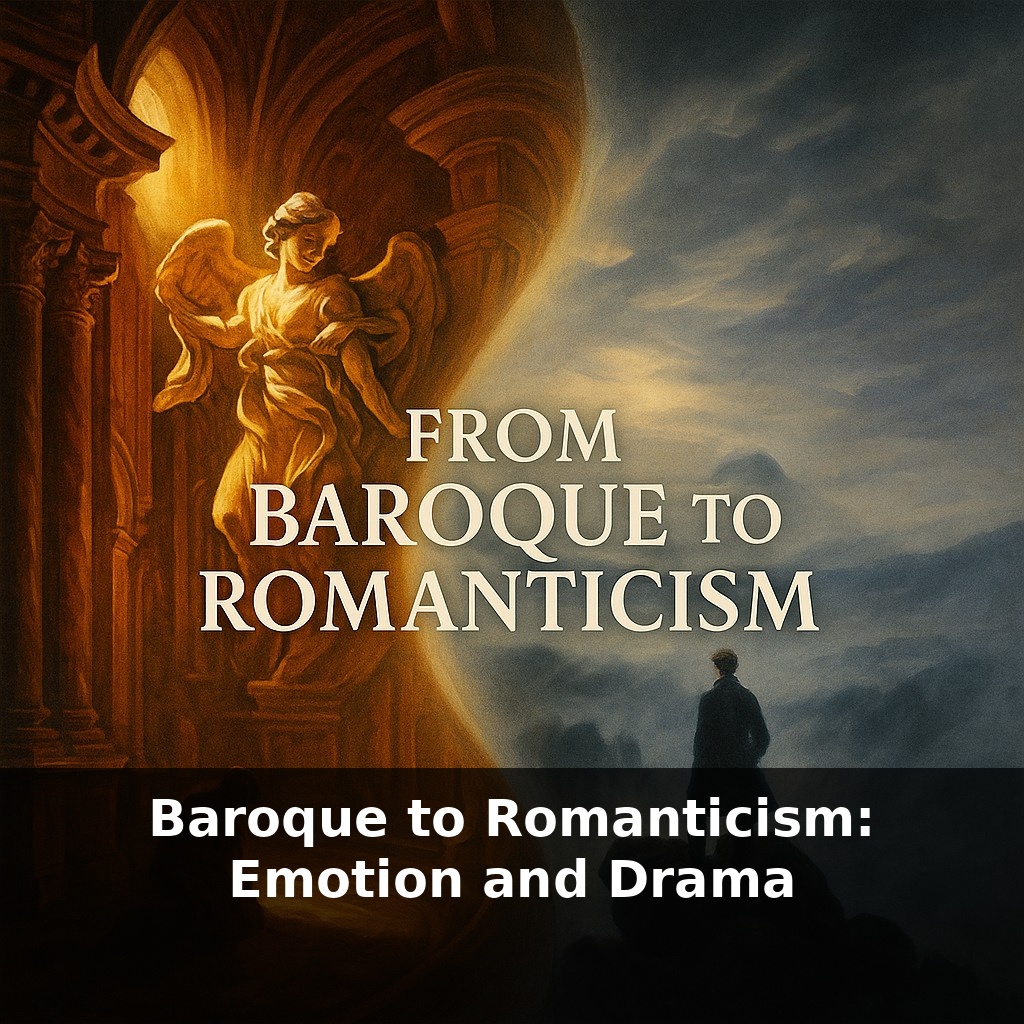
A woman collapses in a church, an angel above her carved so vividly you almost hear her breathing. Two centuries later, a lone figure stands on a cliff, swallowed by fog. Same continent, same tradition—yet the drama has flipped from public spectacle to private storm.
In this episode, we move from identifying *what* Baroque and Romantic art feel like to *how* artists actually engineered those feelings. Think less “style labels,” more “emotional technologies.”
Baroque painters and sculptors worked almost like expert chefs managing flavour: they dialled up contrast, twisted bodies into spirals, and layered space so your eye can’t help but follow their planned route. Caravaggio drags you straight to the action; Bernini times your reaction with hidden light sources and architectural framing. Nothing is accidental.
Romantic artists inherit many of these tools but swap out the recipe. They stretch horizons, shrink human figures, and blur forms so that uncertainty itself becomes the subject. Goya, Friedrich, and Turner all use composition not just to show events or places, but to provoke unease, awe, or moral outrage—on a deeply personal level.
Baroque and Romantic artists weren’t just “expressing themselves”; they were responding to shifting worlds. Baroque flourished in an age of religious conflict and royal display, when lavish churches and palaces functioned like persuasive media campaigns. Romantics, by contrast, painted and wrote through revolutions, industrialisation, and scientific upheaval, when old certainties felt fragile. Think of the canvas as a pressure gauge: in the Baroque, it registers the power of institutions; in Romanticism, it records the strain on the individual psyche facing vast, often indifferent forces.
Baroque and Romantic artists also rewired how viewers *participate* in an artwork.
In a Baroque chapel, you’re choreographed like a guest at a royal banquet. The work expects you to stand in a particular spot, at a particular height, often at a particular time of day, so that the light, perspective, and emotion all “click.” Bernini’s Ecstasy of Saint Teresa doesn’t just sit on an altar; it’s framed by side sculptures that act like an audience, nudging you to join their reaction. Your role is half-witness, half-accomplice. You’re meant to be swept along by a carefully staged revelation.
Romantic artists loosen that script. Instead of guiding every step, they leave gaps you have to complete yourself. Take Friedrich’s Wanderer above the Sea of Fog: the central figure blocks your view of the landscape, so you read the scene *through* his posture. Are you sharing his triumph, his doubt, or his loneliness? The painting never tells you. That ambiguity is the point; you supply the emotional answer.
Colour shifts too, from instrument to atmosphere. Baroque palettes often cluster around rich reds, golds, and deep blacks that echo church interiors and court clothing—luxury pigments broadcasting authority. Romantic painters expand into strange greens, smoky violets, and raw earth tones. In Turner’s late seascapes, form nearly dissolves into weather; colour behaves less like fabric and more like stormclouds. Instead of describing objects, it conveys temperature, danger, or calm.
Even subject choice reveals this pivot. Baroque artists frequently elevate familiar stories—biblical scenes, classical myths, state ceremonies—using intensity to confirm shared narratives. Romantics hunt for moments when meaning itself feels unstable: executions with no heroic resolution, shipwrecks where rescue is uncertain, ruins swallowed by mist. The canvas becomes a place to *question* rather than affirm.
This evolution helps explain why modern viewers often feel that “serious” art should either confront power or probe inner life. We’ve inherited both expectations: that images can work like persuasive architecture around us, and like psychological mirrors within us.
Your challenge this week: whenever you scroll past an image online that feels “dramatic,” pause for five seconds and ask two questions—“Is this trying to direct my reaction, or make me finish the story myself?” and “Does it lean more toward stage-set certainty or foggy uncertainty?” By the weekend, notice which kind you’re more drawn to—and what that says about how you like your emotions handled by images.
Think of a hospital ward. One room holds a tightly scheduled surgery: lights fixed, roles assigned, every movement planned. That’s closer to how a Baroque ceiling works when you stand in the “correct” spot—your response is part of a controlled procedure. Down the corridor, another room hosts a difficult diagnosis: the doctor lays out the scans, then pauses, leaving space for questions, fear, hope. That pause feels nearer to Romantic uncertainty, where you’re invited to interpret.
You can see these modes today in very mundane places. A luxury brand campaign, with its glossy spotlight, choreographed poses, and firm slogan, borrows Baroque certainty to sell authority and desire. An indie film poster showing a small figure against looming weather, with a cryptic title, leans on Romantic openness to hint at inner conflict.
Notice too how weather apps or climate visuals work: clean, sharply defined storm icons “tell” you what to feel (prepare, protect), while hazy heat-maps of future scenarios make you sit with unease, filling in your own emotional forecast.
A push toward immersion is reshaping how we meet images. AR and VR don’t just show works; they stage experiences that react to your gaze, heartbeat, even your voice—like recipes that adjust seasoning as you taste. Museums are testing rooms that darken, warm, or echo in sync with projected paintings. The open question: as systems learn which scenes make us stay longer or feel “more,” will they expand our emotional range—or quietly narrow it to what keeps us hooked?
Maybe the real thread between Baroque pulpits and Romantic cliffs is how both quietly train us to feel on cue. That habit follows us into binge-worthy shows, protest photos, even dating profiles. Next time an image grips you like a plot twist or a weather alert, ask: whose script am I inside—and do I want to keep reading it?
Here’s your challenge this week: pick one Baroque piece (like Vivaldi’s *Winter* or Bach’s *Toccata and Fugue in D minor*) and one Romantic piece (like Tchaikovsky’s *Romeo and Juliet Overture* or Chopin’s Nocturne in E-flat major) and listen to them back-to-back in one sitting. As you listen, physically conduct the beat with your hand during the Baroque piece to feel its driving rhythm, then switch to tracing the main melody line in the air during the Romantic piece to notice its soaring, emotional shape. Finally, replay both and deliberately exaggerate your facial expressions to match the drama you hear—treat it like a mini “silent performance” and see which era pulls a stronger emotional reaction out of you.