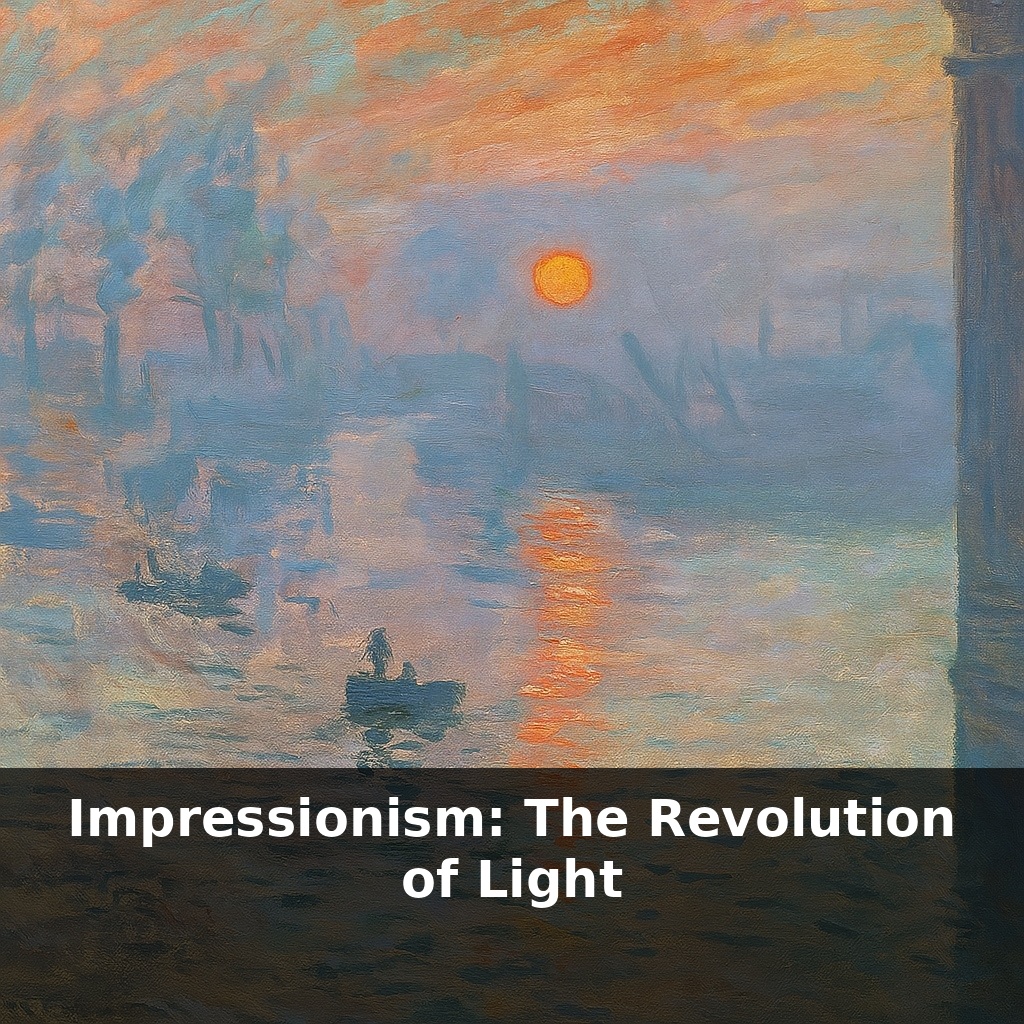
A critic once mocked a painting as just “an impression” of a sunrise. Within about a decade, that insult had named a movement, crashed the respectability of the Paris art world, and reshaped how we see light itself. A quiet revolt began… with a few flickers of color on canvas.
In the 1870s, the “right” way to paint in Paris was almost as scripted as a formal dinner: dark backgrounds, smooth surfaces, noble subjects, long studio hours. Then a handful of painters started breaking all the unspoken rules at once. They cut their canvases strangely, cropped figures at the edge, left brush-marks visible, and chose subjects that felt embarrassingly ordinary—train stations, factory smoke, café waiters, women ironing shirts.
To many critics, these pictures looked unfinished, like drafts that should never have left the studio. But that roughness was deliberate. It was closer to a quick note jotted down while a tune is still in your head than to a polished speech. And just as a handwritten margin note can reveal more urgency than a typed report, these paintings aimed to trap the pulse of a specific hour, a specific corner of the modern city, before it slipped away.
Instead of treating art like a fixed monument, these painters treated it more like a live broadcast: whatever was happening in front of them, however awkward or unspectacular, was fair game. New technology helped. Ready-made paint tubes meant they could leave the studio and work on riverbanks, in train stations, on café terraces, chasing shifting scenes the way someone today might chase good lighting for a photo. At the same time, scientists were publishing theories about how the eye mixes color. The artists read, argued, experimented—and their canvases became laboratories for these visual experiments.
Stand in front of a crowded wall of 19th‑century paintings and you can spot the rebels almost instantly. Where their neighbors sink into brown varnish and perfect outlines, these pictures seem to vibrate: a sky flickers with strokes of lilac and lemon; a black coat is threaded with navy, green, even red. Up close, it’s chaos. Step back, and suddenly your eye does the blending the brush refused to do.
That refusal was deliberate. Instead of smoothing transitions, these painters laid down short, broken marks that sit side by side like ingredients on a cutting board. Only when you “cook” them together with your gaze do they become steam, shadow, or sunlight. This is why their canvases so often fall apart when you zoom in on a phone screen, yet snap into clarity from across the room: they’re designed for distance, for the way a human eye actually behaves in front of a scene.
Color choices were just as radical. Shadows had long been painted with browns and blacks; now violets slipped into snow and greens hid in human skin. Monet could stand in the same field, in front of the same haystack, and find a brass‑gold pyramid at sunrise, a bluish, dissolving mound at dusk, a ghostly pink form in winter fog. It wasn’t the object that changed—it was the envelope of air and time wrapping around it, and that’s what he chased.
Composition shifted, too. Degas sliced figures with the frame as if he held a camera, catching a dancer mid‑gesture, a racehorse mid‑stride. Mary Cassatt pressed viewers right up against theater boxes and bathtubs, as if we were eavesdropping. These odd croppings weren’t accidents; they mimicked the way attention jumps, how you half‑notice a hat brim, a hand, a reflection in passing.
Subject matter followed daily life. Instead of mythological heroes, we meet laundresses, commuters, children in gardens, women at café tables. Yet these scenes are carefully constructed: diagonals pull you into train platforms, arcs of movement loop your eye around ballet rehearsals, rhythms of color echo across a crowd. Under the apparent spontaneity lies a quiet architecture.
When critics scoffed that such works were “mere impressions,” they were partly right: these artists accepted that no painting could be permanent truth. It could only be a record of looking—shaped by weather, fatigue, excitement, and chance—held on the surface of paint before the moment dissolved.
Watch how this plays out in specific works. In Monet’s series of Rouen Cathedral façades, the stone seems to liquefy from canvas to canvas: in one, it’s brittle and frosty; in another, it glows like embers pressed behind lace. The architecture barely shifts, yet the mood flips as sharply as stepping from a chilly hallway into a sun‑warmed room. Degas, obsessed with repetition of another kind, haunts the wings of the Paris Opéra. In one pastel he buries a dancer’s face in shadow and pushes the glare onto a single shoulder strap; in another, the same stage becomes a mist of oranges and sour blues, the bodies almost evaporating into dust. Mary Cassatt turns this sensitivity inward. In her domestic scenes, a child’s ear catches a surprising slash of color, or the shine on a teacup nudges your eye toward a quiet exchange of glances. Like a good diagnostician noticing tiny changes in a heartbeat, these artists train you to read small visual shifts as emotional data.
Study these works and you start treating the world like a living test strip. A rainy street becomes a shifting data field; a sunlit face feels as calibrated as a scientific slide. That sensitivity now seeps into fields far from the museum. UX designers borrow it to decide how a button should glow at “rest” versus “hover.” Neuroscientists mine it to probe how the brain edits what we see. Even your phone, smoothing a sunset into gradients, quietly echoes those 19th‑century hunches about how vision prefers change to certainty.
Notice how this changes your own seeing: a commute becomes a slideshow of micro‑moods, each corner store or bus stop shifting like scenes in a slow‑turning kaleidoscope. Artists once branded as reckless are now closer to field researchers, logging weather, smoke, and café chatter. Follow their lead and your day turns into a sketchbook of small, shimmering trials.
To go deeper, here are 3 next steps: 1) Pull up high-resolution images of Monet’s *Impression, Sunrise*, Renoir’s *Dance at Le Moulin de la Galette*, and Pissarro’s *Boulevard Montmartre* on Google Arts & Culture and zoom in to study how each painter breaks light into visible brushstrokes. 2) Watch the free “Impressionism” playlist from the Musée d’Orsay’s YouTube channel, then cross‑reference what you hear with a quick skim of Sue Roe’s book *The Private Lives of the Impressionists* to connect the artworks to the artists’ personal rebellions. 3) Open a free drawing/painting app like Krita or Procreate (if you have an iPad) and, using just a limited palette (e.g., ultramarine, cadmium yellow, vermilion, white), try recreating a small section of Monet’s sky or water so you can feel how Impressionists built color and light directly on the surface.