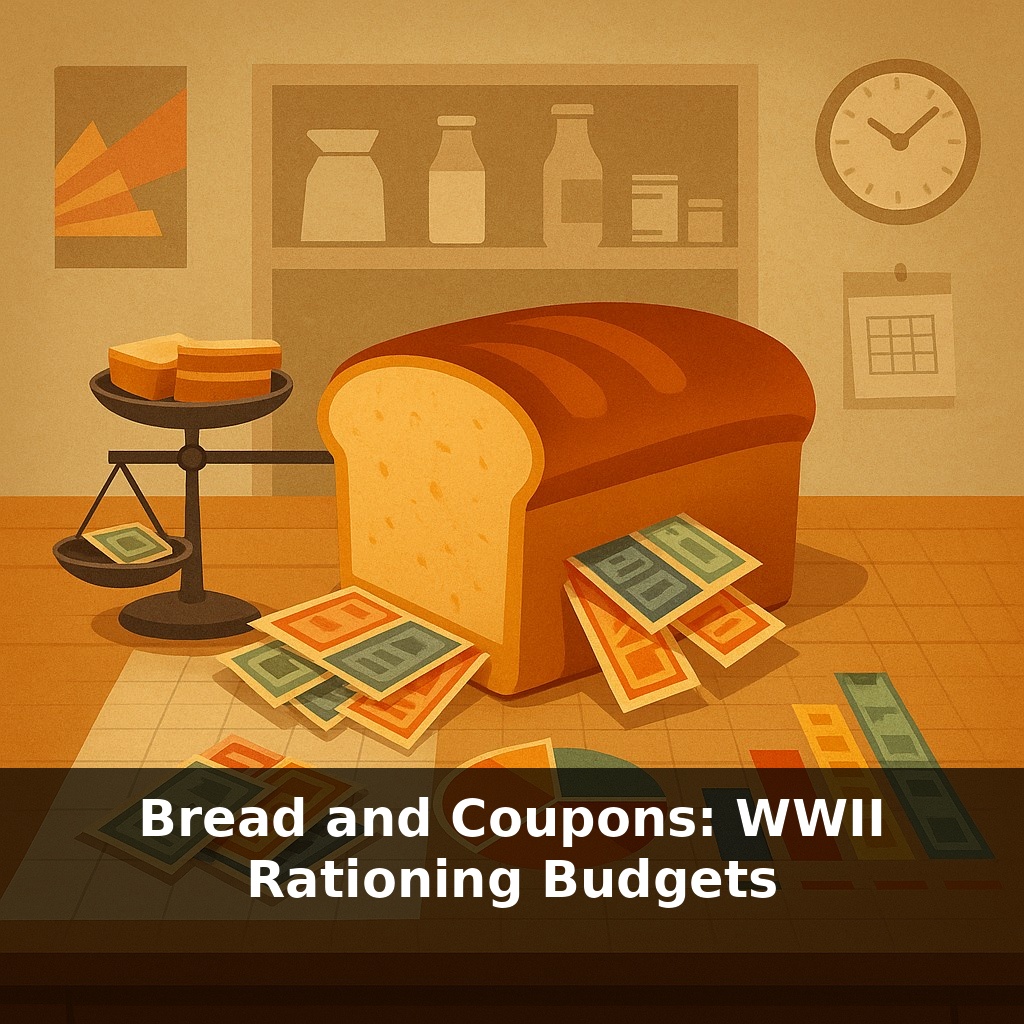
Bread and Coupons: WWII Rationing Budgets
📝 Transcript
Bread lines that don’t shorten, prices that don’t rise, and yet almost nothing on store shelves. In this episode, we step into a world where your grocery budget isn’t cash, but colored coupons—and the government, not the market, decides how much bread your family can afford.
In wartime kitchens, the real drama wasn’t only at the front—it was at the pantry door. Every meal started with a calculation: not “What do we feel like eating?” but “What can we afford in points, sugar, and patience this week?” Housewives and factory workers became reluctant accountants, turning jam jars into ledgers and notebook margins into balance sheets of bacon, butter, and tea. Ration books sat beside family Bibles and rent receipts: another document that could not be lost, traded, or casually spent. The stakes were high. Overspend on meat this fortnight and you weren’t just broke—you were locked out of treats for the rest of the month. Under-spend and you weren’t frugal; you were leaving calories on the table in a world where waste felt almost immoral. Out of that pressure came a strange creativity: soups stretching into stews, stale bread reborn as puddings, neighbors quietly pooling points.
But rationing wasn’t just about food; it was a full-spectrum budget for national survival. Fuel, clothing, and even soap were folded into a kind of enforced minimalism that governments tracked like a wartime spreadsheet. In Britain, bureaucrats calculated average calories, fabric yards, and coal needs per person, then reverse‑engineered how to slice a finite pie across millions of households. Households, in turn, became micro-planners: counting bus rides to save petrol, patching coats instead of buying new ones, and timing oven use like shared Wi‑Fi on a slow connection. Every small choice was part of a collective balance sheet.
Think of the whole system as a three‑layer budget: what the state allowed into the country, what it let shops sell, and what each home could “spend.”
At the top, officials weren’t guessing. They knew, almost down to the slice of bread, how much energy an adult doing factory or office work needed. That’s how Britain ended up with those 2,800 calories a day from controlled foods—helped by a dense, brown “National Loaf” that was fortified, filling, and famously unpopular. Under the skin of that loaf sat a spreadsheet: tonnage of imported grain, shipping losses, mill capacity, regional bakery output, and how many mouths each county had to feed.
The middle layer was the shop counter. Money still changed hands, but prices were pinned down by law, and supplies were throttled through licenses and quotas. A butcher might receive just enough meat to satisfy the points his customers were expected to spend that week—no more. Even if he had cash buyers lined up around the block, selling off‑book could mean losing his license or facing a court. The result was eerie: queues, but no bidding war; demand, but no price surge.
The bottom layer was the household budget. Coupons acted like a parallel currency with strict expiry dates. Some items cost cash but no points (like most vegetables), others cost points and cash (meat, fats), and some were “points free” but simply rare (seasonal fruit, if it showed up at all). Families learned to treat these categories differently: points were guarded, cash was stretched, and windfalls—like an unexpected delivery of fish—could prompt a sudden reshuffle of the week’s meals.
Information glued the layers together. Britain’s “Food Facts” radio spots and posters didn’t just scold; they offered tactics: how to swap bacon for cheese this week, why dried eggs conserved shipping space, how to use every crumb of that coarse bread. In the U.S., color‑coded stamps and shifting “ration periods” forced households to track dates as carefully as dollars.
Of course, not everyone played by the rules. Forged coupons, “diverted” deliveries, and midnight slaughtering rings turned scarcity into a business. Hence those black‑market eggs at several times the legal price, and those eye‑watering fines that made cheating feel less like frugality and more like financial Russian roulette.
A quietly radical thing happened inside those coupon systems: people began to treat time, favors, and skills like shadow currencies. A clerk might swap her talent for deciphering the latest ration tables for a neighbor’s talent for turning root vegetables into something festive. Families learned which weeks to “invest” in pricier items—say, saving meat points for a holiday—versus weeks to “diversify” into cheaper staples. Teenagers became scouts, mapping which shops were likeliest to have off‑ration surprises, like a stray tin of fruit. Some streets evolved informal “allocators”: the auntie who knew which widower wouldn’t use his full meat allowance, or which lodger was hoarding sugar for home brewing. One way to picture it is like a tech company managing limited server capacity: not enough to give everyone peak usage all the time, but just enough if you stagger demand, prioritize critical tasks, and teach users how to schedule their own loads intelligently.
Ration budgets hint at how we might handle tomorrow’s scarcities without defaulting to chaos or pure price wars. Carbon caps, water quotas, even bandwidth during grid stress could be allocated in tiers, then “spent” via apps that feel more like calendars than wallets—nudging us to time-shift laundry, flights, or data-heavy work. Think less supermarket queue, more air-traffic control: lots of moving parts, but shared rules so everyone gets at least a safe landing.
Your challenge this week: Run a one‑week “coupon drill” in your own life. Pick a resource you usually treat as limitless—phone data, streaming hours, car trips, meat portions—and give yourself a strict weekly allowance. No rollovers, no top‑ups. Track where you burn through it fastest, where you barely notice cutting back, and which hacks (planning, sharing, swapping tasks) save the most. You’re pressure‑testing your habits for a future where limits aren’t optional.
Ration budgets quietly rewired what “enough” meant. Many families kept using frugal habits long after coupons vanished, like muscle memory from a tough season. Treat this as a sandbox, not a scolding: a place to prototype future money and resource rules, the way a musician rehearses scales so improvising later feels natural, not frightening.
Try this experiment: For the next 7 days, give yourself a “WWII-style ration” on one everyday item—like limiting yourself to one loaf of bread and a fixed number of slices per day, or a set number of “coupon points” for meat and sugar that you can’t exceed. Before you shop, decide exactly what your weekly ration is (e.g., one loaf, 4 eggs, 100g sugar) and label those items in your kitchen as “rationed.” Each day, plan your meals around stretching those rations, just like a 1940s home cook would—cutting thinner slices, repurposing leftovers, and swapping in cheaper substitutes. At the end of the week, compare your grocery spending and food waste to the previous week and notice how the “coupon mindset” changed your decisions.
From this course
Unusual Budgets in Unusual Times
6 episodesUnlock all episodes
Full access to 6 episodes and everything on OwlUp.
Subscribe — $1.99/monthLess than a coffee ☕ · Cancel anytime