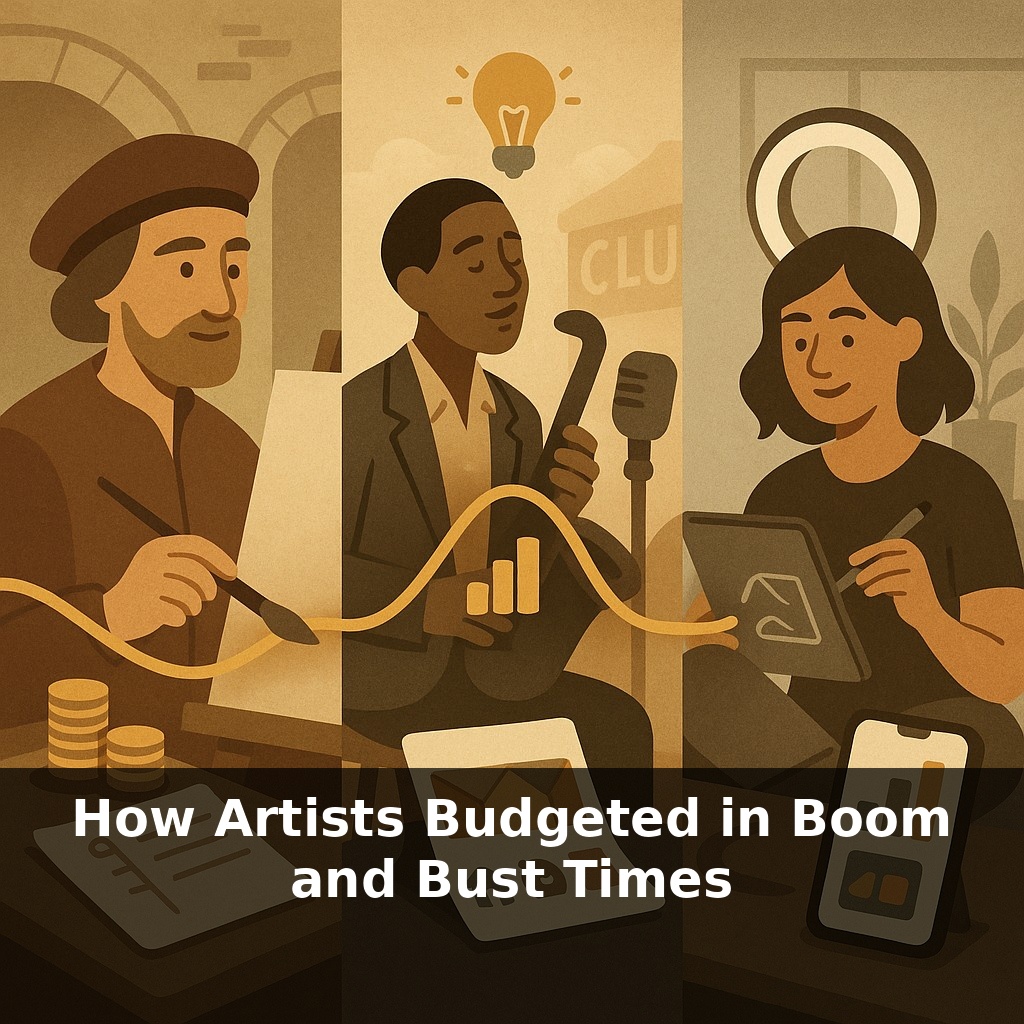
A Renaissance painter, a jazz musician in the Great Depression, and a TikTok illustrator today all share a secret: the ones who last aren’t always the most talented—they’re the best budgeters. Strange, right? In boom or bust, their money habits look almost exactly the same.
In good years, many artists act like the high-paying client will *always* call back, the gallery will *always* renew, the algorithm will *always* love them. Then one canceled show, one platform change, or one recession later, they’re scrambling—selling gear, moving studios, taking any gig that pays.
What’s striking, looking across centuries, is how the survivors structured their money more like a touring band than a solo act: multiple venues, different types of gigs, and a set list that can change last minute. One royal commission dries up? Teach. Prints not selling? Take on design work.
This episode digs into how artists quietly engineered that resilience: splitting how and when they got paid, treating some costs as “on wheels” instead of “cement,” and turning boom-time excess into future studio rent, not just bigger canvases.
So how did those habits actually play out on the ground? In boom years, some Renaissance workshops ran like small agencies: apprentices cranked out backgrounds, masters focused on prestige details, and side jobs—like designing festival decorations—quietly covered everyday expenses. Centuries later, WPA painters treated government wages as the “floor,” layering teaching or commercial sketches on top when they could. Today, a digital artist might stack a gallery show, a small Patreon, and a freelance UI contract. Different eras, same pattern: several modest streams instead of one heroic paycheck.
Start with the numbers: in 2019, U.S. visual artists averaged $52,000; a year later, that dropped to $36,000. The artists who didn’t panic-sell their lives on Craigslist had already built three quiet systems long before the crisis hit.
First, they treated *how* money arrived as carefully as *how much* arrived. Renaissance painters pushed for 1/3 upfront, 1/3 halfway, 1/3 on delivery not just for fairness, but to turn a single commission into three separate cash events. Today’s equivalent: a muralist charging a non‑refundable design fee, a progress payment when the wall is prepped, and a final invoice on completion. Crowdfunded projects mirror this with pre‑launch deposits, campaign payouts, and post‑launch royalties. Same project, staggered paychecks, fewer “all or nothing” months.
Second, they made fixed costs almost suspiciously small. Historical account books show studio rents that looked modest next to the artist’s best years, because they were sized for the *average* or even the *bad* years. Tools and assistants were expanded or shrunk like a software team scaling servers up or down with demand. Contemporary version: renting a shared space and only booking large-format printers or high-end gear per project, instead of locking into long leases and loans that assume every year will be 2019.
Third, in the good seasons, they stocked up on more than cash. Some kept detailed ledgers of who owed them favors, studio access, or introductions—social capital they could “spend” when work slowed. WPA records show artists quietly using stable wages to test new styles, building a back catalog that later became saleable exhibitions or books. Modern creators do something similar when they use boom‑time to batch content, build email lists, or pre‑record courses that can keep earning if client work disappears.
Underneath all of this is a mindset shift: treating volatility as normal, not as a personal failure. When you expect your income graph to look like a heartbeat monitor, you stop chasing a perfectly smooth line and start designing a system that works with the spikes instead of being destroyed by them.
A comic artist in 2024 might quietly mirror those old patterns by splitting their week into “lanes.” Three days are for well‑paying but less glamorous storyboard gigs, one day is reserved for a slow‑burn graphic novel that might not pay for years, and one day is blocked off for experiments—zines, odd collaborations, risky visuals that could later become prints, workshops, or a pitch deck. None of those days alone guarantees security; together, they form a rotating cast of roles the artist can dial up or down as seasons change.
Game developers do something similar when they release a tiny paid tool between bigger titles—a shader pack here, a tileset there—to soften the gap between launches. A touring DJ might treat local bar residencies as the stabilizer that lets them say yes to an unpaid festival set that grows their audience. These micro‑projects and “unsexy” gigs are often where the real insulation lives: they’re small enough to pause quickly, but durable enough to restart when opportunity or crisis demands a reshuffle.
If AI turns basic commissions into cheap templates and platforms skim higher fees, the “middle” market could thin out. Artists may respond by treating each work like a tiny startup: presales to test demand, on‑chain shares for early backers, and long‑tail royalties baked in. Think of a song that automatically pays its contributors wherever it’s remixed or synced—now imagine that for 3D assets, filters, even brush styles. The artists who learn contract literacy as fluently as color theory will set the new baseline.
So the deeper move isn’t just surviving cycles, it’s using them as a studio assistant: booms to test wilder formats, busts to prune what no longer fits. Think of releasing work like staggered book chapters—print run, audiobook, foreign rights—each phase a chance to renegotiate terms, find new allies, and quietly redraw what “making a living from art” can mean.
To go deeper, here are 3 next steps:
1. Open a free YNAB or Monarch Money trial and set up two “boom/bust” mock budgets using your *actual* last 3 months of income/expenses, labeling categories like “studio rent,” “materials,” “festival fees,” and “emergency art fund” the way the artists did in the episode. 2. Download the free sample chapter of *The Creative’s Guide to Money* by Ilise Benun (or a similar artist-focused money guide mentioned in the show) and complete the specific exercise on setting a “baseline survival number” so you know exactly what you must earn in lean months. 3. Set up an automatic transfer in your bank (even $15–$25) into a separate “Feast to Famine Buffer” savings account, then track how many “months of rent + groceries” you’ve built using a simple Google Sheet modeled after the envelope-style system the podcast guests described.