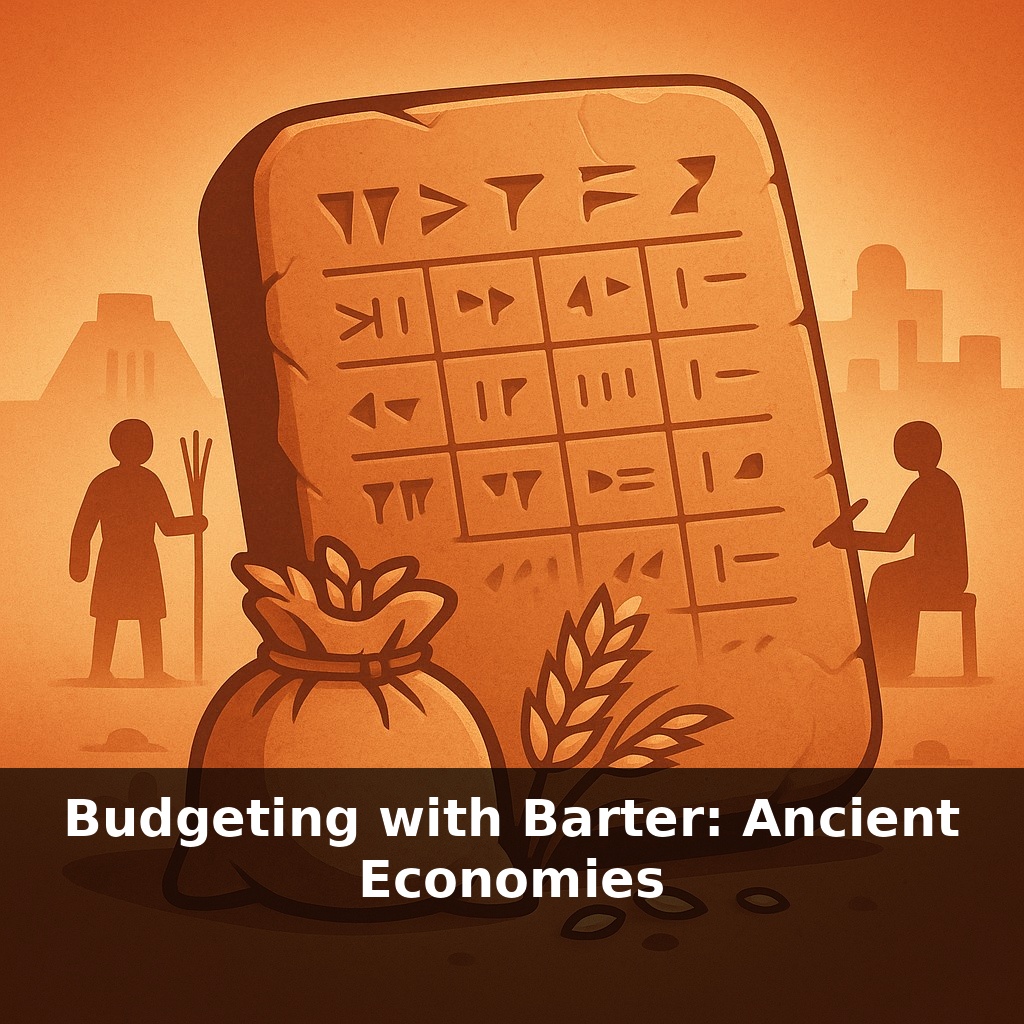
A farmer hands over sacks of barley, and in return, a distant temple agrees to feed his family for an entire winter—without a single coin changing hands. Barter wasn’t chaos; it was a carefully negotiated budget, tracked in promises, memories, and clay.
Those clay tablets in ancient cities weren’t just receipts; they were budget spreadsheets baked in mud. A scribe in Lagash might calmly record that a worker’s yearly pay in grain balanced against temple rations, tools, and debts—line by line, like entries in a family expense tracker. Barley, oil, wool, labor days: each had going “rates,” shifting with harvests, politics, or drought. Some goods even slid into proto-currency status, not because rulers decreed it, but because people kept using them as common yardsticks. And outside the temple walls, households ran their own quiet calculations: Who owes a favor? Which neighbor can be counted on for help at harvest? These weren’t random swaps; they were deliberate strategies for smoothing risk over seasons and lifetimes, especially when one bad year could erase everything.
Beyond the temple walls, these systems scaled up into whole regional networks. A caravan leaving an Inca storehouse or a Mesopotamian quay wasn’t just hauling goods; it was moving lines in a vast, unwritten budget that stretched across valleys and city-states. Proto-currencies like silver weights, barley measures, or strings of cowries worked less like “money” in the modern sense and more like a shared interface—compatible standards that let strangers settle accounts. Anthropologists later noticed a pattern: formal swaps sat on top of deeper layers of trust, credit, and obligation that quietly kept everything glued together.
In the middle of this, something quietly radical appears: choice. Once people share a rough sense of “how many loaves equals how much wool,” they can start deciding not just *what* to trade, but *when* and *with whom*. That’s where budgeting sneaks in—not as a written plan for most people, but as a mental map of options and trade‑offs.
In Lagash, those dense lists of equivalencies didn’t just help scribes clear temple accounts; they let a herder think, “If I bring goats instead of hides, I can still cover my obligations.” In early China, cowries made it easier to break big promises into small ones: instead of owing a whole animal or tool, you could settle a sliver of the debt with shells that most market-goers would accept. Their role was so central that the character 贝 still sits inside modern Chinese words for wealth and trade, a fossil of shell-budgeting built into the writing system.
Anthropologist Caroline Humphrey’s point—that nowhere was barter the *only* game—matters here. A household might keep a running “tab” of favors with kin, rely on temple rations in lean years, and head to a seasonal fair when they needed something unusual. That mix acted like a diversified portfolio. If the harvest failed, social credit or state granaries could buffer the shock long enough to survive the season.
The Inca took this to an extreme. Qollqas—terraced stores stacked with maize, potatoes, and dried meat—let officials think across years, not just months. Filling or emptying a storehouse was less a reaction to crisis and more a planned rebalancing: shift grain toward a drought‑hit valley now, collect more labor or textile tribute later. It resembles a modern operations dashboard, where one metric dips while another rises to keep the system stable.
And barter never really vanished. Today’s corporate barter exchanges plug firms into networks where unsold hotel rooms, ad slots, or excess inventory move through a shared ledger. IRTA’s estimate—that members can trim around 15% of cash spending—comes from the same basic move a Mesopotamian steward might recognize: preserve hard cash for what only cash can buy, and clear the rest of your needs in kind.
A merchant in a port city might quietly “budget” his promises long before any cargo arrived: a future shipment of timber already mentally sliced into roofs for local elites, planks for shipwrights, and a wedge reserved to pay caravan guards. Each commitment narrowed his flexibility, like reserving hotel rooms for a festival months ahead: profitable if the crowds show, risky if they don’t. In another region, a healer could stretch her influence by staggering obligations—helping one household now in return for wool later, taking smoked fish from another but delaying repayment until the next illness season. These weren’t vague favors; people remembered who reliably converted help into timely returns, and who chronically over‑promised. Modern corporate barter works similarly when a radio station trades unused ad slots for office equipment: it’s less about “free stuff” and more about not overbooking tomorrow’s audience to cover today’s needs. The hardest part in every era isn’t trading; it’s not painting yourself into a corner.
Disaster planners already sketch “barter backstops” for moments when ATMs and card readers go dark. Add mesh networks or satellite links, and phones could match needs the way rideshare apps match drivers and passengers. Cities might pilot local-credit circuits that sit idle in normal times, then switch on during shocks. Your challenge this week: list five things you could realistically trade if digital payments failed for a month—and who, specifically, might accept them.
So the real question isn’t whether money could vanish—it’s how quickly we’d rebuild our own ledgers from habits, favors, and shared tools. Think of a neighborhood turning a vacant lot into a rotating garden: seeds, labor, and harvests quietly rebalance over time. Follow that trail far enough, and today’s payment apps start to look like very fast, very shiny memory aids.
Before next week, ask yourself: How would my spending change if, like in ancient barter markets, I had to “pay” with my own time, skills, or handmade goods instead of money—what purchases suddenly feel too “expensive” in that trade-off? Looking at my last 5–10 purchases, which ones would be hardest to barter for because they don’t clearly benefit anyone else, and what does that reveal about what actually matters to me? If I had to set up a mini barter circle with friends or neighbors today, what specific skills or resources could I confidently offer (e.g., meal prep, childcare, tech help), and what recurring expenses might I realistically replace through those trades?