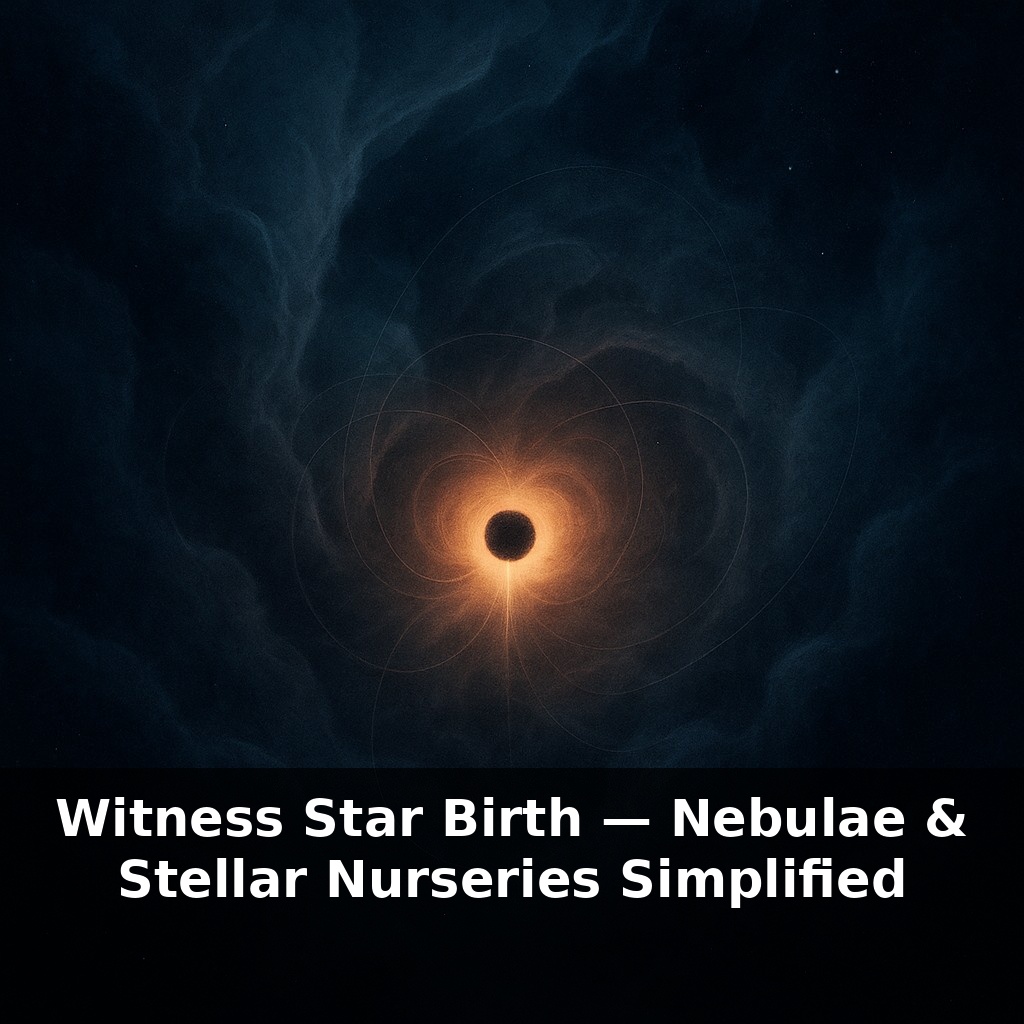
Stars are born in places colder than any winter on Earth, yet they end up blazing hotter than any fire we can create. You’re floating inside one of these dark clouds now—no stars in sight—when, ahead of you, a single point of darkness begins to glow.
Out here, the quiet is deceptive. Inside these frigid regions, space isn’t empty at all—it’s crowded with invisible hydrogen molecules, dust grains smaller than smoke particles, and tangled magnetic fields threading through it all. This is raw material on a colossal scale: a single cloud can cradle enough mass to build millions of suns, yet most of it will never ignite. Subtle motions—shockwaves from past explosions, the distant passage of a spiral arm, the nudge of nearby newborn stars—jostle the gas just enough for gravity to gain a tiny advantage. Where that happens, patches of the cloud begin to gather and thicken. From far away they look like knots in a tangle of cosmic wool; up close, they’re changing quietly but relentlessly, losing heat, shrinking, and concentrating matter into ever-smaller pockets that are poised to cross a critical threshold.
Within those tightening pockets, the physics quietly shifts. Random drifting gives way to organized motion as each clump starts to turn, like a slow, silent whirlpool measured in centuries. The spin flattens material into broad, rotating disks where chaos becomes structure: inner regions crowd closer, outer layers spread into faint halos. Temperatures creep upward from near-absolute zero, not yet fiery, but warm enough that hidden ices begin to change and chemistry grows more complex. JWST now catches these early patterns directly—rings, gaps, and filaments that hint where future stars and planets are already being mapped out.
As the disks evolve, their centers take the lead. Material spirals inward, piling up until the heart of each whirlpool becomes a protostar: not yet a true star, but no longer just cloud. Temperatures soar from frigid to tens of thousands of degrees in the core, squeezed by the weight of everything above. The outer layers, still dusty and opaque, trap this growing heat, so the young object shines mostly in infrared—perfect for telescopes like JWST, which can see where ordinary eyes see only darkness.
Around these brightening cores, the disks grow busier. Gas streams along spiral lanes, clumps collide and stick, and tiny mineral grains begin the climb from speck to boulder. In some disks, we already spot gaps and rings carved into them—signatures that forming planets may be quietly reshaping their birthplaces. The same structure that focuses matter inward to feed a protostar also shuffles leftovers into potential worlds.
Star birth is not a gentle process. Newborns often unleash narrow jets from their poles, blasting material out at hundreds of kilometers per second. Where these jets slam into surrounding gas, they light up as small, colorful shock fronts—fleeting signposts that reveal where hidden stars are still accreting. At the same time, intense radiation from the hottest infants sculpts nearby gas into pillars and cavities, eroding the very cloud that nurtured them. This feedback both halts further growth and seeds the cloud with fresh disturbances, setting the stage for another generation.
On larger scales, stellar nurseries like the Orion Nebula operate as crowded neighborhoods rather than isolated cradles. Thousands of young stars share the same environment, their combined light and winds constantly reshaping the region. Some low-mass stars huddle in calmer pockets where fragile disks can survive; others orbit too close to massive, luminous neighbors and have their disks stripped or boiled away, sharply reducing their chances of forming planets.
Over millions of years, the most active gas disperses. The once-opaque nursery turns transparent, revealing a new star cluster hung against the Galaxy. Only a small fraction of the original mass remains locked into stars; the rest drifts back into interstellar space, where, much later, it may be gathered, squeezed, and tried again.
In places like the Orion Nebula, we don’t just see isolated births; we see whole families forming together, then drifting apart over time. Some of today’s quiet, Sun‑like stars likely started out in such busy clusters before wandering into calmer galactic suburbs. Our own Solar System may be one of them, hinted at by traces of short‑lived radioactive elements in ancient meteorites—signatures that a nearby massive star once exploded, sprinkling freshly forged material into the disk that later formed Earth.
Because star‑making is inefficient, most of the original gas never joins these families at all. That leftover material lingers between clusters, carrying heavy elements that future generations will inherit. Over billions of years, this recycling builds richer chemistry: carbon for cells, oxygen for oceans, iron for planetary cores. Watching a stellar nursery with JWST is therefore less like observing a single event and more like catching one frame in a long, repeating cycle that gradually transforms a galaxy’s raw ingredients into places where complex structures—and eventually, life—can arise.
Star nurseries don’t just shape where stars appear; they sculpt when and how long planets like ours can exist. Regions that form many massive stars burn bright, stir the gas, then fade quickly, like fireworks. Quieter patches build smaller, steadier suns that can warm planets for billions of years. As new telescopes map these patterns, we’re learning which galactic “neighborhoods” are most likely to host long‑lived, stable habitats where complex life could slowly emerge.
Each young cluster we uncover is a draft, not a finished story—a rough sketch of orbits, elements, and futures still being negotiated. As telescopes sharpen their gaze, we begin to trace family trees of stars across the Galaxy, like following rivers back to hidden springs, asking which birthplaces tend to grow rocky worlds, long seasons, and perhaps distant kin.
Start with this tiny habit: When you look up at the sky (even if it’s cloudy or daytime), whisper to yourself, “Every star was once a baby in a nebula.” Then, open your phone’s browser and spend just 30 seconds zooming in on one Hubble or JWST image of a star-forming region like the Orion Nebula or the Pillars of Creation. As you look, try to spot just one detail—like a dark dust lane or a bright newborn star—and say out loud what you notice. This way you’re training your brain to connect everyday moments with the cosmic story of stellar nurseries.