Light can circle Earth several times in a second—yet near a black hole, it can be trapped forever. In today’s episode, we’ll step right up to that invisible edge, where time slows, gravity warps, and the universe quietly breaks its own rules.
Nothing in the cosmos has a reputation quite like a black hole’s—and yet, most of that reputation is wrong. These objects aren’t ravenous vacuums prowling for victims; they’re precise outcomes of physics pushed to extremes. In earlier episodes, we followed massive stars from calm-burning giants to catastrophic endings. Now we zoom in on what some of those endings leave behind: compact remnants so compact that a Sun’s worth of matter can fit inside a city-scale sphere. Near them, orbits twist into tight spirals, gas heats to X‑ray brilliance, and paths of distant galaxies appear bent, like tree trunks seen through a rippling stream. We’ll connect the quiet maths—like a simple “3 km per solar mass” rule—to enormous structures, from stellar corpses to monsters anchoring galaxies, and track how their collisions send tremors across spacetime that we can now record on Earth.
Out past the reach of any solid surface, a black hole is mostly defined by three things: mass, spin, and electric charge—and in nature, that last one is usually negligible. That means two wildly different stories of cosmic collapse can leave behind objects that, from the outside, look nearly identical, like songs sharing the same simple melody but hiding very different studio histories. As mass increases, a neat pattern appears: add a Sun’s worth, gain about 3 kilometers of horizon radius. From stellar remnants to galactic anchors, this simple scaling quietly rules the extremes.
Step closer to that “3 km per solar mass” rule and the landscape sharpens into distinct zones, each with its own strange rules of motion.
Far out, space behaves almost familiarly: stars, gas, even whole clusters can orbit as if circling any massive object of the same mass. But as you move inward, orbital options narrow. There’s a last safe racetrack—the innermost stable circular orbit, or ISCO—inside which you can’t stay on a neat loop no matter how hard you try. Push just a bit closer and paths become doomed spirals, trading altitude for speed as material plunges inward, flaring in high‑energy light along the way.
Crossing the event horizon itself doesn’t involve a physical “surface.” There’s no wall, no impact—just a point in your trajectory where every future path tilts inward. From outside, clocks near that edge appear to slow, and signals stretch to longer wavelengths until they fade from view. To the infalling traveler, though, local physics stays stubbornly ordinary until tidal forces become overwhelming.
Those tides depend dramatically on size. Near a stellar‑mass hole, the difference in pull between your head and feet could rip objects apart well before the horizon. Scale up to a supermassive giant, and the gradient can be so gentle that you’d sail through the horizon intact, only feeling extreme stretching much deeper in. That contrast links directly to density: as mass grows, the horizon radius grows linearly, but the enclosed volume balloons much faster, so the average density can drop below everyday substances.
We know these aren’t just theoretical curiosities because they leave fingerprints. LIGO and Virgo have logged dozens of mergers, each a brief, chirping signal encoding the masses and spins of the colliding holes. On even grander scales, the dark silhouette of M87*—about two and a half times wider than our planetary system—casts its shadow against glowing plasma, matching the shapes predicted by general relativity. And when galaxy‑scale lenses boost distant galaxies by factors of tens to hundreds, they turn otherwise unreachable corners of cosmic history into observable laboratories.
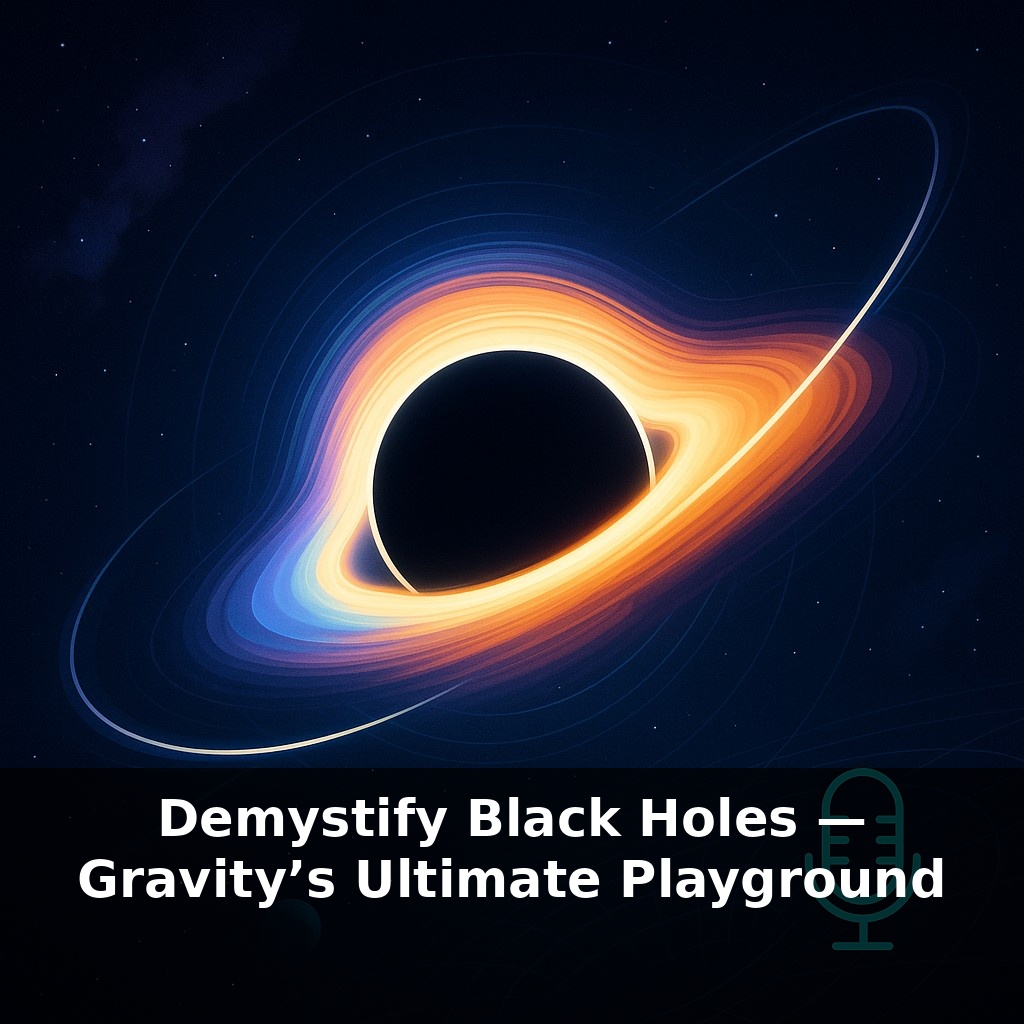
Think of a black hole’s surroundings as a layered storm system, with different “weather” at each distance. Farther out, matter might drift lazily in cold clouds; closer in, it organizes into a hot, whirling disk, where friction and magnetic fields can launch narrow jets that pierce thousands of light‑years of interstellar medium. Those jets aren’t just visual fireworks—they can throttle or trigger star formation in entire galaxies by compressing or dispersing gas.
Closer still, stars can be shredded if they wander too near, producing brief flares called tidal disruption events. These flashes let astronomers weigh otherwise hidden black holes in distant galaxies. On still larger scales, the combined pull of many such objects in a cluster can sculpt giant arcs and multiple images of background galaxies, turning the sky into a natural observatory. Each arc or flare is a specific case study, a new data point that lets us test subtle predictions of general relativity and refine how we map invisible structures across cosmic time.
Next‑generation observatories will treat black holes less like distant curiosities and more like finely tuned instruments. Space‑based detectors such as LISA will listen for mergers over years, tracing how early galaxies assembled. Ultra‑sharp images of glowing plasma will probe whether horizons are perfectly smooth or subtly “ruffled” by new physics. And by tracking how jets disturb surrounding gas—like oars churning a lake—we’ll refine models that also guide fusion research and accelerator design on Earth.
By tracing these dark anchors, we also trace our own origin story: heavy atoms forged in earlier catastrophes, recycled into worlds, oceans, and breath. Your challenge this week: follow one news item or research update about black‑hole observations, and ask what part of *your* story it revises, even slightly, in this ongoing cosmic draft.