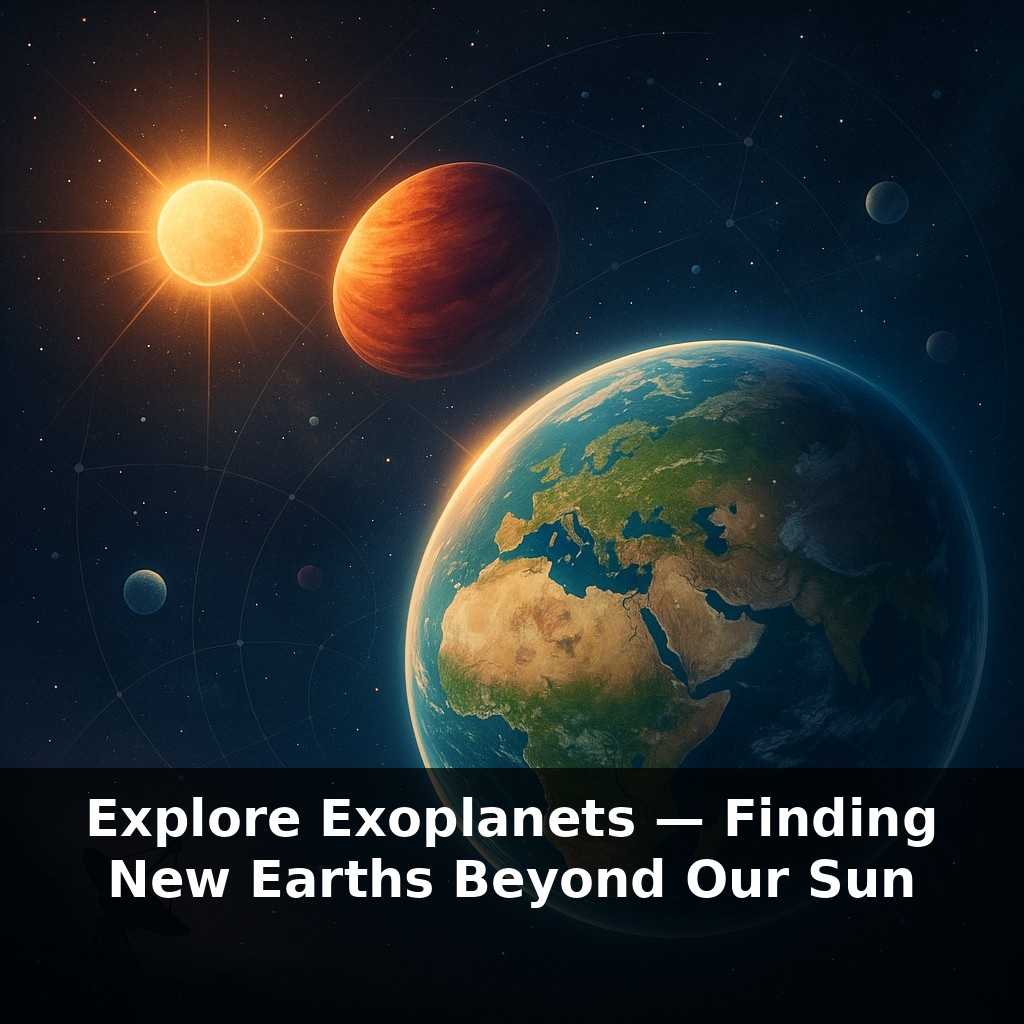
Right now, as you listen, new worlds are being added to our cosmic map—far-off planets we’ve never seen directly, but know are there. A hot Jupiter skimming its star, a quiet rocky world in starlight just right for liquid water. The question is: how many new Earths are hiding out there?
In just three decades, astronomers have gone from knowing only the planets of our own Solar System to confirming more than 5,500 others, spread across roughly 4,000 distant star systems. Instead of a tidy, Solar-System-style layout, we’ve uncovered something far stranger: a cosmic “playlist” where every star seems to remix the rules. Some systems pack multiple small worlds into tighter orbits than Mercury’s; others host a single bloated giant grazing the star’s surface in a searing year that lasts only a few days. And we’re still only sampling a tiny patch of our galaxy. The tools we use—measuring tiny dips in starlight, listening for stellar wobbles, even catching the faint glow of a world itself—are finally sensitive enough to reveal not just the biggest, loudest planets, but quieter, smaller ones that might resemble home in crucial ways. The surprise so far: planets aren’t rare prizes. They’re the norm.
Each new detection method adds another “instrument” to our survey of the galaxy. Direct imaging lets us glimpse a few massive worlds glowing faintly beside their stars, like distant campfires seen across a dark valley. Microlensing catches brief brightening events when a planet’s gravity bends light from a background star, revealing worlds we may never see again. Astrometry, still in its early prime, tracks the tiniest shifts in a star’s sky position to uncover unseen companions. Together, these techniques hint that our Solar System’s orderly layout may be the exception, not the rule.
Think about what that crowded cosmic “playlist” actually contains. When astronomers stack up the discoveries so far, one pattern jumps out: small worlds are everywhere. Based on Kepler’s census, it looks like there’s roughly one planet per star on average, and at least about 30% of Sun‑like stars probably host a roughly Earth‑size, likely rocky planet receiving just the right amount of starlight for liquid water at the surface. That doesn’t guarantee oceans and blue skies—Venus sits in some definitions of our own Sun’s comfortable zone and still turned into a runaway greenhouse—but it does mean that the raw real estate for potentially temperate surfaces is common, not rare.
Zoom into the extremes and the variety gets even wilder. We’ve found planets smaller than Mercury, like Kepler‑37 b—only about 30% of Earth’s size, more like our Moon scaled into orbit around another star. At the other end, there are worlds so puffed‑up and scorched that their atmospheres are probably streaming away into space. KELT‑9 b, for instance, bakes at around 4,300 °C, hotter than some small stars and hot enough to tear apart many molecules that would be stable anywhere in our Solar System.
Then there are planets that don’t fit any Solar System category: “super‑Earths” and “mini‑Neptunes” that sit between Earth and Neptune in size and mass. Our system skips that size range entirely, yet it seems to be one of the most common types in the galaxy. Many of these worlds huddle close to their stars, where a “year” lasts only days; some probably have deep, crushing atmospheres, others may be stripped down to bare rock or even coated in global water layers hundreds of kilometers deep.
The discoveries nearest to us feel especially tangible. TOI‑700 d, just over 100 light‑years away, is the closest known transiting Earth‑size world in its star’s temperate zone—a place we can study as starlight filters through its atmosphere, searching for gases that might hint at clouds, oceans, or something more surprising.
All of this reshapes the big question from “Do planets like Earth exist?” to “Among the countless small, temperate worlds we now expect, how many actually become living planets—if any?”
Think about how different kinds of weather hint at the landscape beneath. Gentle, regular “seasons” might suggest oceans and continents balancing heat; violent, unending storms could point to deep atmospheres or scorching surfaces. Astronomers do something similar by tracking how a world’s light changes as it orbits. Subtle shifts in color can reveal high hazes, reflective clouds, or clear skies. A planet wrapped in bright, towering clouds may hide an active water cycle; a dark, featureless one could be swaddled in soot or metal-rich vapors.
Some worlds even betray volcanic tempers: infrared glow rising and falling over time can signal eruptions resurfacing a hemisphere. Others show hints of winds screaming around the globe, redistributing heat from day to night. As telescopes sharpen, we’re starting to map climate patterns on worlds we can’t directly see—latitudinal temperature bands, possible polar caps, even changing cloud decks. It’s early, but this is how “Could it be habitable?” slowly becomes “What kind of weather does it have?”
Upcoming telescopes will do more than tally distant worlds; they’ll start reading their “weather reports.” Roman, PLATO, and future life‑hunters will watch how alien skies tint and dim starlight, teasing out hints of oceans, hazes, perhaps even seasonal swings. If we ever spot a planet whose colors subtly change like forests through autumn, or whose spectrum “breathes” with gases out of balance, we’ll face a new question: not just are we alone, but who else is sharing this cosmic shoreline?
As surveys widen, we’ll start to see patterns—like birdwatchers finally recognizing migration routes instead of single flocks. Worlds will sort into families: calm, cloud‑draped “ocean” types, airless embers, storm‑ruled giants. Your lifetime may span this shift from rare, nameless dots to a catalog of distinct alien climates and long‑term histories.
To go deeper, here are 3 next steps: 1) Open NASA’s Exoplanet Archive (https://exoplanetarchive.ipac.caltech.edu) and filter for “Earth-size” planets in the habitable zone, then pick one system (like TRAPPIST-1) and read its discovery papers via the linked references. 2) Watch at least one recorded lecture from the “Sagan Exoplanet Summer Workshop” on YouTube and pause to sketch how transit and radial-velocity methods actually reveal a planet’s radius and mass using the examples they show. 3) Grab a free citizen-science account on Zooniverse and join “Planet Hunters TESS,” then spend 15–20 minutes today classifying real light curves to help spot potential new worlds yourself.