Right now, almost every star you can name is just a tiny light in a much bigger pattern we’ve barely mapped. Astronomers now think the universe holds roughly a trillion galaxies or more. In this episode, we’ll zoom out until the Milky Way itself feels like a single city block.
Roughly 200 billion to 2 trillion galaxies may sit inside the part of the cosmos we can observe—and they’re not sprinkled randomly. They clump, stream, and stretch into structure on scales so vast that our home system becomes almost trivial, like one intersection in a continent‑spanning road network.
In earlier episodes, we focused on stars, remnants, and distant worlds. Now we’ll pull the map back so far that those become pixels in a much grander design. We’ll track how galaxies gather into groups and rich clusters, then trace how those clusters align along immense tendrils tens of millions of light‑years thick, leaving behind cavernous voids that can span hundreds of millions of light‑years.
Think of tonight’s sky as a sparse sampling of lights from a far‑off city; the real skyline only appears when you see the whole grid at once. Here, “neighborhood” takes on an entirely new meaning.
Step back once more and patterns emerge beyond simple clumps of galaxies. Astronomers now see a hierarchy: our local environment belongs to a larger flow of matter streaming toward massive concentrations like the Virgo Cluster and beyond, into vast regions such as the Laniakea Supercluster. These aren’t bound like single objects, but they reveal where gravity has been quietly winning for billions of years. To map them, surveys sweep huge swaths of sky, turning redshifts into distances. The result is less like a star chart and more like a 3D weather map, showing where matter “winds” converge, diverge, and stall.
When astronomers say the universe might hold between 200 billion and 2 trillion galaxies, they’re not just throwing around big numbers—they’re exposing how incomplete our map still is. The faintest, smallest systems are hardest to spot, and those missing entries matter, because they help trace the scaffolding beneath everything: dark matter.
Dark matter is the quiet architect here. It outweighs normal matter by about six to one and doesn’t emit light, but its gravity shaped where structures could grow. Early on, tiny wrinkles in density—seeded in the first fraction of a second after the Big Bang—gave dark matter slightly “heavier” regions. Those regions pulled in more material, snowballing into enormous invisible halos. Galaxies formed inside those halos like dew collecting along cold branches.
Zoom into one level of this hierarchy: our own environment belongs to a modest collection of a few dozen galaxies, themselves part of a much larger flow of matter. Rich clusters such as Virgo or Coma sit in the deepest dark‑matter wells. Virgo holds at least 1,300 galaxies, Coma perhaps 10,000, all orbiting in a swarm tens of millions of light‑years wide, immersed in gas so hot it glows in X‑rays. These clusters tend to land where several filaments intersect, like traffic hubs where many routes meet.
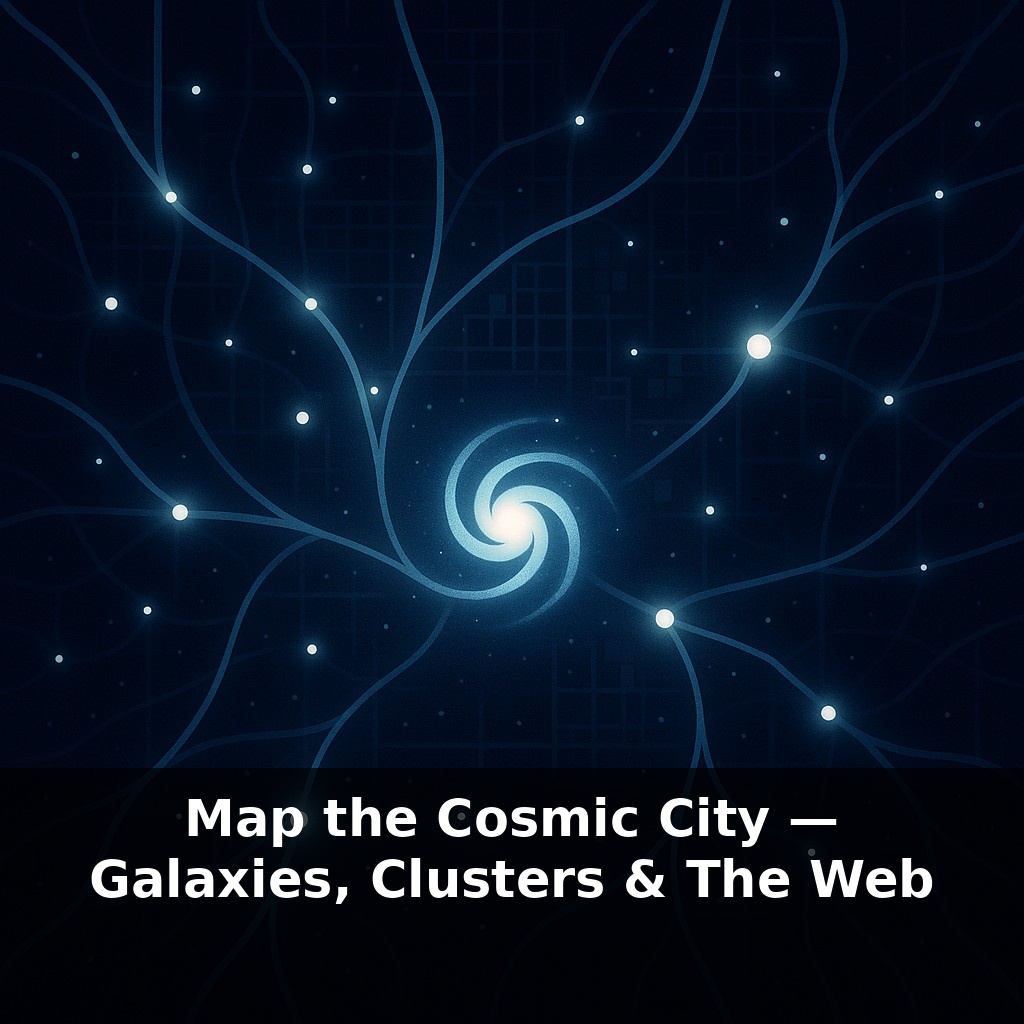
Those filaments are surprisingly consistent in scale: typically 5–20 million light‑years thick, stretching for hundreds of millions of light‑years. Surveys like the Sloan Digital Sky Survey and 2dF built 3D maps by measuring galaxy redshifts and turning them into distances, revealing long chains and walls of galaxies wrapped around vast cavities. The “voids” between them, sometimes 300 million light‑years across, are underdense but not truly empty—hosting thin gas, faint dwarfs, and their own dark matter.
The result is a universe where the bright parts merely highlight an underlying pattern. Stars, planets, and even black holes from earlier episodes are local details; the real drama here is the large‑scale choreography of matter, guided by an unseen component that silently dictates where cosmic cities can grow and where deserts remain.
Think of the cosmic web less as a static map and more as a long‑running weather pattern. Over billions of years, matter doesn’t sit still: it streams along filaments the way air currents slide along jet streams, drifting toward the “low‑pressure centers” marked by massive clusters. Computer simulations let cosmologists fast‑forward this evolution, starting from tiny early‑universe ripples and watching them swell into today’s intricate network. What’s striking is how well those virtual webs match real large‑scale surveys, down to the thickness of filaments and the sizes of the largest voids. That agreement is one of the strongest clues that dark matter is real and that our current cosmological model is broadly right. Yet even here, there are puzzles: why do some filaments appear thicker or more clumpy than expected? Do the properties of galaxies change systematically as they travel from sparse regions into dense crossroads? Future instruments, like the Vera C. Rubin Observatory, aim to turn these questions into precise measurements.
Next‑generation surveys will track how matter actually *flows* through the web, the way meteorologists follow storms across a continent. By watching gas funnel into dense nodes, we’ll see where fresh fuel feeds starbirth and where regions are effectively “cosmic suburbs” going quiet. Subtle mismatches between simulations and these maps could hint at new particles or revised physics, reshaping estimates of where long‑lived, life‑friendly systems are most likely to arise.
As new surveys widen our map, we may spot rare “cosmic downtowns” where activity peaks, and quieter “backroads” where change slows. Your star, your atoms, came from one tiny strand in this sprawl. The mystery now is whether other strands host minds also asking where they sit in this vast, shifting pattern—and whether our paths can ever, even indirectly, intersect.
Here’s your challenge this week: use an online cosmology tool like NASA’s “Eyes on Exoplanets” or the SDSS SkyServer to locate and bookmark **one specific galaxy cluster** (for example, the Coma Cluster) and **three individual galaxies** within or near it. Create a simple “cosmic address” for each—universe → cosmic web filament → cluster → galaxy—and type it into a note or document so it reads like an address label. Then, print or sketch a one-page “cosmic neighborhood map” connecting those galaxies to their cluster and the larger web structure they belong to. By the end of the week, be able to explain out loud—in under 60 seconds—where your chosen cluster sits in the cosmic web, as if you’re giving directions to a friend in space.