A single massive star can forge enough iron to outmatch the core of an entire planet—then hurl it into space in a final, brilliant flash. Tonight, we drop into that last act, right as a stable, shining star quietly crosses the line into catastrophic transformation.
Only about two or three stars in our entire galaxy end in a supernova each century—yet those rare deaths quietly rewrite the chemical map of the Milky Way. In earlier episodes, we focused on how stars are born and how light carries their stories to us. Now we follow a different thread: how a star’s mass secretly scripts its whole biography, from its long, steady years to its abrupt finale. Most of a star’s life is uneventful by human standards: billions of years of hydrogen fusion, like a slow, steady drumbeat. But change the mass—make the star a bit heavier or lighter—and the rhythm shifts. Some swell gently and fade into stellar retirement; others burn through their fuel in a cosmic sprint. It’s this mass-driven timing that decides which stars quietly cool and which, in their final moments, will reshape future planets, oceans, and even the atoms in your blood.
On the main sequence, stars look deceptively similar: steady points of light, like marathon runners all trotting past the same checkpoint. But behind that calm glow, their cores follow radically different schedules. Temperature and pressure rise much faster with mass, so heavyweight stars tear through fuel at rates that would evaporate our Sun’s gentle pace. That rush changes everything: which elements are built, how quickly layers form, and what kind of remnant is left. Follow that chain, and you can “read” a star’s future just from its mass and brightness.
For most stars, the “ordinary” part of life is surprisingly simple: fuse hydrogen, shine steadily, gradually change. The real branching happens when that core fuel runs low. At that point, gravity starts to win subtle skirmishes, and the star must decide—based on its mass—how far it can push nuclear physics before it runs out of options.
Low-mass stars, roughly up to eight times the Sun’s mass, take the slow, methodical route. When their central hydrogen is exhausted, fusion shifts into surrounding layers and their outer regions respond dramatically: they expand and cool into red giants. Inside, helium ash left from earlier burning is compressed and heated until it ignites in a compact core. That helium fusion phase is relatively brief compared to the main stretch, but it reshapes the star’s structure, building carbon and oxygen at the center.
Because these stars never get hot enough in their cores to ignite carbon efficiently, their evolution is a story of diminishing returns. Pulses of fusion in shells around the core stir and mix material, and the outer layers become loosely bound. Stellar winds grow stronger and more chaotic, peeling off gas into space. The result is a glowing planetary nebula, lit from within by the exposed, ultra-hot core: a white dwarf, roughly Earth-size but with about half the Sun’s mass squeezed inside. No further fusion occurs there; it simply cools over billions of years, fading like a leftover ember.
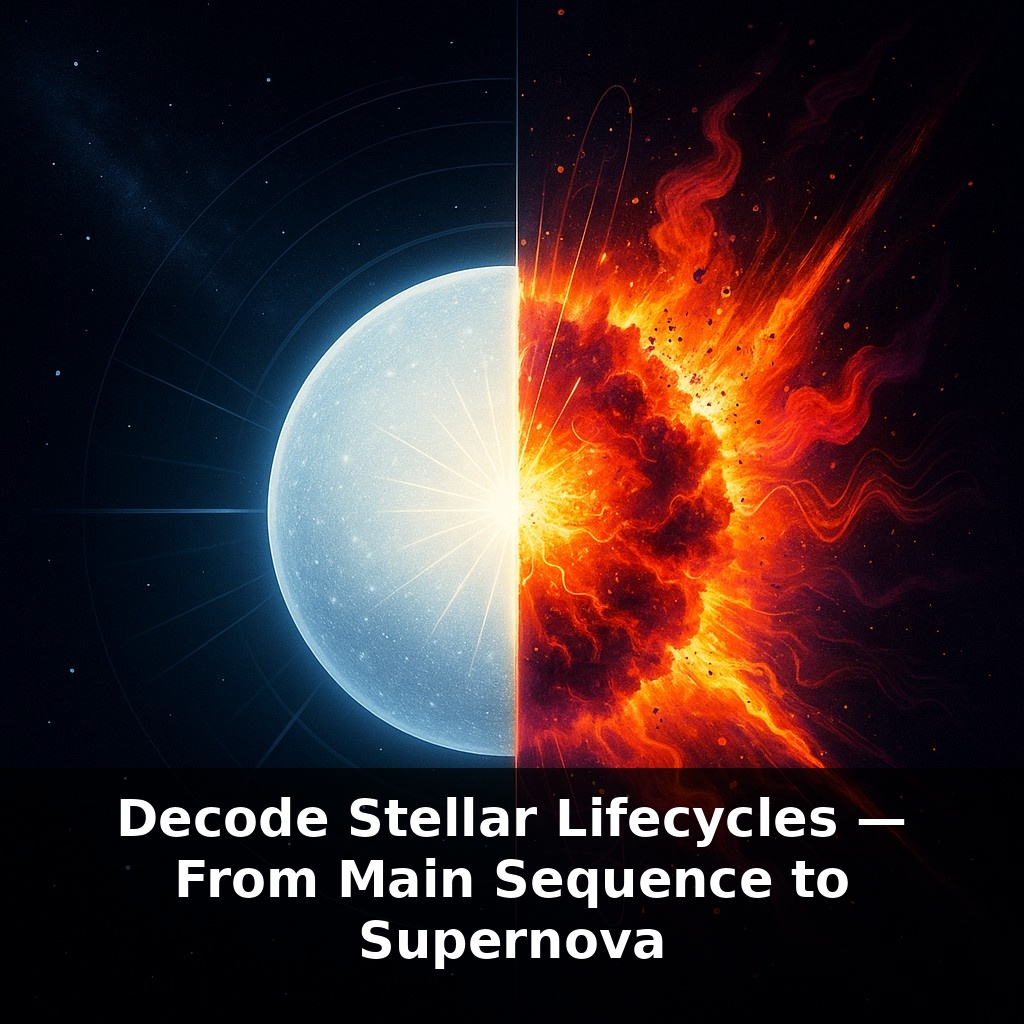
More massive stars diverge sharply after the main sequence. With greater gravity, their cores can ratchet up to far more extreme conditions, sequentially fusing heavier elements in distinct stages. Each stage is shorter than the last; what took millions of years for hydrogen can shrink to years, days, or even minutes for the final fuels. It’s like a storm system shifting through faster and faster weather fronts: long, calm seasons early on, then a rapid cascade of violent changes near the end.
Observations of nearby red supergiants such as Betelgeuse give us snapshots of this brief, unstable period. We see irregular brightness changes, complex plumes of gas, and dust outflows—all signs that the internal balancing act is becoming fragile. Deep inside, the layered structure is setting up the conditions for a core-collapse event that will not only end the star’s life, but also launch newly forged elements into the surrounding space, adding fresh material to future generations of stars and planets.
Some of the best “evidence” for these late stellar lives comes from quietly comparing different neighborhoods of our galaxy. Open clusters, for instance, act like controlled experiments: hundreds of stars born together, same age, same initial ingredients, but with slightly different masses. In young clusters, you’ll find brilliant blue giants already peeled away from the main band on a color–magnitude diagram, while lighter stars still sit snugly in their long, stable phase. Astronomers use the point where that band bends—the turnoff—to read the cluster’s age, almost like tree rings.
You can also trace past explosions by following the heavy elements they’ve left behind. Regions rich in oxygen or calcium hint at one kind of progenitor; areas laced with lots of nickel or gold suggest another, rarer lineage. Even our own Solar System carries these fingerprints: certain meteorites preserve odd isotopes that likely came from different stellar deaths, mixed into the cloud that eventually formed the Sun and its planets.
Galaxies quietly record these stellar endings in their architecture. Spiral arms, for instance, often trace where recent deaths have stirred and enriched gas, like colored threads woven into fabric. As surveys map these patterns in finer detail, we’ll test how violence on stellar scales shapes long-term galactic “weather” — from where planets are likely to form, to which regions may stay calm enough, long enough, for biology to take root and persist.
Long after the last flare fades, dense remnants keep whispering into space—spinning like cosmic lighthouses, merging like colliding storms. Their crashes can shake spacetime itself, the way a distant thunderclap ripples across still water. Your atoms remember these echoes; future worlds will, too, as new stars rise from the stirred-up debris.
Here’s your challenge this week: Pick ONE real star (like Betelgeuse, Sirius, or Proxima Centauri), look up its mass and current lifecycle stage, and sketch its entire future path—from main sequence through red giant/supergiant to its final fate (white dwarf, neutron star, or black hole). Then, using a free planetarium app or website, find that star in the sky tonight (or as soon as it’s visible in your location) and spend five minutes outside looking at it while mentally “fast‑forwarding” through its lifecycle. Finally, explain its full story out loud to someone else—in 60 seconds or less—like you’re narrating that star’s personal biography.