Norse Mythology vs. Reality: Understanding Vikings
📝 Transcript
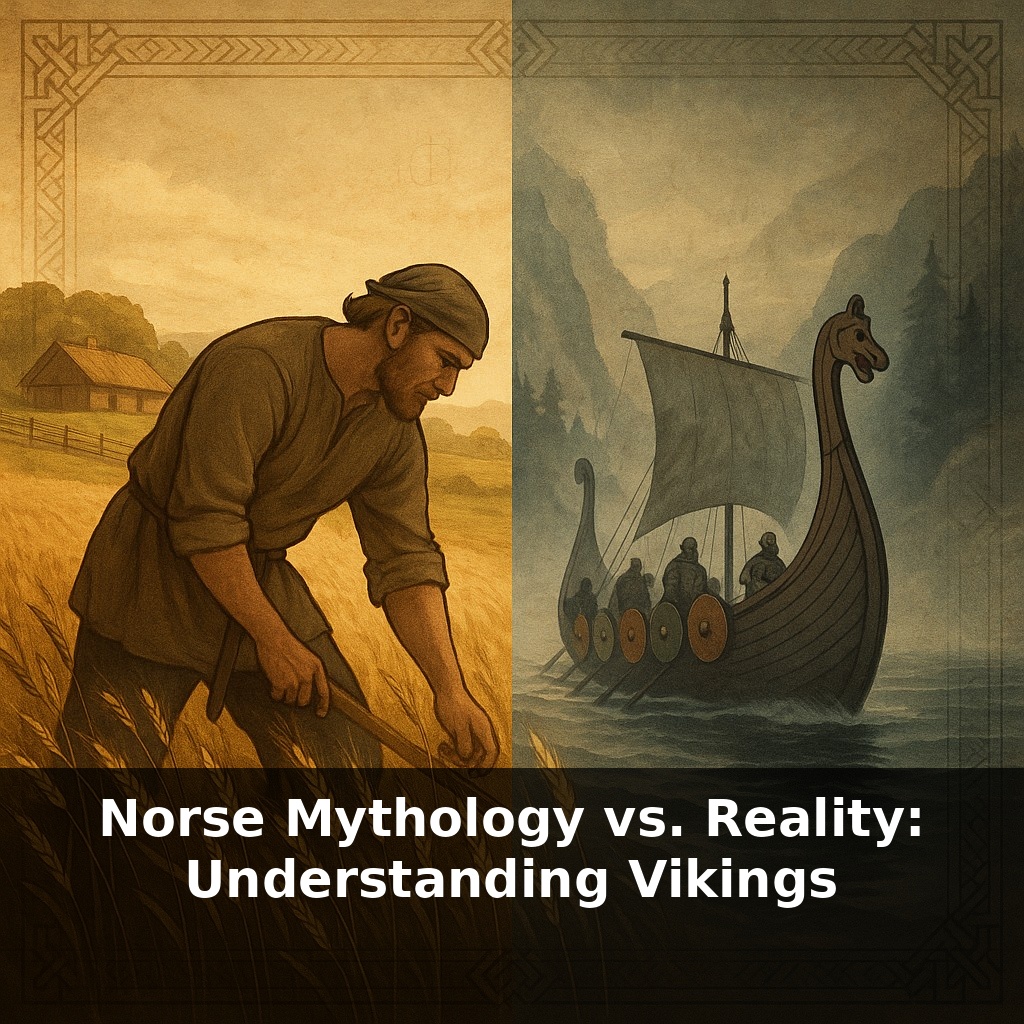
A Viking farmer bends over a field of barley—then, a few months later, that same person is steering a longship up a foreign river. Here’s the twist: most “Vikings” spent far more time planting and trading than raiding. So why do our stories remember the blood and forget the barley?
That gap between what Vikings mostly did and what we choose to remember isn’t an accident; it’s the result of centuries of selective storytelling. Medieval monks, terrified coastal villagers, 19th‑century nationalists, and modern filmmakers have all taken turns “editing” the Viking reel. Each group zoomed in on the moments that suited their needs—martyrdom, heroic ancestors, box‑office spectacle—while quietly cropping out the daily grind of tending livestock or haggling over walrus ivory. It’s a bit like watching only the highlight reel of a long sports season: you’d think every match was a last‑second goal and never see the endless training, injuries, and tactical retreats. To really understand Norse people, we need to step off the battlefield and into the shipyard, the law court, and the winter longhouse—places where belief, trade, and power quietly intertwined.
To make sense of that world, we need to separate two overlapping layers: the mythic stage where Odin, Thor, and Loki scheme, and the archaeological ground where ship rivets, pollen grains, and DNA quietly sit. One layer tells us what Norse people *imagined*—their fears, ideals, and cosmic rules. The other shows what they *actually did* and how they organized land, labor, and power. These layers aren’t enemies; they’re more like two blueprints in an architect’s folder, one for the grand facade, one for the plumbing. Reading them together lets us see where belief steered real voyages—and where later eras redrew the lines.
Strip away the Wagner horns and Marvel thunder, and what’s left isn’t a disappointment—it’s a stranger, more interesting puzzle. Norse myths weren’t written as history; they were closer to a spiritual user’s manual for a hazardous world. Ragnarok, the doom of the gods, reads very differently when you remember how often crops failed or winter lingered too long. A cosmos fated to end in ice and fire makes emotional sense in a subarctic climate where one bad season could erase a household.
Modern tools let us test that emotional landscape against physical traces. Pollen in lake sediments shows when fields expanded or were abandoned; suddenly, the sagas’ offhand mentions of famine or migration line up with visible dips in barley and rye. Strontium isotopes in teeth reveal who grew up locally and who came from elsewhere, turning once‑anonymous skeletons into evidence of mobility, intermarriage, and enslaved labor moving through Norse households.
Texts have their own bias problem: most written accounts from the period either come from Christian outsiders or from Icelandic authors writing generations later. So historians treat every line like a witness on the stand—credible in parts, self‑serving in others, and always needing corroboration. When a monastery chronicle rages about “heathen cruelty,” archaeologists check: do we find layers of burning, or a pattern of targeted theft without mass slaughter?
Even the longship, that poster child of Viking ferocity, looks different under scrutiny. Ship burials, harbor remains, and tool marks tell us about standardized production, maintenance networks, and seasonal rhythms of travel. Taken together, they point less to chaotic raider gangs and more to communities planning logistics with care: timber supply, repair crews, landing spots, and information routes stretching from Newfoundland to the Caspian.
Your challenge this week: whenever you encounter a “Viking” in pop culture—a logo, a sports team, a TV character—pause for ten seconds and silently sort what you’re seeing into three mental buckets: (1) mythic element, (2) historical evidence supports this, or (3) later invention. Don’t look anything up in the moment; just notice how much of that image rests on story versus soil and bone.
Think of how a software team works: there’s the public launch video and there’s the version‑control log. Norse poetry is closer to the glossy promo; postholes, seed remains, and iron slag are the commits and bug‑fix notes. For example, high‑status graves packed with imported silk, scales, and silver hacksilver show that some households functioned as mini trade hubs, aggregating goods from distant markets. Harbor excavations at places like Hedeby reveal workshops, warehouses, and carefully cut mooring posts—evidence of scheduled traffic, not random drift. At rural sites, soil chemistry maps out byres, waste zones, and fenced plots, letting us reconstruct how people organized work and status across a farmyard. Even tiny details—loom weights, whetstones, glass beads—act like timestamps of connection, tying a quiet coastal settlement into webs reaching Byzantium or the Abbasid Caliphate. Piece by piece, that material record lets us follow real decisions: where to settle, who to ally with, when to risk the sea.
As labs pull more data from teeth, textiles, and ship timbers, the Viking Age starts to look less like a closed chapter and more like an open dataset. Climate curves, migration maps, and trade routes can be layered like tracks in audio software, letting researchers “solo” one line—say, Arctic sea‑ice extent—and hear how it rises or clashes with settlement shifts. That same method can be pointed at our own era, testing how stories, power, and environment tangle long before anyone writes a saga.
Peel back enough layers and Vikings stop being stock villains or heroes and start looking like neighbors with different tools and fears. Norse myths, ship timbers, and law codes become parallel playlists you can shuffle between, noticing harmonies and glitches. Follow those mismatched beats, and the Vikings turn from costume into a moving, unfinished question.
To go deeper, here are 3 next steps: (1) Grab Neil Price’s *Children of Ash and Elm: A History of the Vikings* and read the opening chapter, then compare his description of everyday Viking life with how the podcast corrected “horned helmet” and “constant-raider” myths. (2) Open the free online Poetic Edda translation at sacred-texts.com or the Jackson Crawford translations and read “Völuspá,” jotting down every place where the gods behave in surprisingly human, flawed ways, just like the episode discussed. (3) Visit the Vikings section of the National Museum of Denmark or British Museum websites and zoom in on 3 objects (like the Oseberg ship artifacts, brooches, or runestones), then write a brief paragraph for yourself on how each one reflects real trade, religion, or daily life rather than Hollywood-style stereotypes.
From this course
Viking Ventures: Norsemen Beyond Legends
5 episodesUnlock all episodes
Full access to 5 episodes and everything on OwlUp.
Subscribe — $1.99/monthLess than a coffee ☕ · Cancel anytime