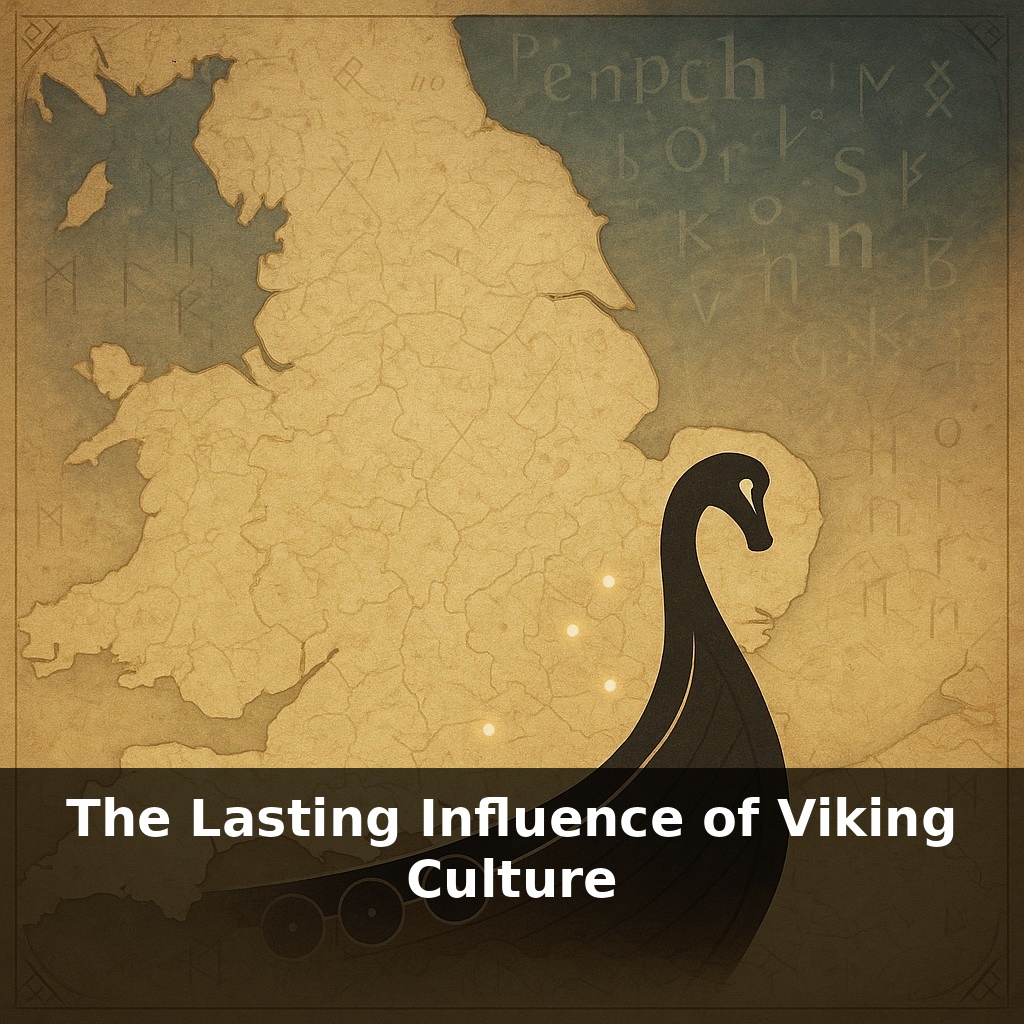
Vikings left so many town names on the English map that driving a single hour can feel like reading their autograph. A quiet village ending in “-by,” a farm called something “-thorpe”—each is a fossil of Norse rule hiding in plain sight, reshaping how we read the landscape.
Nine out of ten English speakers use Viking words every day without realizing it. “Sky,” “skill,” “egg,” “law,” “wrong,” even the blunt little “they” all sailed in with Norse speakers and never left. This wasn’t poetic, high-status vocabulary; it was the toolbox language of daily life—weather, work, arguments, neighbors. Think of it as the nuts and bolts in the furniture of modern English: rarely noticed, absolutely essential.
Those same people who left their mark on speech also bent European technology and politics in new directions. Their longships rewrote the limits of distance; their legal customs pushed ideas of shared decision-making and public law into new regions. Follow their wake, and you start seeing Viking fingerprints in places far beyond coastal raids: in parliaments, shipyards, courtrooms—and in the words you just used this morning.
By the time those words and customs settled in, Viking influence was woven into everyday routines rather than grand events. Think of a market day in York or Dublin: silver coins stamped with both Christian crosses and Norse designs changing hands, traders swapping news from the Baltic as casually as we scroll headlines. Their network stretched from North America to the Middle East, carrying not just loot but timber, furs, glass, silk, and even fashion. Over generations, this traffic didn’t just decorate Europe—it quietly rewired how people dressed, dealt, traveled, and told their own stories.
Ninth‑century England didn’t just negotiate with Viking armies; it had to negotiate with Viking rules. When the Danelaw spread across northern and eastern territories, it brought different expectations about property, inheritance, and punishment. Land was measured and taxed in new ways; disputes might be settled by compensation instead of mutilation or execution. Over time, English rulers absorbed some of these practices not because they loved their rivals, but because they worked. When later kings standardized law across the realm, they were blending older customs with habits forged under Norse pressure—a legal hybrid that favored written codes, public recitation, and the idea that even a king’s will had to be expressed “according to law.”
Similar fusions happened far from Britain. In Iceland, settlers built a society with no king at all, relying on a national assembly where chieftains bargained, feuded, and forged compromises under a shared framework of rules. That system, refined over centuries, left such a deep groove that modern Icelandic courts still echo its vocabulary and rhythms. In Scandinavia itself, local assemblies evolved into early representative bodies—stepping stones toward the parliaments that now sit in Oslo, Stockholm, and Copenhagen.
Material culture followed a comparable pattern of blending rather than replacement. Norse metalworkers who could turn out a crucible‑steel Ulfberht blade didn’t just impress warriors; they influenced what neighboring elites considered “proper” prestige. A sword that cut cleaner, a brooch that locked a cloak more securely, a ship-rivet that resisted corrosion a bit longer—each small technical edge nudged tastes and expectations. As these objects circulated from Kiev to Dublin, they redefined what counted as good craftsmanship.
Today’s fascination with “Viking style”—from sleek, overlapping wooden cladding on houses to minimalist knotwork tattoos—draws unconsciously on those preferences. Clean lines, visible structure, and hardware meant to endure harsh conditions trace back to a culture that built for rough seas, cold winters, and quick repairs. Even when the myths are stripped away, what remains is a set of design instincts and legal habits that survived precisely because later societies found them too practical to abandon.
A museum in Oslo once tested a replica Viking ship by sailing it alongside a modern racing yacht. The carbon‑fiber hull outpaced it, but in shallow, choppy water the older design slipped ahead, riding over waves the sleeker boat had to fight. That trade‑off—raw speed versus adaptability—echoes in how Viking habits survive today. Coastal rescue boats in Scandinavia still favor high bow curves and flexible hulls to cope with unpredictable seas. In politics, Nordic coalition governments resemble those old assemblies not in ritual, but in the constant bargaining required to keep many factions on board. Even language carries this layered pragmatism: modern Icelanders can read medieval texts with less effort than Italians tackling Dante, because written norms froze early to keep law and literature mutually legible. In cities from Dublin to Kyiv, ongoing digs keep turning up everyday objects—gaming pieces, whetstones, cheap jewelry—that show people across this network quietly aligning their pastimes, tools, and tastes long after the war bands faded.
Norse traces now guide how we think about movement and mixing. DNA studies read Viking‑age graves like layered timelines, revealing marriages, adoptions, even kidnapped children folded into new families. Digital projects do something similar with carved stones, stacking scans to track erosion year by year. As Arctic ice retreats, proposed shipping lanes quietly retrace old sea paths, turning historical routes into prototypes for future logistics tests and fragile cultural corridors.
Their legacy also hides in how we tell stories and see ourselves. Comics, prestige TV, and metal bands dress Norse figures in new clothes, like rebooted software running on very old code. Each remake tweaks courage, exile, or fate for modern fears. Follow those updates, and you’re really tracking how our own culture is still quietly rewriting the sagas.
Start with this tiny habit: When you first sit down with your morning drink, whisper a single Old Norse word you’ve learned (like “skál” or “vinr”) and look up its meaning once. Then, when you walk through a doorway later that day, take one calm breath and imagine you’re stepping into a Viking longhouse, asking yourself how a Viking might handle the next thing on your schedule.