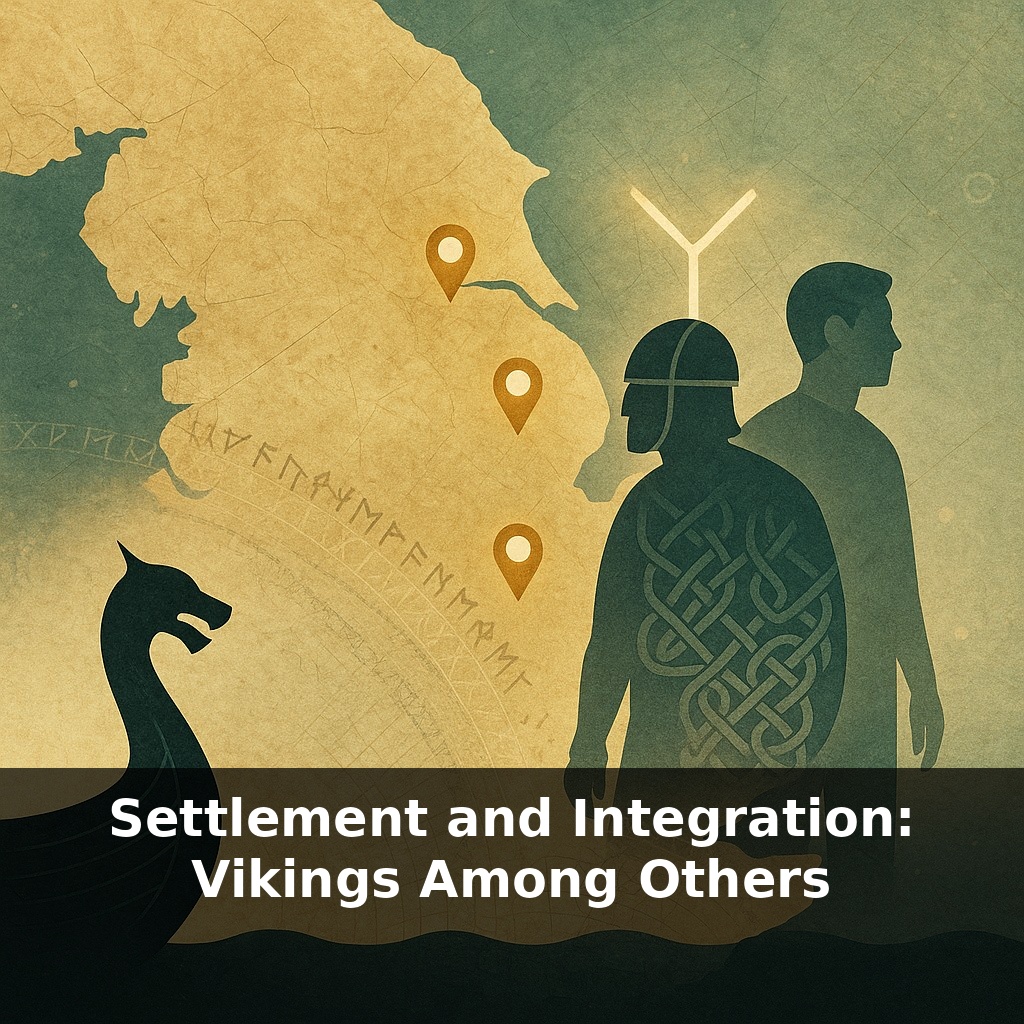
About a third of the place-names in parts of northern England are secretly Viking. Grimsby, Whitby, Derby—ordinary towns today, but each one whispers Old Norse. So here’s the puzzle: how did “foreign raiders” end up naming the very places they supposedly only attacked?
Roughly one in twenty men in parts of north-west England today carry a Y-chromosome lineage most strongly associated with Scandinavia. That isn’t a museum statistic—it’s living evidence that some Vikings didn’t sail home; they stayed, had children, and slowly became “locals.” And the surprises don’t stop there. When scientists sequenced over 400 Viking-Age genomes from burial sites across Europe, they found that many “Vikings” weren’t genetically Scandinavian at all. In other words, even in the Viking Age, Viking identity was already a mix. The sagas quietly confirm this: they mention hundreds of women from Ireland and Scotland woven into Norse households, not as footnotes but as founders of families. Follow those threads forward and you get something far more complex than invaders versus natives—you get layered, negotiated belonging.
Legal customs, marriage patterns, and even meeting-places quietly reveal how “outsiders” became neighbours. In England’s Danelaw, local law codes preserved earlier Anglo-Saxon rules but added Norse-style assemblies and fines, creating a hybrid system rather than a replacement. In Iceland, law-speakers recited rules shaped by both Scandinavian habit and Celtic storytelling traditions. Think of local society as a shared workspace where new users arrive: they don’t rewrite everything from scratch, but adjust the settings, add their own shortcuts, and leave traces other users gradually adopt as normal.
In the archaeological record, this blending shows up first in the most ordinary places: houses, graves, and rubbish pits. In Scandinavian homelands, longhouses follow a familiar layout; in the British Isles and along the Irish Sea, you start seeing buildings that fuse Norse styles with local construction—stone where wood was expected, hearths placed according to older regional habits, storage pits borrowed from pre-existing traditions. The people moving in weren’t erasing a blueprint; they were modifying an existing “floor plan” to fit both their needs and what was already there.
Grave goods tell a similar story. In early phases, you can pick out “Norse-looking” burials—oval brooches, swords, boats. A few generations later, objects mix: a woman buried with Scandinavian jewellery but local-style pottery, or a man with a sword of Frankish manufacture in a cemetery plot organized like earlier Anglo-Saxon ones. Even burial rites themselves blend: cremation in some zones gives way to inhumation, but with imported weapon types or dress ornaments. Instead of neat ethnic boxes, you get families choosing from multiple funerary toolkits at once.
DNA studies extend this pattern east and west. In the North Atlantic, genomes from Iceland and the Faroes show a high proportion of women with ancestry from the British Isles paired with men of Scandinavian origin. Far to the east, along the rivers to the Black Sea and Caspian, graves linked to Scandinavian-style material culture often contain individuals whose genetic signatures are Slavic, Baltic, or Finno-Ugric. Joining a raiding or trading crew could mean stepping into a ready-made cultural package, regardless of where your grandparents came from.
Language quietly follows. Loanwords slip across borders: nautical terms and legal phrases in the British Isles; personal names and title-words in eastern Europe and the Rus’ lands. In written charters and runic inscriptions alike, you can trace individuals with double naming traditions—one form suited to a Latin or Slavic document, another to a Norse audience—showing people who could operate in more than one cultural register at once.
Over time, these mixed households, shared markets, and bilingual gatherings produced something new: not a uniform “Viking world,” but overlapping, regional Norse-influenced societies, each tuned to its own landscape and neighbours.
In some regions, you can still walk the echo of these mixed communities. On the Isle of Man, stone crosses carved in the 10th century show ship-prowed Norse dragons twisted together with Celtic interlace and Christian scenes. One monument even names a man called Gautr, son of Björn—Norse names—yet the carving style leans heavily on local artistic habits, a visual record of overlapping loyalties. In eastern Europe, contracts of the early Rus’ rulers list leaders with names that sound half-Scandinavian, half-Slavic, marking elites who had to speak to more than one audience at once. Maritime dictionaries quietly preserve this, too: terms for anchors, sails, and rigging in North Sea languages often share Norse roots, fossil traces of ports where crews from different shores haggled over cargo and crew shares. Integration here wasn’t a single event but an ongoing project, more like software that receives constant updates than a one-time install—new features added, old ones patched, until no one remembers the original version clearly.
Future work stitches burial maps, genome data, and loanwords together like layers in a GIS project, revealing not just routes but social textures: who married in, who ruled, who blended quietly at the margins. As models sharpen, some proud “homelands” may discover their heroes were already mixed communities. That can unsettle tidy origin myths, but it also offers a toolkit: past integrations become case studies for thinking about borders, diaspora, and cultural endurance in the present.
Today, trains and highways run over ground once ruled by those shifting alliances, yet their legacy survives in how modern nations manage mixed identities—from dual citizenship to regional autonomy. Your challenge this week: notice one local custom, word, or border rule that feels “out of place,” and ask what quiet past integration might lie behind it.