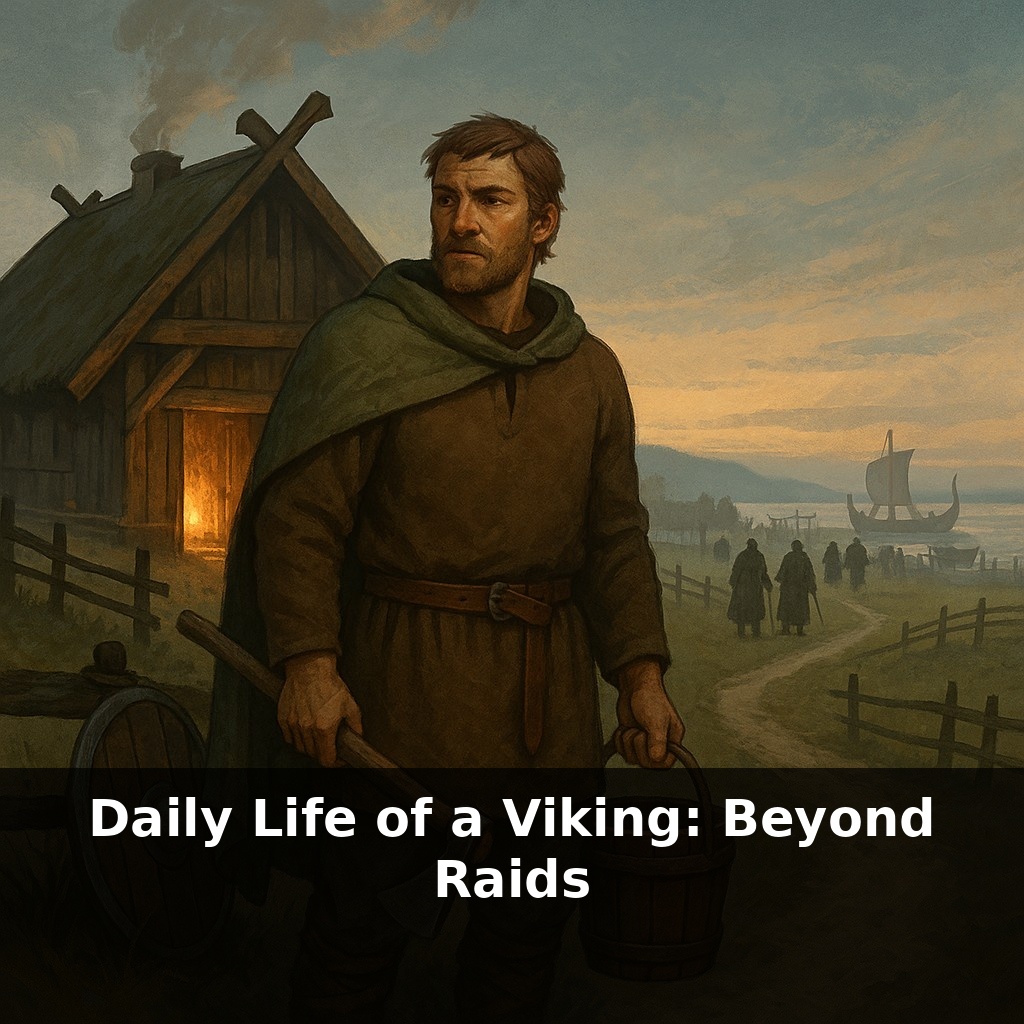
About nine out of ten Vikings spent their days not swinging axes, but feeding animals and arguing over fences. On a cold dawn in a smoky longhouse, a farmer grabs his tools—not a sword—while his neighbors head to a local assembly to settle a land dispute.
Step outside that longhouse door and the Viking world widens fast. Beyond the farmyard, narrow paths lead to landing places crowded with boats, market stalls, and the smell of tar and dried fish. A teenager might spend the same week learning to carve a rune, mend a fishing net, and memorize a verse of poetry—because status wasn’t just about owning land, but about showing skill and memory. Women managed storerooms packed with imported glass beads and spices, proof that distant harbors mattered as much as nearby fields. Think of the farm as the “hardware” that kept everyone alive, and these crafts and trade routes as the “software” that made society flexible and surprisingly cosmopolitan. When the local gathering broke up, some people walked home with judgments; others walked straight to their boats, carrying news, goods, and stories onward.
Step inside that smoky longhouse again and focus on the small, repeating motions that filled a day. A woman twists wool into yarn so fine it might end up in a cloak sold hundreds of miles away. A boy tends the fire, gauging heat by eye for an ironworker shaping a nail—one of dozens needed to keep a single ship seaworthy. Nearby, someone carves a few runes on a stick, a quick record of a deal or a name to remember. Meals are built from salted fish, cheese, and stored grain, each bite a quiet reminder that last season’s choices still shape today. Overhead, beams creak softly, like a steady drum marking time.
Walk away from the hearth and follow the sounds instead: the thud of loom-weights, the rasp of a whetstone, the slap of water on hulls pulled up along a rocky shore. In coastal settlements, one neighbor might vanish before dawn to check herring nets; another stays home to finish a cloak promised to a trader who will arrive with Baltic amber and, if you’re lucky, a sliver of bright silk. Work clusters by season: haymaking when the grass is high, slaughter when frost comes, roof repairs in the narrow window between storms. People move through these rhythms like members of a crew, shifting roles as weather and opportunity change.
Inland, forest edges buzz with different chores. Men and women tap bog iron, burn charcoal, and cut timber that will become ribs of a ship or beams in a new hall. Children gather berries and herbs—not busywork, but real contributions to winter stores and household medicine. A skilled healer might know which moss to tuck into a wound, which plants ease childbirth, which charms to whisper while working. Written recipes are rare, but practical knowledge passes mouth to ear, reinforced each time someone recovers—or doesn’t.
Religion threads through this busyness without stopping it. Instead of weekly services in a single building, offerings happen at carved posts, at small groves, at family burial mounds. A fisherman might knot a token for Njord into his line; a weaver might dedicate the first neat band of a new pattern to Freyja. When larger feasts occur—autumn blót for good harvests, midwinter sacrifices for the sun’s return—they pull scattered farms together. These gatherings are part worship, part networking event, where future marriages, voyages, and partnerships are quietly arranged alongside toasts to gods and ancestors.
Not everyone chooses—or gets—to stay rooted. Some younger sons, with little chance of inheriting land, sign on to a voyage east toward the rivers of today’s Russia, or west toward shifting frontiers in Ireland and Francia. Their letters home are rare, but their presence shows up in foreign grave goods, hacked-up silver used as currency, and in the way place-names far from Scandinavia echo old tongues. Mobility isn’t an exception; it’s one of the tools families use to balance risk, spread influence, and bring back news of a wider world that keeps seeping into even the quietest valley.
A quiet corner of this world sits in the law-speaker’s memory. He’s trained for years to hold thousands of words in his head: legal formulas, genealogies, precedent. When he stands at the þing and recites a clause, he’s not improvising; he’s retrieving something as structured as a modern database query, except the storage medium is a living brain. Nearby, a merchant mentally tracks who owes him walrus ivory, who prefers furs, who pays in silver. No ledgers on parchment—just overlapping mental spreadsheets, checked against witnesses who also remember the deal. Even households rely on this mental infrastructure. A foster-child might grow up far from birth-kin, yet still be woven into an invisible web of obligation that stretches across fjords and generations. Marriage, too, works like a long-term contract: livestock, tools, and future support for widows are negotiated in detail. The result is a society where trust is rarely blind; it’s audited by shared memory, public recitation, and many keen listeners.
Soon, researchers may treat a single tooth like a time‑stamped passport: aDNA and isotopes can reveal where a person drank water as a child, where they grazed animals as an adult, even shifts in diet after a bad harvest. That level of detail won’t just refine maps; it could redraw family sagas, confirming or challenging which journeys really happened. Your challenge this week: notice how your own “daily routine data” could someday narrate a life as vividly as any saga, if someone had the tools to read it.
Centuries from now, someone might read our leftovers—plastic, code, satellite images—the way we read buried ships and pollen. A single seed in a posthole reframes a whole farm; one hacked coin shifts a trade route. Your challenge this week: treat one ordinary object you use daily as if it were evidence in a future excavation of your life.