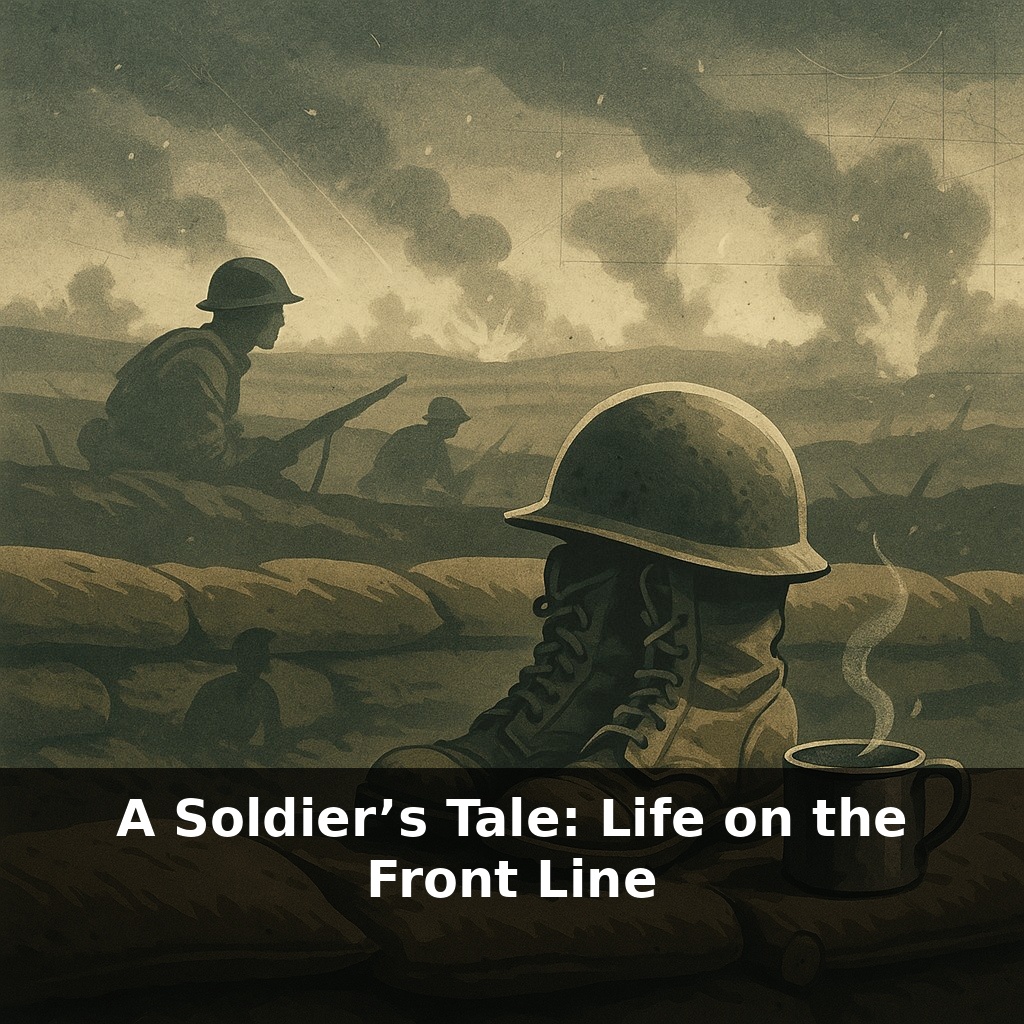
Shells can fall so often at the front that some soldiers said the silence felt more frightening than the noise. One moment you’re fixing a boot or trading jokes; the next, the earth lifts, time shrinks, and your whole world is the few people crouched beside you.
On the front line in WWII, “normal” was constantly renegotiated. A good day might simply mean dry socks, a hot drink, and no one missing at roll call. Between bombardments, soldiers slogged through chores that felt almost domestic: mending gear, heating thin soup in blackened mess tins, scraping mud from rifles with the care of someone cleaning a family heirloom. Letters arrived like brief breaks in bad weather, bringing the smell of home in creased paper and faded ink. Jokes were recycled as often as uniforms, not because they were funny, but because they were familiar. Time fractured into odd units—until the next patrol, until the next meal, until the next mail call. In this narrow world, survival wasn’t just about dodging bullets; it was about stitching tiny human rituals into days ruled by orders, mud, and the distant thud of someone else’s war.
Rations, sleep, and safety formed a kind of unstable triangle for front-line soldiers, and something was almost always missing. A metal tin holding 2,800 carefully calculated calories could still leave a man feeling strangely hollow when eaten cold in a frozen foxhole. Nerves often outran exhaustion: some troops wrote of being too tired to stand yet too alert to truly rest, listening for the tiny changes in sound that meant danger. Over time, bodies adapted in crude ways—weight dropped, uniforms hung looser, cigarettes became as valuable as coins, and even a lukewarm cup of coffee felt like a small, temporary promotion from the edge of collapse.
Mud, noise, and orders shaped everything—but so did mathematics and logistics. The front line was the sharp end of an enormous, carefully calculated system that tried to turn men into a reliable instrument of war. Training had drilled them until movements felt automatic: how to hit the ground, how to clear a jammed rifle by touch, how to space out on a march so one shell wouldn’t take everyone. Yet once theory met a ruined village or a frozen riverbank, plans bent quickly. Patrol routes changed because a single tree had been splintered by artillery. Schedules slid when a bridge washed out or a mule collapsed in the road.
Combat itself came in brief, violent doses that rewrote priorities in seconds. A rifle company that hadn’t seen the enemy all week might suddenly be told to cross open ground before dawn. In those minutes, leadership mattered less as a rank on a sleeve and more as whether a sergeant could get people moving when every instinct screamed to stay prone. Veterans learned to read tiny signs—a change in enemy firing patterns, a new smell of cordite on the wind—and adjust without waiting for perfect information. Orders traveled by shouted fragments, hand signals, or a runner sprinting between shell bursts.
Danger wasn’t evenly shared. Statistically, the rifle platoons at the very front paid a far higher price than the artillery batteries miles back, even though both were “in the war.” In U.S. forces, a small fraction of units absorbed the majority of casualties, which meant some companies lived an almost continuous cycle of replacements. New arrivals might step into a squad where half the faces had changed since last month. Bonds had to form quickly, because the next attack wouldn’t wait for friendships to ripen.
Despite that churn, many groups developed a rhythm of their own. One man always scrounged extra coffee; another carried photos of movie stars everyone pretended to critique seriously. Someone else became the unofficial barber or letter writer. These roles weren’t in any manual, but they helped turn a shifting roster of individuals into something that could function when the shooting started. Like a small jazz combo in a noisy bar, they learned to hear each other under the din, trusting that when chaos came, the others would pick up the line without missing a beat.
A single foxhole could hold a whole spectrum of lives. In one, you might find a former butcher from Chicago carefully trimming frayed bootlaces as if they were cuts of meat; in another, a farm kid from Iowa checking his rifle with the same quiet focus he once gave to a temperamental tractor. Between barrages, the platoon’s “radio man” in practice might be the guy with the best singing voice, passing time by humming half-remembered swing tunes. The unofficial quartermaster could be whoever had a knack for bartering with support units, trading captured binoculars for extra socks or coffee. Even reading a letter became a shared performance: one man reading aloud the harmless parts while skimming silently past lines that hit too close. A front-line platoon, like a small weather system, had its own microclimate—inside jokes, taboos, lucky charms, and quiet superstitions—that could shift from clear to stormy in an instant when a new replacement arrived or a familiar voice went missing.
Modern planners mine these foxhole stories like core samples, testing how much strain a unit can absorb before it fractures. Data on rotation, casualty patterns, and cohesion now shapes policies for drones, cyber teams, even disaster responders. Your challenge this week: notice one “front line” in your own world—a hospital ward, a help desk, a fire crew—and ask someone there what unofficial roles keep their small team holding together when pressure spikes.
In the end, front-line life wasn’t just endured; it was interpreted. Many veterans later described the war as a series of “snapshots” that never fully fit together—like pages torn from different books and stapled into one diary. Some found meaning in those fragments, others only questions, but all carried a private archive of moments no archive can fully hold.
Before next week, ask yourself: 1) “If I woke up tomorrow in that soldier’s boots on the forward operating base, what would scare me most—and what concrete routine (a morning ritual, a buddy check-in, a phrase I’d repeat) would I put in place to stay grounded under that kind of fire?” 2) “Thinking about how they leaned on dark humor and shared stories in the bunker, who in my life could I be more honest with about my own ‘battlefield’ stresses this week, and what very real thing am I willing to tell them that I usually keep to myself?” 3) “After hearing how they replayed tough missions in their head at night, what’s one recurring ‘mental replay’ from my own day that I’ll consciously interrupt tonight—and what specific replacement thought or image (a person I protect, a future I want, a calm place) will I practice turning to instead?”