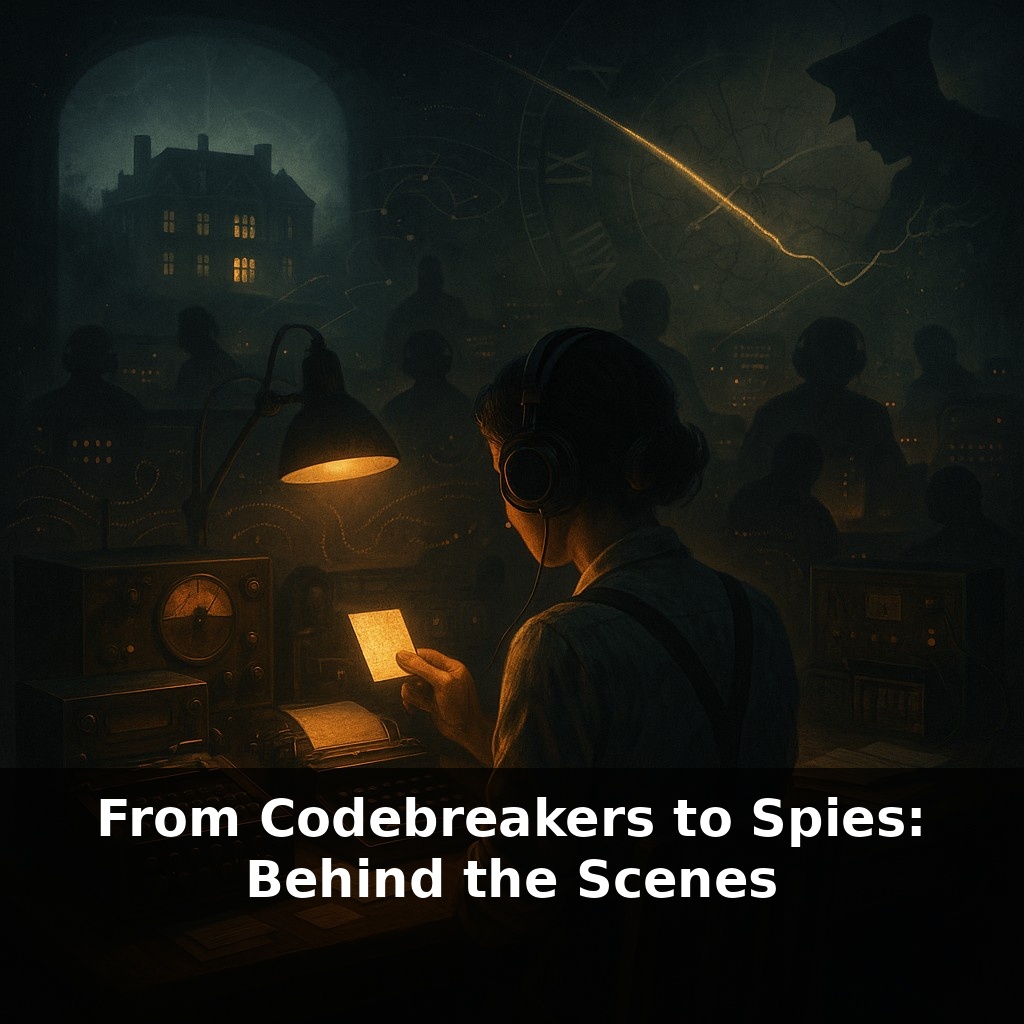
A war can be won by people who never fire a shot. In one cramped British mansion, thousands worked in total secrecy, racing midnight deadlines. A few hours later, far away, a general would change a battle plan—without ever knowing who had just saved his army.
The strangest part? The most powerful “weapon” in this hidden struggle was often a scrap of routine: a lazy radio operator repeating a phrase, a weather ship reporting like clockwork, a clerk signing off with the same greeting each day. Code-breakers hunted these tiny habits the way detectives study smudged fingerprints. Every slip narrowed possibilities inside machines designed to be mathematically unbreakable.
But numbers alone weren’t enough. While mathematicians chased patterns in intercepted messages, couriers slipped across borders, resistance cells tapped phone lines, and double agents fed just enough truth to earn trust—then quietly twisted the story. When their work aligned, a decrypted signal could be cross-checked against a whispered report from a café in Paris or a fishing boat off Norway, turning scattered clues into a map of the enemy’s intentions.
Sometimes that “map” arrived almost too quickly to believe. A message sent from a U‑boat at dawn might be on an Allied commander’s desk before lunch, translated, analyzed, and flagged as urgent. To make that possible, entire hidden ecosystems grew up behind the front: listening posts lining lonely coasts, vans bristling with antennae drifting through static, clerks logging signal times with the precision of astronomers tracking stars. Nearby, other teams sifted reports from occupied cities and remote islands, testing which fragments fit together and which were deliberate traps. This was the quiet race inside the wider war.
The numbers behind this hidden war were almost absurd. A three‑rotor Enigma could be set in more than 158,000,000,000,000,000,000 different ways for a single day. Germany trusted that no enemy could possibly search that ocean of options between one midnight and the next. Yet at Bletchley Park and other centers, teams quietly did just that—using brains, paper, and, eventually, machines that pushed the limits of what “calculation” even meant.
That pressure for speed changed technology itself. Early in the war, rows of people worked with pencils, slide rules, and electromechanical “bombes” to test rotor settings. By 1944, Colossus appeared: a vast, humming machine reading 5,000 characters per second from looping paper tape. It didn’t look like a modern laptop; it was banks of valves, switches, and wires. But it introduced a crucial idea: let electronics chew through possibilities while humans decide which patterns matter.
On the human side, a similar scaling‑up happened. The British Government Code and Cypher School drew in linguists, chess champions, Egyptologists, and crossword‑puzzle winners. The U.S. Navy recruited mathematicians and bridge players to tackle Japanese naval codes, while specialists picked apart PURPLE, Tokyo’s diplomatic cipher. The OSS, America’s wartime intelligence agency, trained roughly 13,000 people in everything from lock‑picking to report writing. Women were central to this effort: around a third of Bletchley Park’s staff, and countless others in Allied services, ran machines, translated traffic, and distilled raw material into something commanders could actually use.
None of this mattered unless it could move faster than events at the front. Allied planners aimed to have crucial decrypts on desks within roughly 8–12 hours of interception. That meant night shifts, overlapping teams, and rigid workflows: intercept, route, process, translate, assess, distribute. A delay of even a few hours could turn brilliant insight into stale history.
Historians like Sir Harry Hinsley later argued that this sustained advantage—cumulative, often invisible—may have shortened the war in Europe by two to four years. That estimate is debated, but it captures a core truth: the most decisive blows sometimes landed far from any battlefield, in rooms thick with cigarette smoke, humming with valves and typewriters, where the loudest sound was the tearing of another strip of paper tape.
Some of the cleverest successes came from pairing machine output with very human quirks. When Allied analysts spotted multiple U‑boats suddenly “going dark” in the same patch of ocean and a spy in a Spanish port reported extra fuel drums loaded onto a single dock, planners inferred a wolfpack forming long before any ship saw a periscope. Elsewhere, resistance reports of fresh concrete near a remote French village aligned with a spike in construction‑related radio traffic; that helped flag launch sites for new German rockets.
In the Pacific, a deliberately planted detail—an island ordered to report a “water shortage” over open radio—lured Japanese cryptographers into repeating the phrase in a secret message. That confirmation let U.S. analysts tie a codeword to a real location, sharpening their map of future operations. Across theaters, these moments felt less like solving a single puzzle and more like listening for harmonies in an orchestra: when signals, sabotage, and whispered rumors all hit the same note, commanders paid attention.
Tomorrow’s “Bletchley” may live in server racks and satellites. Quantum machines could punch holes through today’s ciphers, forcing societies to redesign secrecy from scratch. AI can sift oceans of data, but deciding *which* insights to trust becomes its own craft. As space and cyberspace crowd with competing probes and probes-of-probes, the sharpest advantage may lie in how well we mix coders, ethicists, diplomats, and field experts—like tending a diverse forest instead of a single hardier tree.
Today, some of the sharpest “listeners” are algorithms trawling social feeds, shipping logs, even satellite glints off harbor water. A hashtag spike can matter as much as a radio burst once did. Yet the real leverage still lies where unlikely clues meet curious minds—like spotting a lone firefly and guessing there’s a whole field blinking just out of sight.
To go deeper, here are 3 next steps: 1) Watch the film *The Imitation Game* and then read Andrew Hodges’ book *Alan Turing: The Enigma* to compare how Bletchley Park’s codebreakers are portrayed versus the historical record. 2) Visit the official Bletchley Park website (bletchleypark.org.uk) and take their virtual tour, zooming in on the Bombe and Enigma exhibits to connect the episode’s codebreaking stories with real machines and declassified documents. 3) Pick one real spy mentioned in the episode (like Kim Philby or Oleg Gordievsky) and read a full biography—Ben Macintyre’s *The Spy and the Traitor* is a great start—then jot a quick “then vs. now” comparison of how espionage tradecraft from their era shows up in today’s cyber and intelligence news (try browsing the Spy Museum’s resources at spymuseum.org).