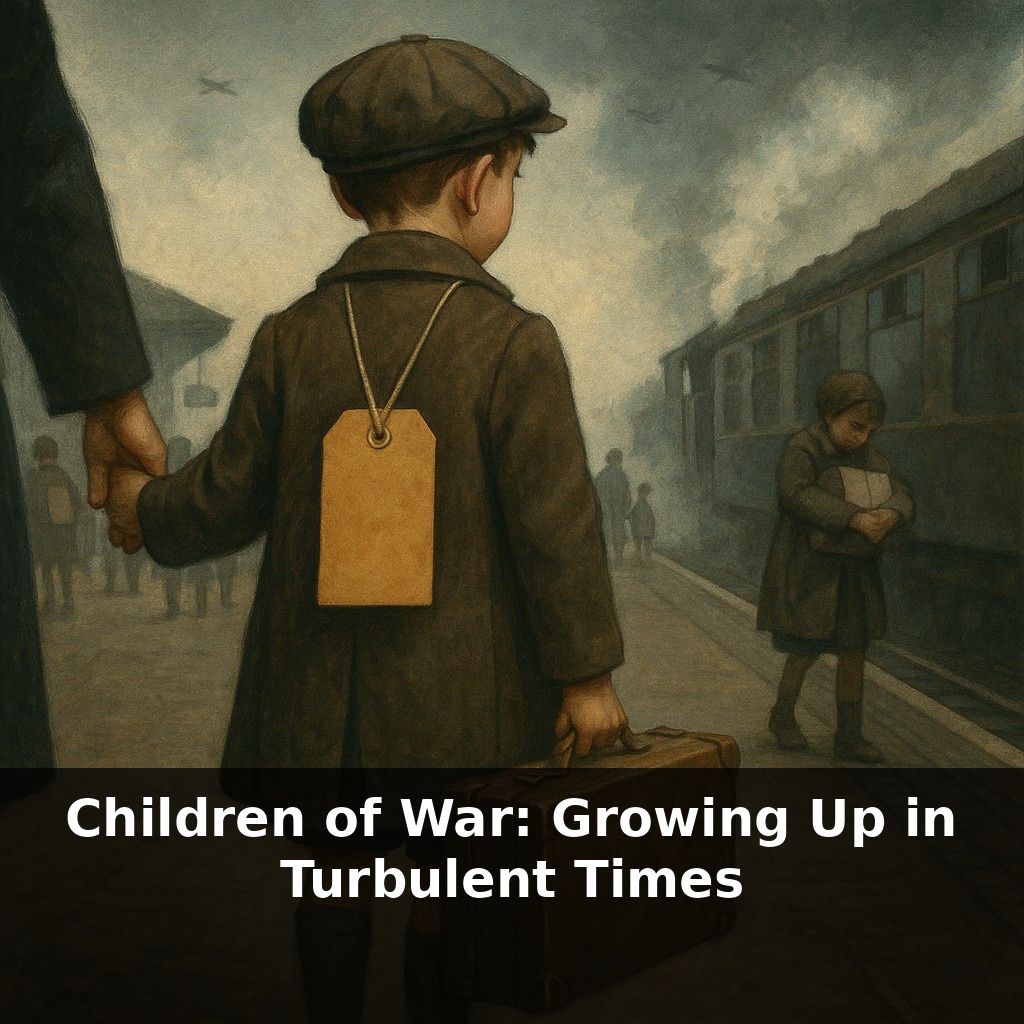
In the summer of 1940, schoolchildren in Britain were boarding trains with nametags around their necks—sent to live with strangers for safety. Some remembered it as an adventure. Others never saw their parents again. How does a childhood hold both of those truths at once?
Some children of war later said the hardest part wasn’t the bombs, but the in‑between times—the long queues, the empty desks at school, the waiting for news that never came. Their days were stitched together from ordinary moments and sudden shocks. A math lesson could be interrupted by sirens; a game in the street might end at a crater’s edge.
Researchers now track these disrupted patterns the way a seismograph tracks tremors: not just the “big quake” of a battle or a raid, but the constant aftershocks of separation, hunger, and uncertainty. These subtle jolts can echo years later in bodies and minds—shaping stress hormones, immune systems, even how people trust others. Yet within the same streets and shelters, some children found anchors: a steady teacher, a neighbor who shared food, a choir that kept meeting in a basement.
In World War II, those anchors often appeared in unlikely forms. A classroom meeting in a church hall, chalk dust mingling with sandbags. A billet family insisting homework be done even after a night in the shelter. Records show that up to 90% of London’s elementary schools reopened within three weeks of the Blitz, not because buildings were intact, but because adults understood that predictable lessons could steady frayed nerves. Meanwhile, evacuation schemes like Operation Pied Piper uprooted 3.5 million children, forcing them to navigate new dialects, rules, and affections while sirens wailed miles away.
When historians sift through wartime records, they find children’s lives reduced to categories: “evacuated,” “bombed out,” “orphaned,” “malnourished.” Yet behind each label is a web of experiences that didn’t stop when sirens did. For some, the war rewrote the body from the inside out. The Dutch “Hunger Winter” of 1944–45, for example, left a biological fingerprint. Decades later, adults who had been in utero or very young during that famine showed higher rates of conditions like type‑2 diabetes and cardiovascular disease, a trace of scarcity etched into metabolism. Deprivation, it turned out, could echo across a lifetime.
Psychologists looking at Holocaust child survivors found another kind of long echo. Around half eventually met full criteria for PTSD: nightmares, flashbacks, a nervous system that never fully stood down. Yet a smaller portion—roughly a quarter—described something more paradoxical: “post‑traumatic growth.” They reported deeper appreciation for life, stronger empathy, a fierce drive to protect others. Pain and growth coexisted, not canceling each other out but shaping a complicated adulthood.
What tipped the balance? Protective factors rarely arrived as grand gestures. A consistent caregiver, even in a ghetto or camp, could offer a sense of continuity. Siblings smuggled jokes along with bread. After the war, some children were absorbed into communities that prioritized rebuilding schools, youth groups, and rituals—structures that signaled, “You still belong somewhere.” Others were shuffled through institutions or silenced by families who could not bear to talk; their outcomes, on average, were harsher.
Modern researchers link these patterns to what children are allowed to do with their stories. Those encouraged to speak, draw, or later write about what happened often piece together a more coherent narrative. Those met with denial—“you were too young to remember,” “better to forget”—can be left alone with wordless fear. Neuroimaging now underscores what many survivors long insisted: even preverbal experiences can leave durable traces in the brain.
A child in wartime is like a sapling in gale‑force winds: battered, sometimes permanently bent, but not defined solely by breakage. Roots—relationships, routines, chances to make meaning—matter as much as the storm itself.
In post‑war Europe, some youth groups functioned almost like informal laboratories in resilience. A Polish scout troop, for example, met among rubble to practice first aid and plan community clean‑ups. What looked like simple tasks quietly rebuilt a sense of competence and agency: “I can still help. I still matter here.” Elsewhere, diaries kept in bunkers later became school projects, turning private memories into shared history rather than private burdens.
Modern programs in Syria and Ukraine borrow from these early experiments. Mobile classrooms arrive with art supplies, story circles, even small radios so children can broadcast their own programs. One team found that when kids produced short audio dramas about daily hassles—lost toys, annoying siblings—alongside war themes, they were less likely to withdraw socially. It wasn’t erasing fear; it was widening the emotional playlist. Like adding new instruments to a damaged orchestra, these small, structured chances to create can help young people hear themselves as more than victims of a single, overwhelming note.
Future implications ripple beyond battlefields. Data from WWII now guides how we design shelters, apps, and even games for kids in current conflicts: shorter separations from caregivers, steady schooling, quiet spaces for expression. Humanitarian teams are starting to treat mental health like clean water—non‑negotiable in every response. As digital tools spread, the risk is a “patchwork peace” where connected children heal faster while others wait outside the signal, unheard.
The next frontier is listening to children not just as patients, but as historians of the present. Their drawings, voice notes, and text threads are already archives in progress. Policies that invite their input—on shelters, schools, even play spaces—do more than consult them; they hand back a small share of control, like returning a lost house key.
To go deeper, here are 3 next steps: 1) Watch the documentary “For Sama” or “Born in Gaza” and, as you do, keep the UNICEF “Children and Armed Conflict” page open so you can connect individual stories to the bigger global patterns the episode talked about. 2) Pick one frontline NGO supporting war-affected kids—such as War Child, Save the Children’s “Children in Conflict” programs, or the International Rescue Committee—and set up a modest monthly donation or start a small workplace/classroom fundraiser using their online toolkits. 3) If you’re a parent, teacher, or caregiver, download the “Helping Children Cope with Crisis” guide from the International Red Cross or the National Child Traumatic Stress Network, choose one concrete strategy from it (like a grounding game or routine), and try it with a child in your life today while briefly, calmly explaining what’s happening to children in war zones.