A war can be decided by a teaspoon of sugar. In one street, a mother waters down stew so her kids eat; in another, a factory worker pulls a double shift while her shoes fall apart. The guns are thousands of miles away, yet every quiet sacrifice is pushing the front lines.
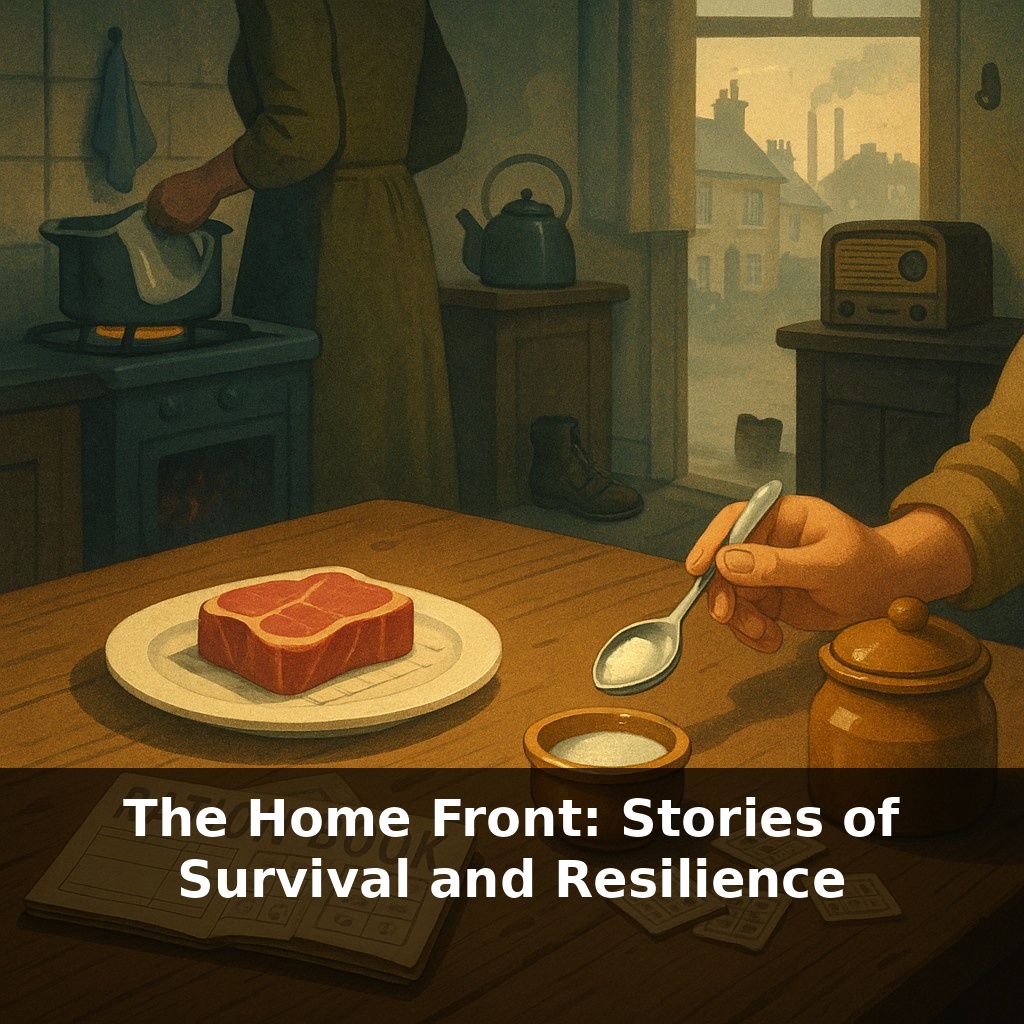
By 1943 in Britain, the weekly meat allowance for an adult was about the size of a deck of cards—8 ounces to stretch across seven days. Yet kitchens turned that sliver into stews, pies, and sausages that could feed a family, the way a clever musician turns three chords into a dozen songs. On the other side of the Atlantic, car showrooms stood almost empty: U.S. factories that once rolled out millions of shiny sedans now spat out tanks, jeeps, and bombers instead. At the same time, women in overalls and turbans stepped onto assembly lines, into offices, and behind plows, transforming “women’s work” into simply “work that had to be done.” Backyard lawns became Victory Gardens; window boxes grew carrots and beets. Far from being passive, these home fronts were vast, improvised systems of survival—every queue, recipe, and shift change part of a quiet, relentless campaign.
Gasoline vanished into fuel tanks marked “Army Only.” Nylon disappeared from shop windows and reappeared as parachutes. In many cities, nighttime streets dimmed under blackout curtains while families listened for distant engine hums, rehearsing what to do if sirens wailed. Children collected scrap metal and rubber the way others might trade baseball cards, except every bent spoon or burst tire felt like a tiny bolt in a bomber or ship. Recipes shifted overnight as cooks learned to treat dried eggs and powdered milk like puzzle pieces—odd shapes that still had to form a complete, nourishing picture.
Queues wrapped around corners not just for food, but for soap, fuel, clothing, even news. Governments understood that patience could wear out faster than supplies, so they tried to turn endurance into a shared project rather than a private misery. Public campaigns didn’t just shout “Do with less”; they offered concrete scripts for how to cope: recycling recipes, clothing repair guides, posters showing how to darn socks or “make do and mend” a single dress into a skirt for one child and a shirt for another. In some British cities, sewing rooms were set up in church halls where neighbors pooled skill and scraps, turning worn-out coats into toddlers’ jackets or padded vests for air-raid wardens.
In the United States, the sudden plunge in civilian car production collapsed an entire way of moving through daily life. Commuting became a group activity: “share-the-ride” clubs, company buses, even informal truck beds packed with workers heading to plants at dawn. Tires were so precious that people walked or cycled miles rather than risk a flat they couldn’t replace. Cities experimented with staggered work hours to ease pressure on public transport, reshaping the clock itself to keep factories running.
Children stepped into roles adults could no longer fill. In Canada and Australia, teenagers took seasonal leave from school to help bring in harvests, earning the nickname “field armies.” In the Soviet Union, students worked in “labor brigades,” unloading trains, clearing rubble, or helping in makeshift hospitals. Air-raid drills, fire-watching shifts, and first-aid classes turned backyards and corridors into training grounds for responsibilities that would have been unimaginable a decade earlier.
The home’s emotional climate became another front to manage. Governments feared despair and rumor as much as shortages. Films, radio dramas, and songs were carefully curated to acknowledge hardship without letting it dominate. Letters from soldiers were often read aloud in kitchens or courtyards, stitching distant fronts back into the fabric of neighborhood life. In besieged Leningrad, concerts and poetry readings continued even as shells fell, signaling that culture itself was a form of resistance, a refusal to let daily life dissolve entirely into survival calculations.
Some of the most striking adaptations happened in places that looked utterly ordinary: living rooms, corner shops, schoolyards. A London hairdresser quietly switched from beauty treatments to delousing services for evacuee children. Boarding houses in Melbourne and Chicago posted rotating “sleep schedules” on kitchen doors, so shift workers could claim a few silent hours in shared beds. In Leningrad, librarians wrapped precious books in waxed cloth and stored them in basements beside potatoes, treating words like emergency rations for the mind.
On factory floors, workers learned to treat time the way they treated fuel: something to be stretched, not burned. A single broken machine could derail a production line, so informal “repair circles” formed—retired mechanics, hobbyist tinkerers, even watchmakers meeting after hours to nurse tired equipment through another week. The effect was like neighbors quietly shoveling snow from a concert hall’s roof all winter; without them, the music—the flow of supplies, the fragile normalcy of home—would have simply caved in.
Today’s planners quietly study those kitchens, queues, and sewing circles as prototypes. Instead of recipe leaflets, they test apps that nudge neighborhoods to share tools, spare rooms, solar power. Energy “rations” become dynamic quotas that reward cooperation, not just conservation. Libraries pilot roles as storm shelters and Wi‑Fi lifelines. The lesson is less about nostalgia than muscle memory: how quickly ordinary streets can rewire themselves when continuity, not comfort, is the goal.
In the end, the home front is less a chapter of history than a toolkit we keep misplacing. Those crowded kitchens and improvised shifts hint at how neighborhoods might face blackouts, heatwaves, or broken supply chains now—more like a jazz band trading solos than a marching army, each person adjusting their rhythm so the song can keep going.
Here’s your challenge this week: Pick one “home front” resilience practice from the episode—like creating a household communication plan, setting up a quiet zone for emotional cool-downs, or designating a weekly family “state of the union”—and fully implement it in your home within the next 48 hours. Block off 30 minutes on your calendar, tell everyone in your household what you’re doing and why, and walk them through exactly how this new practice will work in stressful moments. By the end of the week, check in with each person and ask them one specific question: “Did this make hard moments at home feel even a little bit safer or calmer for you?”