The Enigma Machine: Cracking the Code
📝 Transcript
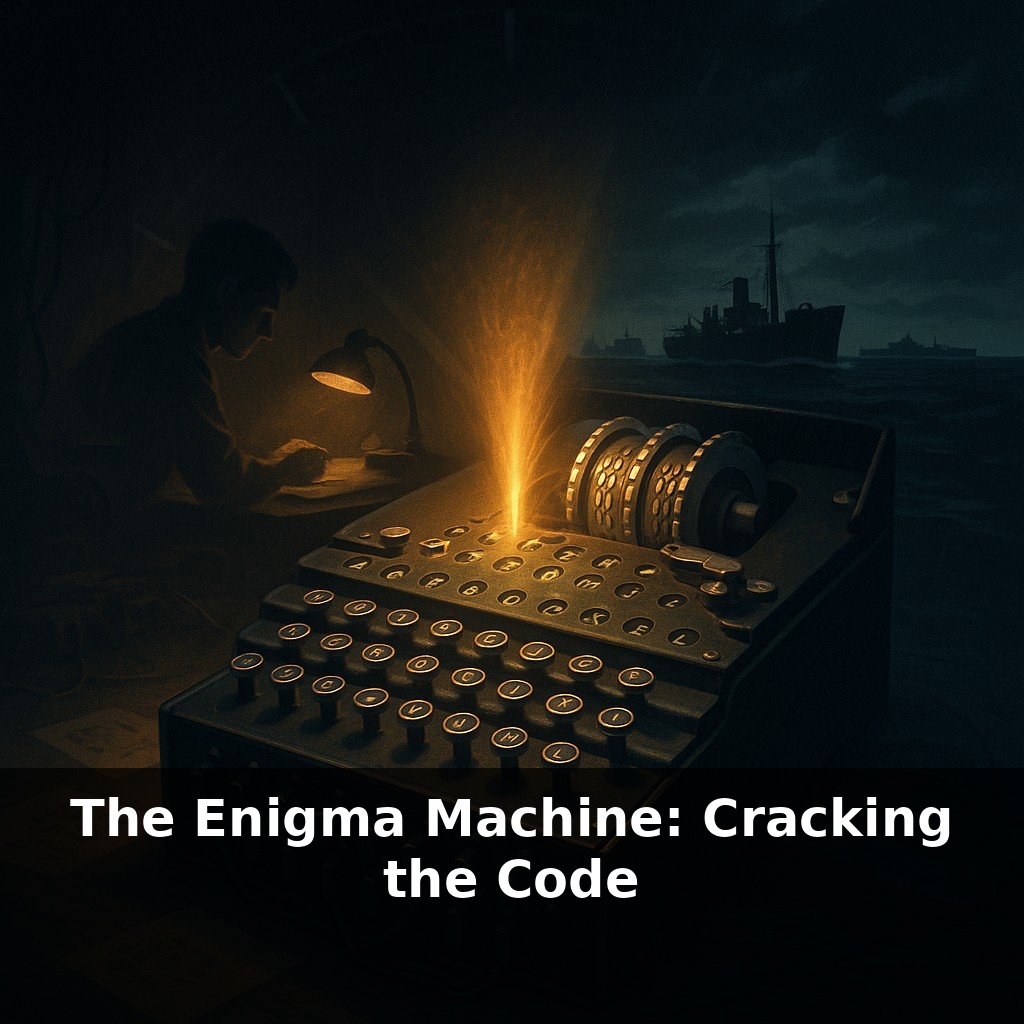
Depth charges rumble beneath a dark Atlantic sky. A convoy sails blind, unaware a wolfpack circles nearby. In a cramped room far away, young codebreakers race a midnight deadline. Here’s the mystery: how did the Allies read messages sent on a machine everyone swore was unbreakable?
By 1942, the battle in that cramped room had turned into a race against midnight that restarted every single day. Each dawn, German operators across Europe and the Atlantic changed their Enigma settings, wiping out yesterday’s hard-won progress. The Allies weren’t just breaking a code once; they were breaking a moving target, over and over, often with only scraps to start from.
A weather ship off Norway might send a routine forecast. A harbormaster in Bordeaux might file a predictable morning report. These “boring” messages became gold. At Bletchley Park, teams hunted for such regular traffic—phrases like “weather report” or “nothing to report”—then used them as hooks to drag out an entire day’s key.
Meanwhile, in a Polish basement years earlier, three mathematicians had quietly proved Enigma wasn’t magic at all, but a machine with patterns—and patterns can be hunted.
Instead of one genius moment, the breakthrough was a chain of messy, human-sized steps. In 1932, Polish mathematicians in Warsaw quietly reconstructed Enigma’s wiring using stolen German manuals and pure algebra, then built their own machines to mimic it. When German procedures grew more complex in 1939, they handed their work to the British and French at a secret meeting near Pyry forest. Years later, trawlers seized U-boat documents in freezing Atlantic raids, and resistance fighters smuggled key lists on crumpled paper. Each scrap narrowed the search just enough for machines to finish the job.
At Bletchley Park, the real magic wasn’t the mystery—it was the workflow.
Each morning, intercept stations across Britain and the Empire funneled rolls of pencilled Morse into a central hub. Clerks sorted them by network—Army, Luftwaffe, naval—because each used different procedures and machines. Then came the hunt for “depth”: pairs or bundles of messages that shared the same daily setup but different content. Those clusters were the raw material for attack.
One concrete routine: a Luftwaffe base in France might send out the same request format every afternoon—unit code, time, weather, planned sorties. Analysts learned those habits. When today’s version arrived, they guessed likely fragments of the German text and aligned them with the cipher. Any clash—like a letter mapping to itself, which Enigma never allowed—killed that guess instantly. Surviving guesses were precious; they went to the Bombe rooms.
There, long rows of metal racks spun and clattered as Wrens tended switches and paper logs. A single run might chew for half an hour, testing thousands of hypothetical settings. But the logic had been pre‑distilled: the machine only explored configurations consistent with the partial deductions humans had already made. When a run halted on a “stop,” operators didn’t celebrate—they phoned a checking room, where another group tried the candidate setup on a replica machine against real traffic. Only if whole messages suddenly bloomed into clear German did the room erupt.
Naval traffic demanded an extra layer of craft. The Atlantic command used a more complex variant and stricter discipline. To crack it, analysts built vast “crib books” of recurring phrases from ship reports and naval bureaucracy. A U‑boat’s nightly position signal, sent in a rigid template, might reveal just enough structure for a narrow, painstaking attack. That work fed directly into maps in an adjacent hut, where officers quietly shifted convoys away from danger based on dots of ink that, officially, should not have existed.
The pace was relentless. Keys changed at midnight; any delay meant today’s messages might only be readable when they were tomorrow’s history. That pressure forced constant innovation: new statistical tests, refined procedures for choosing cribs, faster ways to distribute fresh settings to every relevant hut. The system behaved almost like a living organism, adapting week by week to German countermeasures and mistakes.
Every successful day’s key opened a window not just on orders and reports, but on rhythms—who commanded whom, which units moved together, where fuel and ammunition flowed. Over months, those patterns of communication became a second map of the war, one drawn not in terrain and rivers but in relationships and habits. Depriving the enemy of surprise turned out to be as decisive as any tank or bomber.
In early 1941, a German weather ship in the North Atlantic sent its routine forecast, unaware a boarding party would soon capture its codebooks. Those soggy pages didn’t “solve” anything alone; instead, they gave Bletchley a narrow window into how one corner of the German system behaved. From there, analysts inferred habits of nearby commands—who forwarded which reports, at what times, on which circuits. That social map of signals traffic often mattered more than any single decrypt.
Something similar happened in North Africa. When Rommel’s supply convoys reported delays, the resulting messages—logistics complaints, rescheduling notes, fuel tallies—let ULTRA staff estimate how many tanks could actually move on a given day. Commanders then chose when to attack based not on desert terrain, but on invisible shortages revealed by intercepted grumbling.
Like listening to a symphony from outside the concert hall, analysts couldn’t see the score, but they could learn which instruments entered when—and predict the next movement from the rhythm alone.
Building on that living, adapting system at Bletchley, let’s zoom out to what it all meant.
First big lesson: ULTRA didn’t just win clever puzzles; it bent the shape of the war. Many historians argue it cut the European conflict by roughly two years, because leaders could choose battles knowing what German commands were planning, not guessing.
Second: Enigma’s “unbreakable” math still failed in the real world. Human habits, operator shortcuts, captured sheets—those cracks mattered more than theory. That’s a warning for today’s encryption and cybersecurity: the algorithm is rarely the weakest link. It’s the people, the procedures, the rushed moment when someone reuses a password. When was the last time you saw a “secure” system undermined by a simple mistake?
Third: notice who actually cracked Enigma. Polish pioneers, British organizers, American industrial muscle; linguists, engineers, classicists, chess players. No single genius, but a messy coalition. For modern challenges—from quantum‑era cryptography to ethical AI—that might be the deepest takeaway. Big, complex threats yield most when we assume no technology is perfect, keep a healthy skepticism, and put very different minds in the same room to probe for the flaws.
Building on those lessons, step back for a moment. A war once bent because one “unbreakable” machine wasn’t. Habits, rushed decisions, and quiet cooperation turned metal boxes into a stream of insight.
Years later, Anna steps out of Bletchley’s gates for the last time, swears to keep the secret, and fades into ordinary life. Maybe you’ve walked past someone like her: an elderly woman on a park bench, or a neat little house with blackout‑era curtains still tucked away in a drawer. The traces of this hidden war sit in museums, in archived letters, and in memories that were locked up for decades.
Here’s your challenge this week: pick one hidden system you rely on—how your phone locks, how your messages travel, how your browser says a site is “secure”—and follow it one step deeper. Don’t just accept the padlock icon or the fingerprint scan; read a short article, watch a talk, or visit a local museum with a wartime radio or cipher wheel if you can.
Because the heart of the Enigma story is this: the world is full of systems we’re told are too complex to question. The codebreakers’ quiet defiance—asking “what if it isn’t?”—helped shorten a brutal war. Carry a bit of that skepticism with you, and remember the paradox we started with: a battlefield won not by louder explosions, but by listening more closely to what was never meant to be heard.
From this course
War Machines: Technology's Role in WWII
6 episodesUnlock all episodes
Full access to 6 episodes and everything on OwlUp.
Subscribe — $1.99/monthLess than a coffee ☕ · Cancel anytime