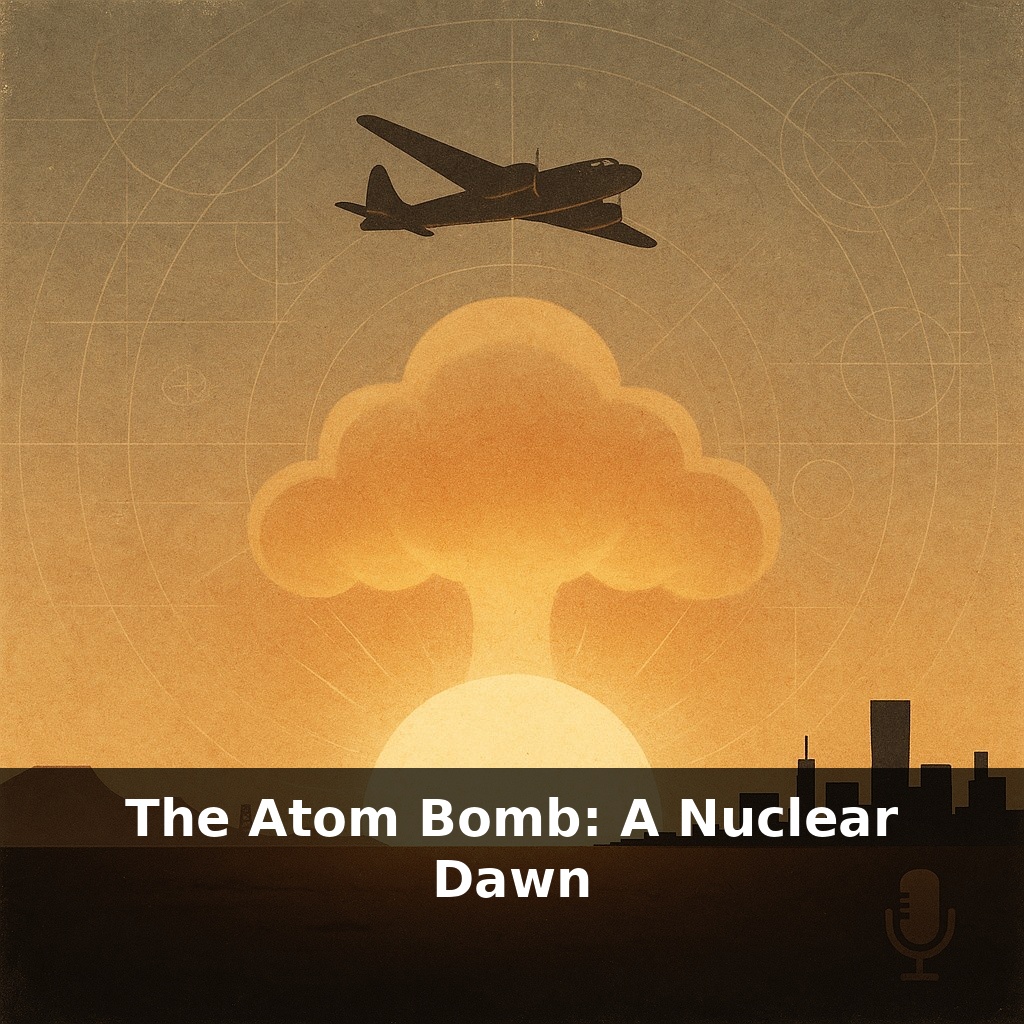
A single bomb over Hiroshima released more energy than some entire campaigns of World War Two. In one blinding flash, centuries of warfare became obsolete. A scientist in the desert, a city waking up, and a world stepping—half in awe, half in terror—into a nuclear dawn.
Before Hiroshima and Nagasaki, “total war” meant factories, fleets, and years of grinding campaigns. After August 1945, it could mean a single mission, a single payload, a single decision. The atom bomb didn’t just add a stronger weapon to the shelf; it rewired how nations thought about time, risk, and survival. Diplomats now negotiated under a clock that could, in theory, run out in minutes, not months. Scientists, once shielded in labs, found their equations echoing in war rooms and presidential briefings. Civilians, far from any frontline, suddenly lived with the knowledge that their ordinary streets could become targets not for conquest, but for erasure. This episode follows that shift: from secret desert test sites to charred city blocks, from scientific breakthrough to political nightmare, tracing how one technology turned the future itself into a contested battlefield.
A weapon this new didn’t appear in a vacuum. It emerged from a crash program that quietly turned university labs, desert mesas, and factory towns into nodes of a single vast machine. Most workers knew only fragments of what they were building; secrecy was stitched into every blueprint, every train car of uranium ore. Politicians signed off on budgets without fully grasping the physics, while generals planned invasions unaware that a different kind of endgame was being assembled. In this fog of half-knowledge, decisions with planetary consequences moved forward step by step.
At the center of that vast machine sat a deceptively simple idea: if one atomic nucleus could be split, releasing neutrons, those neutrons might split others, and the process could multiply on its own. Turning that from blackboard math into a weapon meant solving three brutal engineering questions: how to get enough fissile material, how to force it together fast enough, and how to carry it to a target.
The first problem became an industrial nightmare. Natural uranium is mostly U‑238, which refuses to sustain the kind of reaction bomb designers needed. The rarer U‑235 had to be teased out, fraction by fraction, in facilities the size of small cities. At Oak Ridge, Tennessee, calutrons and gaseous diffusion plants ran day and night, pulling just grams of enriched material from tons of feedstock. In Hanford, Washington, purpose‑built reactors bred plutonium in graphite blocks and water‑cooled channels, then chemical plants stripped it out in stages that left behind lakes and soil laced with long‑lived waste.
The second problem—assembling a “critical mass” in microseconds—split the program along two paths. For uranium, engineers settled on a gun‑type design: two subcritical pieces slammed together by conventional explosives. Plutonium, contaminated with an isotope that pre‑ignited the chain reaction, forced a much harder solution: spherical “implosion,” using precisely timed explosive lenses to crush a core evenly from every side. That design was so uncertain that the Trinity test in July 1945 was effectively a proof‑of‑concept shot fired at the desert itself.
Meanwhile, aircraft crews trained for a mission they barely understood. B‑29s were stripped, modified, and drilled in high‑altitude, single‑bomb runs to avoid enemy fire and, they hoped, outrun the blast. Meteorologists became quiet gatekeepers of fate, parsing winds and cloud ceilings over Japanese cities because humidity, temperature, and crosswinds would shape the fireball and fallout much as shifting jet streams shape the spread and intensity of a storm front.
When the devices finally worked—not in theory, but in glassed sand and burning streets—the consequences reached far beyond the immediate devastation. The successful weapon instantly turned every previous estimate of military manpower, industrial output, and “acceptable losses” into an outdated spreadsheet. Strategic planners now had to calculate scenarios where one bomber could impose damage once requiring entire air fleets, and where the “front line” was defined less by geography than by who controlled the enrichment plants, reactors, and laboratories feeding this new, terrifying capability.
A single weapon that could erase a city didn’t just terrorize leaders; it rewired everyday habits. In postwar civil‑defense drills, schoolchildren learned to “duck and cover,” not because a desk could stop a blast, but to offer some protection from flying glass and to give a sense of control in the face of the uncontrollable. City planners quietly mapped evacuation routes and fallout shelters into zoning decisions; highway systems and suburban sprawl doubled as potential dispersal plans for urban populations. Militaries, too, began redesigning their playbooks: fleets were spread across wider oceans, bomber bases scattered, command centers buried or placed in motion aboard aircraft and submarines. Nuclear arsenals grew not only in number but in variety—tactical warheads for battlefields, massive thermonuclear devices for cities, submarine‑launched missiles meant to stay hidden until the worst day. Each new deployment option forced fresh calculations about miscalculation itself: how many layers of warning, how many chances to stand down, were enough?
Nuclear weapons also reshaped peacetime power. States with arsenals gained outsized influence, while others clustered under “umbrellas,” trading autonomy for protection. Domestic budgets tilted toward weapons labs and missile fields instead of schools and hospitals. Public anxiety rose and fell in waves, like tides driven by distant storms: test-ban treaties, near-miss crises, and reactor accidents all nudged societies to question whether deterrence was stability—or a long gamble against luck.
The atomic age didn’t just arrive and stop; it keeps unfolding, like ripples from a stone dropped in deep water. Today’s debates over nuclear energy, accident risks, and “tactical” warheads all trace back to that first leap. The core question lingers: can a species that learned to end cities in a heartbeat learn, just as quickly, how not to?
Try this experiment: Go outside tonight with a map app and pick a real location in your city that roughly matches the distance from Hiroshima’s hypocenter to the edge of the major blast damage (about 2 km / 1.2 miles), then walk that radius as if the bomb had gone off at your starting point. As you walk, imagine which specific buildings, people, and infrastructure in your path would be instantly destroyed, badly damaged, or only affected by heat and radiation, based on what you learned about blast zones in the episode. When you get home, compare what you imagined to actual Hiroshima damage maps from 1945 (search for “Hiroshima blast radius map”) and notice where your mental model was off. This will give you a visceral sense of scale that numbers in the podcast can’t fully convey.