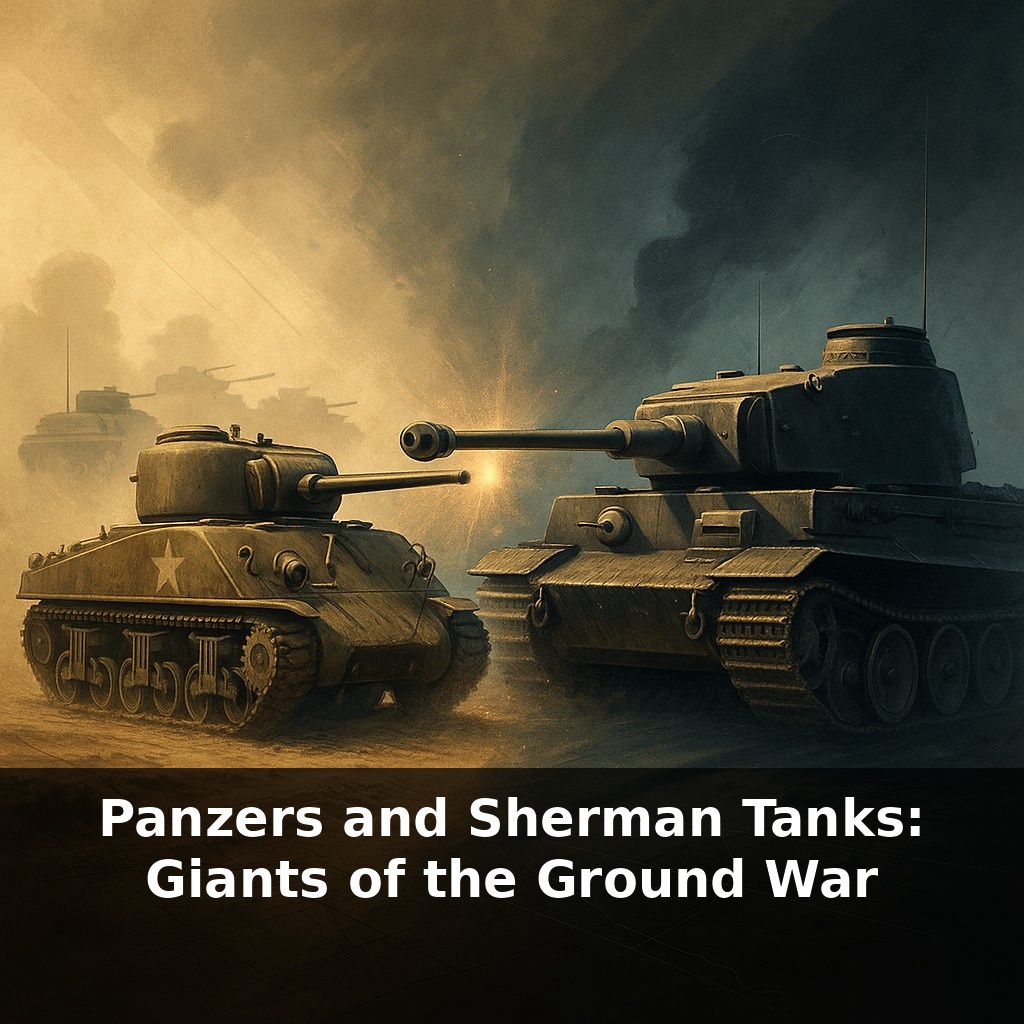
A tank duel where one side wins most face‑to‑face fights, yet still loses the war. That’s the paradox at the heart of the showdown between German Panzers and American Shermans—a clash where raw power met relentless reliability, and the “weaker” tank helped tip history.
On paper, late‑war German tanks looked like the obvious winners: thicker armor, harder‑hitting guns, and an aura of invincibility that echoed through Allied briefing rooms. Yet the real story of Panzers versus Shermans lives less in armor thickness charts and more in the muddy, fuel‑starved logistics trails behind them. A tank, after all, is less a lone gladiator and more the lead violin in an orchestra: impressive only if the rest of the section shows up on time and in tune.
In this episode, we’ll trace how design choices made in factories and planning offices—about cost, complexity, and maintenance—shaped what actually happened on the battlefield. We’ll look at why a tank’s “paper strength” often collapsed under real‑world conditions, and how the side with fewer “perfect” machines could still dominate the ground war.
Numbers tell the rest of the story. By mid‑war, Germany could send roughly a few thousand tanks east, while the U.S. alone was turning out tens of thousands of Shermans across multiple plants. That scale reshaped strategy: the Allies could plan offensives assuming losses and breakdowns, much like a commander budgeting for bad weather, while German planners increasingly gambled on individual “wonder weapons” turning the tide. We’ll explore how this imbalance in industrial depth, repair networks, and fuel supply meant that who built the tanks—and how—mattered as much as who crewed them at the front.
The contrast begins at the drawing board. German engineers kept pushing for better guns and heavier armor, accepting complicated suspensions, delicate transmissions, and cramped interiors as the price of performance. The Panzer IV that rolled into Poland in 1939 was relatively simple; the Panther and Tiger that followed were far more complex machines, full of precision parts that demanded skilled labor and time Germany was rapidly running out of.
American planners, by contrast, optimized the M4 Sherman for standardization. Components were interchangeable across factories, which meant an engine block cast in Detroit could mate with parts assembled in Ohio or California. That choice reverberated at the front: field workshops could cannibalize one wreck to revive three others, and crews knew that replacement parts would actually fit without modification.
Crew experience diverged as well. German tankers often trained extensively and benefitted from early‑war combat lessons, but by 1944 attrition was brutal. Veteran crews were lost faster than they could be replaced, and new recruits climbed into increasingly demanding vehicles with less time to master them. U.S. training wasn’t perfect, yet it was systematic: gunnery tables, radio procedures, and coordination drills were designed to be replicated quickly for thousands of men.
Doctrine amplified these trends. German armor units fought increasingly as “fire brigades,” rushed from crisis to crisis, which magnified wear and left little time for maintenance. American doctrine leaned on combined arms: Shermans rarely operated alone when they could move with artillery, infantry, engineers, and close air support. A Panther might win a duel on a quiet hedgerow lane, but it struggled when every advance risked calling down fighter‑bombers and massed artillery.
Terrain and timing added another twist. In the tight bocage of Normandy, long‑range gunnery mattered less than ambushes at a few hundred meters, where even a “lesser” gun could penetrate side armor. Later, in the open spaces of France and Germany, the Shermans’ ability to stay moving—bridges they could cross, roads they wouldn’t tear up, tracks that lasted longer—meant more tanks reached each new line of resistance.
Like a river system that seems calm at the surface yet is shaped by countless hidden streams, the outcome of Panzer versus Sherman wasn’t decided by single duels but by how design, training, and doctrine all flowed together over months of campaigning.
On the ground, these abstract choices showed up in very specific moments. In Normandy, U.S. units sometimes pushed Shermans forward almost like expendable scouts, probing for hidden Panthers so artillery or fighter‑bombers could strike the revealed positions. German commanders, knowing each late‑war Panzer was precious, often held them back for carefully prepared counterattacks instead of routine patrols. That difference in how “spendable” a tank felt shaped daily tactics.
You can see a similar pattern in how both sides handled damage. American field reports describe Shermans knocked out on Monday, towed back, patched with parts from two other hulks, and reappearing in Thursday’s attack under the same crew. German workshops, facing parts shortages and more intricate machinery, might labor over a single disabled Panther for days, only to abandon it when the front shifted.
In that sense, the Sherman fleet behaved less like a set of individual vehicles and more like a living organism constantly shedding, healing, and regenerating its armored “skin” at the front.
Today’s designers face a similar fork in the road. A few exquisite main battle tanks can dominate trials, yet in prolonged conflict, the side that can rapidly replace, adapt, and network its machines may gain the upper hand. Swarms of cheaper vehicles and unmanned systems, updated by software like shifting weather fronts, could outpace slower, “perfect” platforms. The real contest may be less about the toughest tank and more about which ecosystem can evolve fastest under fire.
In the end, neither side built a “perfect” machine; they built answers to different questions about war. That contrast still shadows modern doctrine, where armies debate whether to chase a few cutting‑edge, sensor‑laden behemoths or field adaptable fleets that can be updated like storm forecasts, shifting with each new threat rather than trying to overmatch them outright.
Try this experiment: set up a simple “Sherman vs. Panzer” wargame on your kitchen table using coins or chess pieces—Shermans on one side, Panzers on the other—and give Shermans numerical advantages (e.g., 3 Shermans for every 1 Panzer) plus “reliability” and “repair” bonuses. Run 10 quick battles, rolling a die for each shot fired (e.g., 4–6 = hit), but give Panzers better armor (they need two hits to be knocked out) while Shermans can come back into the fight after one turn if they “pass” a repair roll. Track how often the Germans win individual duels versus how often the Americans win the overall engagement thanks to numbers and faster returns to battle. When you’re done, compare the results to the podcast’s point about German quality versus Allied quantity and logistics, and notice how your little tabletop war reflects the real strategic tradeoffs.