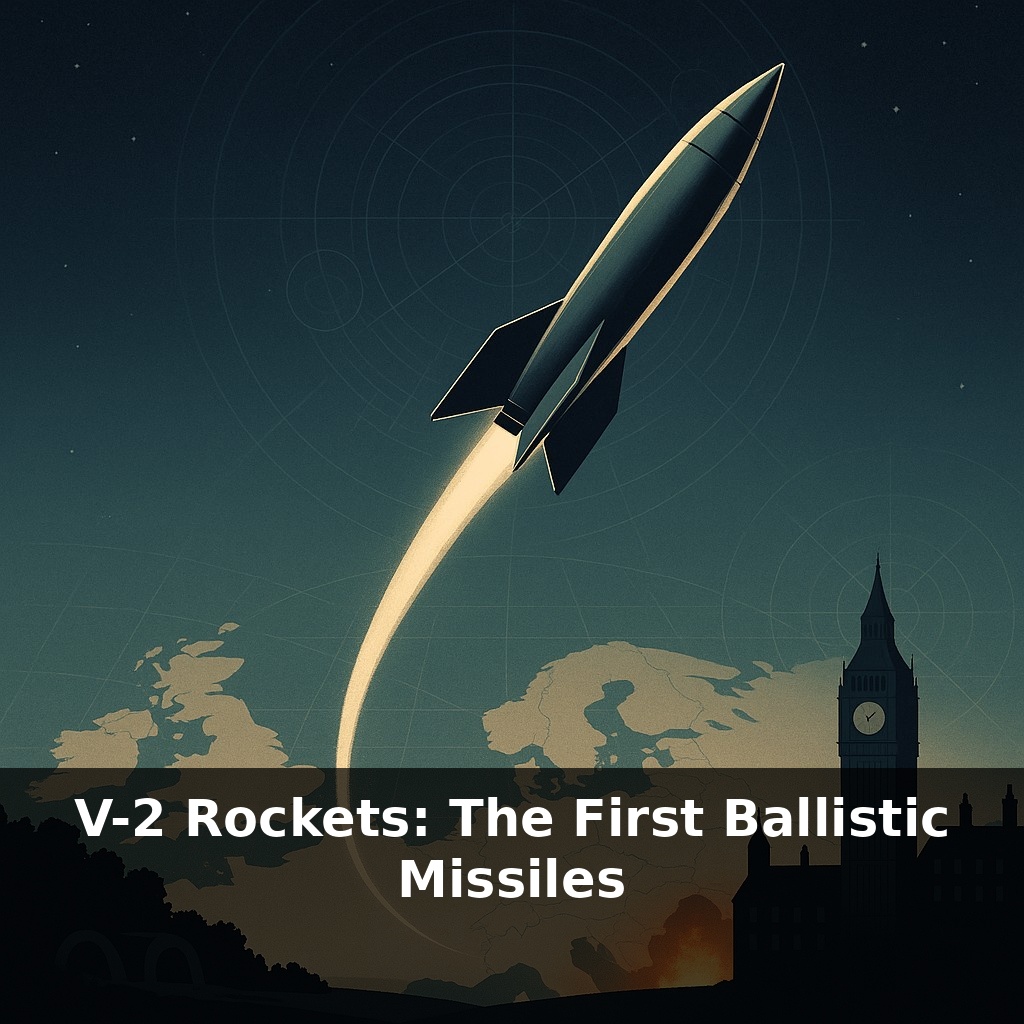
A warhead fell on London before anyone heard it coming. No sirens, no engine roar—just a sudden explosion from a weapon that had crossed countries and brushed the edge of space. In this episode, we follow that silent arc and ask: what really began with the V-2?
The shock in London and Antwerp was only half the story; the other half was unfolding in forests, tunnels, and drafting rooms across Europe. The V‑2 was not just a new weapon, it was the first time humans routinely hurled machines high enough that the sky began to thin and the curvature of Earth subtly revealed itself. Engineers were wrestling with problems no army had faced before: guidance at supersonic speeds, fuel that had to stay stable yet burn ferociously, metal that wouldn’t tear itself apart under forces stronger than any artillery shell had known. Each launch was both an attack and an experiment, a data point in a brutal research program. And as fragments rained down, rival powers were already calculating what this technology might become once pointed upward, not at cities, but at the stars.
The V‑2 program grew inside a vast industrial shadow-world: underground factories, forced labor, and test ranges carved out of forests and coastlines. Its engineers weren’t just perfecting a single weapon; they were assembling a toolkit—high‑speed aerodynamics tables, new alloys, turbopumps, gyroscopic controls—that future designers could shuffle like musical themes to compose entirely new machines. Each failure on the launch pad rewrote checklists, rewired procedures, refined blueprints. Governments watched closely, not for the blast itself, but for the spreadsheets, sketches, and scraps of code‑like equations left in its wake.
The V‑2’s most radical feature wasn’t just how far it went, but how it decided where to go. Deep inside the fuselage sat a kind of mechanical “autopilot”: gyroscopes sensing rotation, linked to analog calculators that nudged graphite vanes in the exhaust and small aerodynamic fins. Once launched, no radio operator steered it; the brain rode with the missile, integrating tiny twists and accelerations into continuous course corrections. It was crude by modern standards, but it made the rocket a self‑contained, one‑way machine—launched, then essentially unreachable.
To feed that brain, the Germans built a data ecosystem around Peenemünde and other ranges. Each test generated film from tracking cameras, fragments for metallurgists, and timing logs for ballistics experts. Miss‑distance on impact translated into tweaks to valve timings and gyroscope mountings. The “wonder weapon” image masked something more familiar to any engineer today: an iterative development cycle, driven by test results and intense pressure to ship a version that was “good enough” for field use, even if it fell miles off target.
Deploying the V‑2 meant turning that experimental apparatus into a nomadic system. Mobile launch batteries moved on roads and rails, bringing along fuel trains, test trucks, and survey units. Crews had to align each shot to Earth’s curvature with field instruments, then pack up before Allied aircraft could respond. In practice, more time could be spent preparing the trajectory than the rocket spent in flight. The elegance of the arc through near‑space relied on an untidy, vulnerable choreography on the ground.
That choreography was sustained by a brutal production machine. At Mittelwerk, underground assembly lines ran on coerced labor under lethal conditions. Precision components—guidance assemblies, pumps, tanks—were bolted together by prisoners who often knew the device only as a number and a shape. The same drawings that thrilled foreign engineers after the war were, for many who handled the parts, blueprints of survival odds measured in weeks.
When the war ended, the technology scattered but the logic remained. The United States and the Soviet Union both airlifted hardware, documents, and specialists into new programs. Early American and Soviet test ranges lit the sky with re‑painted V‑2s carrying cameras, biological samples, and instruments. What had been weapon trials turned into proto‑spaceflights: measuring cosmic rays, photographing cloud patterns, and watching thin air bend fins and antennas. The arc was no longer just from one city to another, but from battlefield engineering toward a future in which hitting the other side of the planet—or leaving it—would be problems of the same family, solved with the same inherited tools.
Engineers treated each launch like listening to a complex piece of music, then rewriting the score bar by bar. One test might reveal a subtle “off‑key” wobble in flight data; the remedy could be as small as shifting a component’s weight or stiffening a bracket. Over dozens of flights, these almost invisible edits accumulated into a radically more reliable machine. That same mindset shows up now in how reusable rockets land on barges or how long‑range missiles trim their paths mid‑course—fine‑tuning based on a history of recorded “notes” rather than a single perfect design.
The political reuse of V‑2 knowledge followed a similar pattern. In the U.S., ex‑Peenemünde staff found themselves sketching vehicles for weather research and upper‑atmosphere sampling. In the USSR, teams folded captured drawings into projects that would lead to Sputnik and intercontinental delivery systems. Neither side simply copied; they iterated, swapping materials, fuels, and control ideas to suit their own doctrines. What began as a narrow wartime project thus became a shared, if deeply contested, technological vocabulary whispered across a divided world.
Cold War arsenals, GPS satellites, even commercial launch startups all inherit patterns first rehearsed with the V‑2: rapid iteration, dual‑use hardware, secrecy wrapped in spectacle. Today’s hypersonic tests and private Mars pitches replay that script, only faster and at global scale. Your challenge this week: whenever you see a “breakthrough” in space or missile news, trace its family tree—ask which past conflicts, treaties, or labs quietly shaped the glossy demo you’re being shown.
Each era since has tuned that original design language for its own score: early satellites for weather maps, later probes for planetary flybys, today’s constellations for always‑on navigation and surveillance. The arc now includes climate models, precision farming, even disaster alerts—benefits braided to a lineage that began with a weapon aimed sideways across a wounded continent.
Here’s your challenge this week: Using the V-2 as your model, sketch a simple, labeled “systems map” of a ballistic missile launch—from fueling the alcohol/oxygen tanks, to gyroscopic guidance, to supersonic re‑entry and impact—and then rewrite it as a 5–7 step checklist in plain language a curious teenager could follow. Next, spend 20 focused minutes comparing that V-2 launch checklist to a modern space launch (e.g., Falcon 9 or Ariane 5), noting at least three concrete differences in guidance, propulsion, or payload protection. Finally, in one page or less, argue whether the V‑2 should be remembered primarily as a scientific breakthrough or as a weapon of terror, and back your stance with at least three specific examples from the episode (Peenemünde testing, London/Antwerp attacks, slave labor at Mittelwerk, etc.).